How does SUI compare to its competitors in performance, market cap, and user base in 2025?

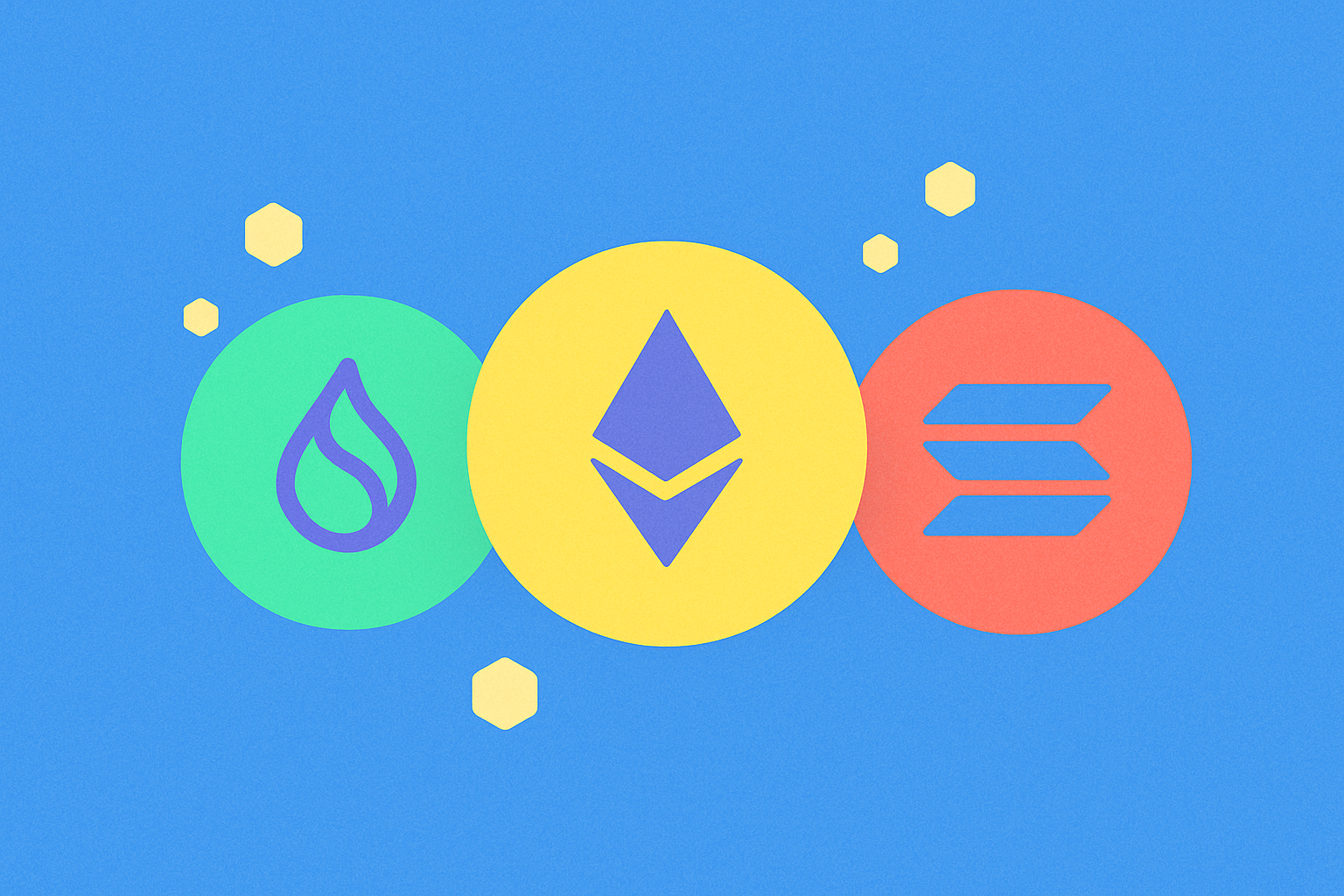
SUI's transaction speed exceeds 130,000 TPS with sub-second finality, outperforming major competitors like Ethereum and Solana
SUI's architecture delivers exceptional performance through its object-centric model and innovative consensus mechanism. The network maintains a mainnet throughput of approximately 130,000 transactions per second, with some measurements indicating sustained capacity around 103,435 CPS as of December 2025. More impressively, SUI achieves sub-second finality, enabling transaction confirmation in under 400 milliseconds—a critical advantage for time-sensitive applications.
When positioned against established Layer 1 blockchains, SUI's performance metrics demonstrate substantial improvements:
| Metric | SUI | Ethereum | Solana |
|---|---|---|---|
| Average TPS | 90-103,435 | 13-16.7 | 4,700-5,289 |
| Peak TPS | 297,000 | Limited | 107,540 |
| Finality Time | ~400ms | ~15 minutes | ~12.8 seconds |
| Block Time | Sub-second | ~12 seconds | ~400ms |
Ethereum, the industry's largest blockchain by market capitalization, processes significantly fewer transactions despite its mature ecosystem, primarily operating at 13 TPS on its main layer. Solana offers competitive throughput at peak capacity but requires substantially longer confirmation times. SUI's dual-execution path model—separating simple transfers from complex transactions—enables this scalability advantage while maintaining security and decentralization.
Market cap reaches $9.58 billion with fully diluted valuation of $26.428 billion, ranking as a top-tier Layer 1 blockchain
Sui's substantial market capitalization reflects strong investor confidence in its Layer 1 blockchain architecture and technical capabilities. With validators securing the network by staking over $29.81 billion in SUI tokens—representing 75.47% of total circulating supply—the platform demonstrates robust network security fundamentals that support its valuation premium. This deep liquidity pool of staked assets enables the blockchain to maintain consensus mechanisms with minimal latency while processing transactions at industry-leading speeds.
The distinction between Sui's market cap and fully diluted valuation reveals significant growth potential embedded in the token economics. This valuation gap positions Sui competitively within the Layer 1 ecosystem, where investors evaluate blockchains based on technical performance metrics and adoption trajectories. Sui's object-oriented data model, which facilitates parallel transaction execution and sub-second finality, justifies its premium positioning relative to earlier-generation Layer 1 blockchains. The network's emphasis on performance over maximum decentralization at this development stage has resonated with developers and institutions seeking scalable infrastructure. This strategic focus, combined with expanding developer ecosystems and institutional interest, establishes Sui as a formidable competitor among top-tier Layer 1 platforms in 2025.
Active addresses surge to 1.2 million in 2025 with transaction fees stabilized at $0.001, demonstrating strong user adoption and ecosystem growth
The surge to 1.2 million active addresses marks a pivotal moment for Sui's position within the Layer 1 landscape. This milestone reflects genuine user engagement rather than speculative trading, indicating that Sui's technical architecture is attracting both mainstream users and developers seeking genuine utility. When compared alongside competitors facing congestion and higher operational costs, Sui's achievement becomes particularly significant—active addresses directly correlate with network health and real economic activity.
The stabilization of transaction fees at $0.001 represents a fundamental competitive advantage in the blockchain ecosystem. Most rival Layer 1 networks struggle with variable and unpredictable fees that fluctuate based on network demand, creating friction for user adoption. Sui's consistency demonstrates its horizontal scalability through the object-based model and Mysticeti consensus mechanism, which enable parallel transaction execution and sub-second finality. This predictable cost structure removes barriers to regular user participation, enabling use cases like gaming, payments, and decentralized finance that demand affordability at scale.
These metrics collectively signal robust ecosystem growth with measurable momentum. The combination of millions of active participants transacting at minimal cost has attracted over 200 decentralized applications to the network. Institutions have also taken notice—over $29.81 billion in SUI tokens are staked by validators, representing 75.47% of circulating market cap. This convergence of user adoption, technical performance, and institutional confidence positions Sui distinctly against competitors still struggling with scalability trade-offs.
Strategic partnerships and Asian market expansion drive 2025 Q2 transaction volume to $11.2 billion, positioning SUI as an emerging competitor
During Q2 2025, SUI demonstrated remarkable momentum as its transaction volume reached $11.2 billion, a significant milestone that underscores the network's accelerating adoption. This growth was principally driven by strategic partnerships that expanded SUI's ecosystem functionality and Asian market expansion that tapped into rapidly growing demand for decentralized finance solutions in the region. The network's circulating market cap increased 31.3% quarter-over-quarter to $9.44 billion, notably outpacing the broader cryptocurrency market's 23.5% growth rate during the same period. This divergence highlighted SUI's strong relative performance among blockchain platforms competing for market share. The DeFi sector on SUI experienced record activity, with both decentralized exchange volumes and total value locked increasing substantially. These metrics collectively indicate that users not only engaged in trading but also committed significant capital to DeFi protocols, reflecting genuine ecosystem utilization rather than speculative positioning. Despite this exceptional network growth and increasing institutional interest, the SUI token price failed to keep pace with the network's fundamental achievements. This divergence between on-chain metrics and token valuation presents an important distinction when evaluating SUI's competitive positioning—the network's infrastructure strength and user adoption clearly position it as a serious contender in the decentralized finance landscape.
FAQ
Why is Sui so popular?
Sui is popular for its exceptional high throughput, ultra-low transaction costs, and fast finality. Built by Mysten Labs with expertise from Facebook's Diem project, it outperforms major competitors in speed and efficiency, attracting developers and users seeking scalable blockchain solutions.
Can Sui be next Sol?
Sui shows strong potential with superior throughput and lower costs, but surpassing Solana requires overcoming its established ecosystem and community. Sui may carve its own market leadership rather than directly replicate Solana's path.
What are Sui's main technical advantages compared to Solana and other Layer 1 blockchains?
Sui offers superior transaction throughput with significantly lower fees than Solana. Its innovative data model enables faster, cheaper transactions while maintaining security, positioning Sui as a competitive next-generation Layer 1 blockchain.
How has Sui's market cap and user base grown compared to competitors in 2024-2025?
Sui's market cap and user base have grown rapidly in 2024-2025, significantly outpacing overall blockchain TVL growth of approximately 100%. Sui's accelerating trajectory demonstrates that innovative technology and superior user experience can disrupt established markets and capture meaningful ecosystem value faster than competitors.
What is Sui's current transaction speed and throughput versus Solana, Aptos, and other competitors?
Sui achieves 297,000 TPS through parallel execution, significantly outperforming Solana's 65,000 TPS and surpassing most competitors. This superior throughput establishes Sui as a leading high-performance blockchain.
FAQ
What is sui crypto coin?
SUI is a high-performance layer-1 blockchain by Mysten Labs designed for scalability and low-latency transactions. Its token serves for fees, staking, and governance, utilizing parallel transaction execution and innovative consensus mechanisms for faster, more efficient blockchain operations.
Is Sui a good coin to buy?
Yes, Sui offers superior scalability and significantly lower transaction fees than Ethereum. With strong ecosystem growth in DeFi, NFTs, and gaming, SUI demonstrates compelling long-term potential. Its innovative technology and expanding developer adoption make it an attractive investment opportunity for crypto investors seeking next-generation blockchain solutions.
Can Sui reach $10?
Yes, SUI has strong potential to reach $10. With growing DeFi adoption, institutional interest, and increasing total value locked, analysts project it could achieve this target within 12-18 months, supported by ecosystem expansion and positive technical indicators.
Is Sui the next Solana?
Sui possesses distinctive technology and strong backing that differentiate it from Solana. While both are high-performance blockchains, Sui's unique architecture and growing ecosystem position it as a compelling alternative rather than a direct successor. Success depends on ecosystem adoption and market conditions.
Share
Content
SUI's transaction speed exceeds 130,000 TPS with sub-second finality, outperforming major competitors like Ethereum and Solana
Market cap reaches $9.58 billion with fully diluted valuation of $26.428 billion, ranking as a top-tier Layer 1 blockchain
Active addresses surge to 1.2 million in 2025 with transaction fees stabilized at $0.001, demonstrating strong user adoption and ecosystem growth
Strategic partnerships and Asian market expansion drive 2025 Q2 transaction volume to $11.2 billion, positioning SUI as an emerging competitor
FAQ
FAQ
How to Buy Cryptocurrency


Trending Cryptocurrencies



How does AVAX compare to Ethereum and Solana in performance and market share?

SLIM vs ETC: Comparing Two Cutting-Edge Weight Loss Approaches for Optimal Results
What is the Difference Between Competitor Analysis and Market Share in Crypto?

How Does HBAR Compare to Ethereum and Solana in 2030?

USDT price trend analysis in 2025: Tether stablecoin market outlook

Ethereum 2025 Beginner's Guide: Working Principles, Smart Contracts, and Investment Strategies

What You Need to Know About SMS Phishing Attacks
What is the Injective BuyBack Community Program?

What is autotrading?
Vanguard Does Not Offer Bitcoin ETF, Maintains Conservative Investment Strategy
Smart Trader’s Guide: Grid Bots in Spot and Smart Picks