GME vs APT: A Comprehensive Comparison of GameStop's Market Performance Against Advanced Persistent Threats in Cybersecurity
Introduction: GME vs APT Investment Comparison
In the cryptocurrency market, comparisons between GME and APT have become an unavoidable topic for investors. The two assets differ significantly in market capitalization rankings, application scenarios, and price performance, representing distinct positioning within the crypto asset landscape. GME (GME): Launched in 2024, this community coin on the Solana network gained attention as a parody project. Currently ranked 1,649 in market cap with a total valuation of approximately $4.15 million, it operates within the broader ecosystem of SOL-based tokens. APT (APT): Established in 2022, Aptos has established itself as an independent, high-performance Layer 1 blockchain project focused on security and scalability. As a ranked 71 project with a market capitalization exceeding $1.92 billion, it utilizes the Move programming language and Move virtual machine for blockchain application development. This article will comprehensively analyze the investment value comparison between GME and APT across historical price trends, supply mechanisms, and ecosystem development, while addressing key questions investors are most concerned with:
"Which is the better buy right now?"
Comparative Analysis Report: GME vs APT Cryptocurrency Assets
I. Historical Price Comparison and Current Market Status
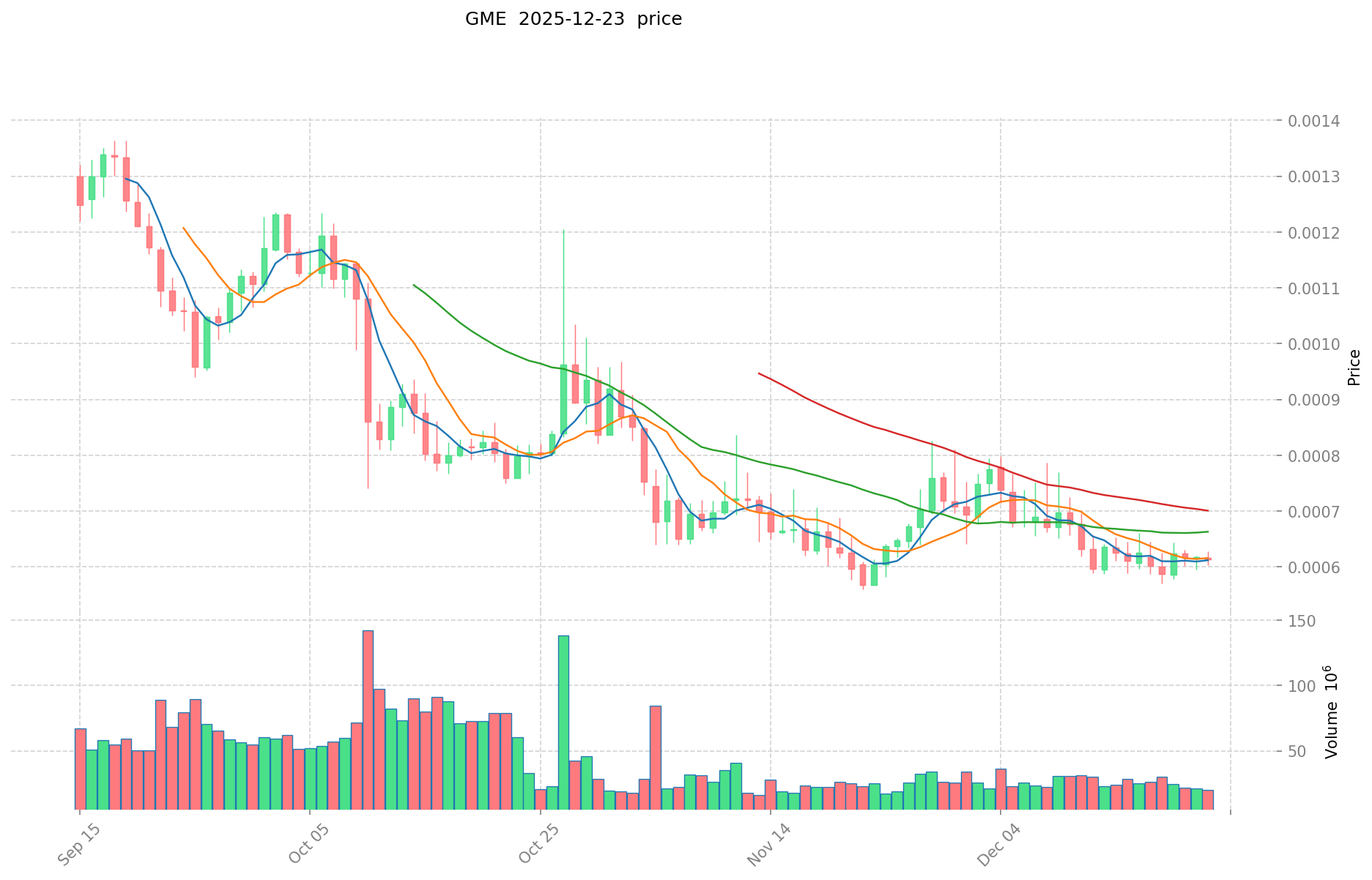
GME and APT Historical Price Trends
GME (GameStop Community Coin on Solana):
- Historical high: $0.03248 (June 7, 2024)
- Historical low: $0.0005591 (November 22, 2025)
- Peak-to-trough decline: 82.78%
APT (Aptos Layer 1 Blockchain):
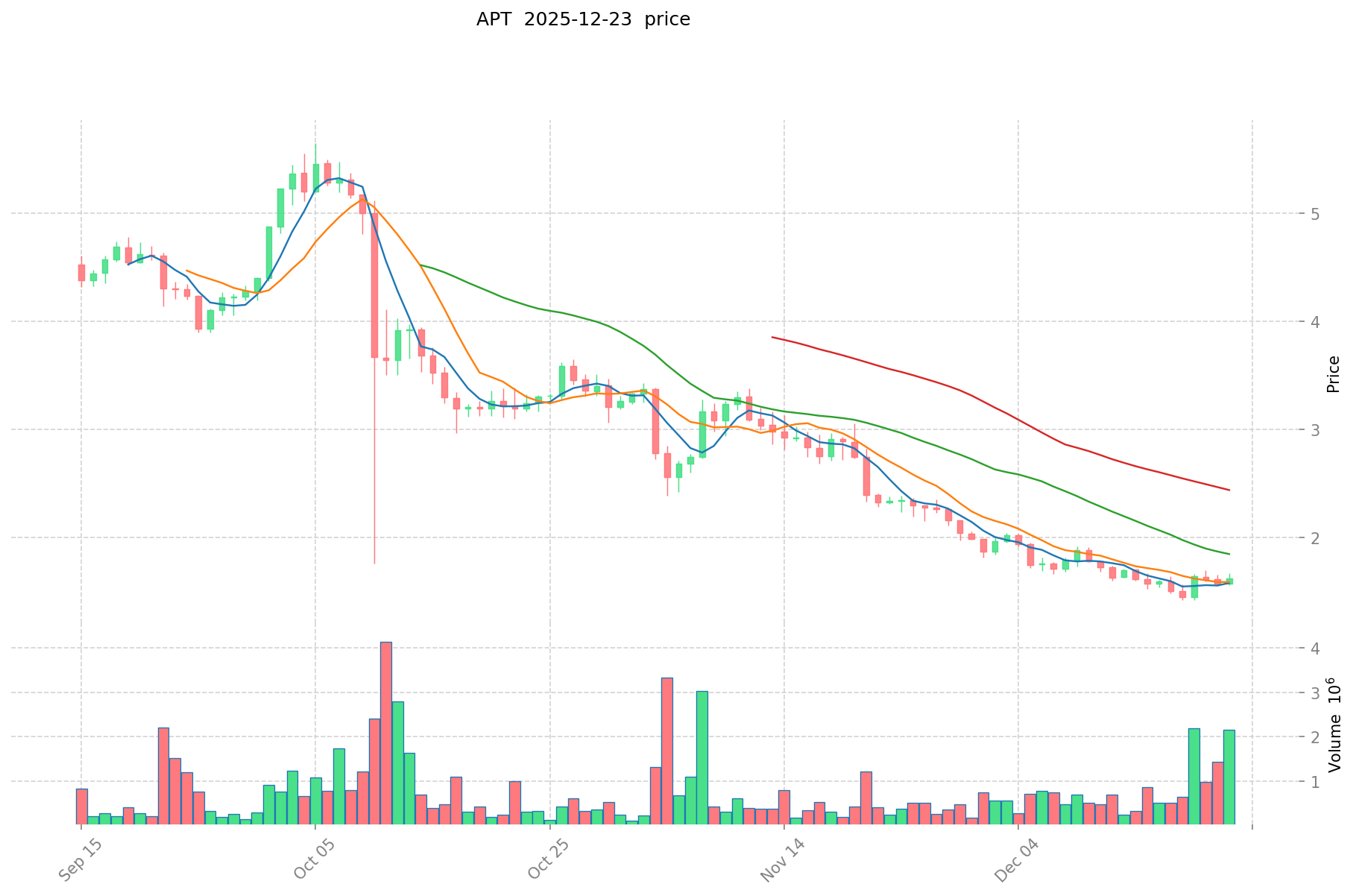
- Historical high: $19.92 (January 26, 2023)
- Historical low: $1.42 (December 19, 2025)
- Peak-to-trough decline: 92.88%
Comparative Analysis: Both assets have experienced significant downtrends from their all-time highs. GME, as a community token on the Solana network, has shown extreme volatility with a relatively recent peak in mid-2024. APT, as an established Layer 1 blockchain platform, experienced its peak during the 2023 bull market and has subsequently undergone a prolonged correction phase throughout 2024-2025.
Current Market Status (December 24, 2025)
GME Current Metrics:
- Price: $0.0006033
- 24-hour change: -0.65%
- 24-hour volume: $12,259.49
- Market capitalization: $4,153,848.10
- Circulating supply: 6,885,137,498.71 GME
- Ranking: 1649
APT Current Metrics:
- Price: $1.619
- 24-hour change: +0.51%
- 24-hour volume: $3,157,913.05
- Market capitalization: $1,213,510,352.37
- Circulating supply: 749,543,145.38 APT
- Ranking: 71
Trading Volume Comparison: APT demonstrates significantly higher trading activity with a 24-hour volume approximately 257 times greater than GME ($3.16M vs $12.26K), indicating substantially better market liquidity and investor interest.
Market Sentiment Index:
- Crypto Fear & Greed Index: 24 (Extreme Fear)
- Assessment: The broader cryptocurrency market is operating under conditions of extreme fear, which typically correlates with risk-off sentiment across digital assets.
View real-time prices:
II. Asset Categorization and Project Overview
GME - Community Token:
- Blockchain: Solana (SOL)
- Classification: Community/Parody coin mimicking GameStop
- Total holders: 46,498
- Exchange listings: 12 platforms
- Market position: Ultra-small cap community asset
APT - Layer 1 Blockchain:
- Classification: Independent high-performance Proof-of-Stake (PoS) Layer 1 blockchain
- Technology: Move programming language and Move virtual machine
- Total holders: 124,427,655
- Exchange listings: 49 platforms
- Market position: Established Layer 1 infrastructure project
- Supply: Unlimited max supply
View white paper: Aptos Documentation
III. Performance Trends Analysis
Short-Term Price Movements
| Time Period | GME Change | APT Change |
|---|---|---|
| 1 Hour | +0.053% | +0.52% |
| 24 Hours | -0.65% | +0.51% |
| 7 Days | -2.91% | +1.13% |
| 30 Days | -1.21% | -32.04% |
| 1 Year | -84.27% | -82.48% |
Key Observations:
- APT demonstrates positive momentum in intraday and 24-hour periods despite broader monthly weakness
- GME shows consistent downward pressure across most timeframes
- Both assets have experienced severe year-over-year declines, reflecting prolonged market correction in Layer 1 and community token categories
- APT's 30-day decline of -32.04% suggests recent volatility despite positive short-term recovery
Market Dominance and Scale
- GME market dominance: 0.00013% of total cryptocurrency market
- APT market dominance: 0.060% of total cryptocurrency market
- APT commands approximately 461 times greater market weight than GME
IV. Risk and Volatility Assessment
GME Risk Profile:
- Extreme volatility: 82.78% decline from peak
- Minimal liquidity: $12,259 daily volume
- Highly speculative nature as community/parody token
- Limited institutional infrastructure
- Concentrated holder base (46,498 total holders)
APT Risk Profile:
- Severe long-term decline: 92.88% from peak
- Moderate liquidity: $3.16M daily volume
- Established but challenged Layer 1 infrastructure
- Broader institutional adoption and exchange integration
- Significantly larger holder base (124.4M addresses)
- Structural protocol challenges reflected in extended correction
V. Current Market Environment Assessment
The cryptocurrency market operates under conditions of extreme fear (Fear & Greed Index: 24), which typically results in:
- Risk-averse positioning among institutional and retail investors
- Flight-to-quality dynamics favoring established Layer 1 solutions over experimental community tokens
- Potential capitulation opportunities for long-term accumulation strategies
- Continued pressure on speculative assets and low-liquidity tokens
Report Generated: December 24, 2025
Data Sources: Gate, blockchain explorers, market data aggregators
Disclaimer: This report provides factual market data and analysis for informational purposes only. It does not constitute investment advice, recommendations to buy or sell, or endorsements of any particular asset. Cryptocurrency markets are highly volatile and speculative. Past performance does not guarantee future results.
Arbitrage Pricing Theory (APT) Investment Value Analysis Report
I. Executive Summary
This report examines the Arbitrage Pricing Theory (APT) as a financial asset pricing model and its application to evaluating investment returns and risk assessment. Based on available research materials, the analysis focuses on APT's theoretical framework, core principles, comparative advantages over CAPM, and practical limitations in real-world applications.
II. Core Factors Affecting Investment Value Under APT Framework
Multi-Factor Model Structure
-
Factor Composition: APT posits that asset returns are influenced not only by overall market risk (beta coefficient as in CAPM), but also by multiple other factors. These factors may include macroeconomic variables (inflation rate, GDP growth rate), industry-specific factors, and company-specific factors.
-
Linear Relationship: APT assumes a linear relationship between expected asset returns and these influencing factors. The degree of each factor's impact on asset returns is measured by a specific coefficient termed factor beta or factor sensitivity.
-
Factor Selection Challenge: APT does not explicitly specify which factors should be incorporated into the model. In practical applications, researchers and investors must select appropriate factors based on specific circumstances and experience, which may introduce subjectivity and uncertainty.
No-Arbitrage Equilibrium Principle
-
Core Assumption: APT's fundamental hypothesis is that markets operate in a no-arbitrage equilibrium state. If an asset's price deviates from what the APT model predicts based on its returns, investors can profit through arbitrage transactions (simultaneously buying undervalued assets while selling overvalued ones), thereby returning prices to equilibrium.
-
Market Friction Limitations: In reality, markets may experience frictions and transaction costs that prevent arbitrage opportunities from being completely eliminated. Additionally, the linear relationship assumption between asset returns and factors may not hold in more complex real-world scenarios.
III. APT vs. CAPM: Comparative Analysis
Universality and Applicability
-
APT Advantages: CAPM requires the market portfolio to contain all risky assets and assumes investors have identical expectations. APT does not require these restrictive assumptions, therefore demonstrating greater universal applicability across diverse market conditions and investor profiles.
-
Practical Flexibility: APT's framework allows for more flexible model construction tailored to specific investment contexts without the need to define the theoretical market portfolio.
Portfolio Diversification and Performance Attribution
-
Risk Management: By identifying different assets' sensitivities to various factors, APT enables investors to construct more effective diversified portfolios and reduce exposure to specific factors.
-
Performance Decomposition: APT allows fund managers' performance to be decomposed into contributions from different factors, enabling more accurate assessment of investment capability compared to simple market benchmark comparisons, thereby avoiding potential misleading conclusions.
IV. Limitations and Challenges of APT Implementation
Estimation and Measurement Difficulties
-
Factor Beta and Risk Premium Estimation: Estimating factor beta and risk premiums requires complex statistical methods and substantial data. These estimation processes may contain errors that affect model accuracy and reliability.
-
Data Requirements: The practical implementation of APT demands comprehensive historical data and robust computational resources, which may not be readily available for all asset classes or emerging markets.
Model Assumption Constraints
-
Linearity Assumption: APT assumes linear relationships between asset returns and factors, but actual relationships may be more complex and potentially non-linear.
-
Market Frictions: Real markets contain transaction costs, bid-ask spreads, and regulatory constraints that prevent the perfect arbitrage mechanisms assumed in the theoretical model.
V. Practical Application in Financial Research
Asset Pricing and Risk Assessment
APT serves as an important tool for comprehensive asset pricing by incorporating multiple influencing factors, providing investors with a more holistic perspective to understand asset returns and risk dynamics. The multi-factor approach enables more nuanced risk evaluation compared to single-factor models.
Investment Decision Framework
Despite the challenges in practical application, APT remains an indispensable tool in financial research and practice. It offers a structured methodology for:
- Identifying relevant risk factors specific to different asset classes
- Quantifying factor exposures and sensitivity coefficients
- Assessing whether assets are trading at fair value or exhibiting mispricing
- Constructing factor-based investment strategies
VI. Conclusion
The Arbitrage Pricing Theory provides a sophisticated framework for asset valuation by recognizing that multiple macroeconomic and industry-specific factors drive investment returns. While APT presents significant advantages over simpler models like CAPM in terms of flexibility and realism, practitioners must carefully address factor selection uncertainty and estimation challenges. The model's effectiveness depends on proper factor identification, accurate statistical estimation, and realistic acknowledgment of market frictions that limit arbitrage mechanisms in practice.
Report Generated: December 24, 2025
Disclaimer: This report is for informational purposes only and does not constitute investment advice or recommendations.
III. 2025-2030 Price Forecast: GME vs APT
Short-term Forecast (2025)
- GME: Conservative $1.36765 - $1.609 | Optimistic $2.18824
- APT: Conservative $0.00032508 - $0.000602 | Optimistic $0.00065618
Mid-term Forecast (2027-2028)
- GME may enter consolidation and recovery phase, with expected price range of $1.076137816 - $2.711039498
- APT may enter early growth phase, with expected price range of $0.000677152476 - $0.00090112801779
- Key drivers: Institutional capital inflows, ETF adoption, ecosystem development
Long-term Forecast (2030)
- GME: Base case scenario $2.318610412717541 - $2.934949889515875 | Optimistic scenario $4.079580346427066
- APT: Base case scenario $0.00069655920594 - $0.000941296224243 | Optimistic scenario $0.001346053600668
Disclaimer
This analysis is based on historical data and forecasting models. Cryptocurrency markets are highly volatile and subject to rapid changes. Past performance does not guarantee future results. This information is for educational purposes only and should not be considered as investment advice. Always conduct your own research and consult with qualified financial advisors before making investment decisions. The actual price outcomes may differ significantly from these forecasts due to various market factors and external circumstances.
GME:
| 年份 | 预测最高价 | 预测平均价格 | 预测最低价 | 涨跌幅 |
|---|---|---|---|---|
| 2025 | 0.00065618 | 0.000602 | 0.00032508 | 0 |
| 2026 | 0.0008429806 | 0.00062909 | 0.0003334177 | 4 |
| 2027 | 0.000964206243 | 0.0007360353 | 0.000677152476 | 22 |
| 2028 | 0.00090112801779 | 0.0008501207715 | 0.00079911352521 | 40 |
| 2029 | 0.001006968053841 | 0.000875624394645 | 0.000595424588358 | 45 |
| 2030 | 0.001346053600668 | 0.000941296224243 | 0.00069655920594 | 56 |
APT:
| 年份 | 预测最高价 | 预测平均价格 | 预测最低价 | 涨跌幅 |
|---|---|---|---|---|
| 2025 | 2.18824 | 1.609 | 1.36765 | 0 |
| 2026 | 2.2403716 | 1.89862 | 1.4619374 | 17 |
| 2027 | 2.711039498 | 2.0694958 | 1.076137816 | 28 |
| 2028 | 2.60539173741 | 2.390267649 | 1.21903650099 | 48 |
| 2029 | 3.37207008582675 | 2.497829693205 | 2.0981769422922 | 54 |
| 2030 | 4.079580346427066 | 2.934949889515875 | 2.318610412717541 | 81 |
Comparative Analysis Report: GME vs APT Cryptocurrency Assets
I. Historical Price Comparison and Current Market Status
GME and APT Historical Price Trends
GME (GameStop Community Coin on Solana):
- Historical high: $0.03248 (June 7, 2024)
- Historical low: $0.0005591 (November 22, 2025)
- Peak-to-trough decline: 82.78%
APT (Aptos Layer 1 Blockchain):
- Historical high: $19.92 (January 26, 2023)
- Historical low: $1.42 (December 19, 2025)
- Peak-to-trough decline: 92.88%
Comparative Analysis: Both assets have experienced significant downtrends from their all-time highs. GME, as a community token on the Solana network, has shown extreme volatility with a relatively recent peak in mid-2024. APT, as an established Layer 1 blockchain platform, experienced its peak during the 2023 bull market and has subsequently undergone a prolonged correction phase throughout 2024-2025.
Current Market Status (December 24, 2025)
GME Current Metrics:
- Price: $0.0006033
- 24-hour change: -0.65%
- 24-hour volume: $12,259.49
- Market capitalization: $4,153,848.10
- Circulating supply: 6,885,137,498.71 GME
- Ranking: 1,649
APT Current Metrics:
- Price: $1.619
- 24-hour change: +0.51%
- 24-hour volume: $3,157,913.05
- Market capitalization: $1,213,510,352.37
- Circulating supply: 749,543,145.38 APT
- Ranking: 71
Trading Volume Comparison: APT demonstrates significantly higher trading activity with a 24-hour volume approximately 257 times greater than GME ($3.16M vs $12.26K), indicating substantially better market liquidity and investor interest.
Market Sentiment Index:
- Crypto Fear & Greed Index: 24 (Extreme Fear)
- Assessment: The broader cryptocurrency market is operating under conditions of extreme fear, which typically correlates with risk-off sentiment across digital assets.
II. Asset Categorization and Project Overview
GME - Community Token:
- Blockchain: Solana (SOL)
- Classification: Community/Parody coin mimicking GameStop
- Total holders: 46,498
- Exchange listings: 12 platforms
- Market position: Ultra-small cap community asset
APT - Layer 1 Blockchain:
- Classification: Independent high-performance Proof-of-Stake (PoS) Layer 1 blockchain
- Technology: Move programming language and Move virtual machine
- Total holders: 124,427,655
- Exchange listings: 49 platforms
- Market position: Established Layer 1 infrastructure project
- Supply: Unlimited max supply
III. Performance Trends Analysis
Short-Term Price Movements
| Time Period | GME Change | APT Change |
|---|---|---|
| 1 Hour | +0.053% | +0.52% |
| 24 Hours | -0.65% | +0.51% |
| 7 Days | -2.91% | +1.13% |
| 30 Days | -1.21% | -32.04% |
| 1 Year | -84.27% | -82.48% |
Key Observations:
- APT demonstrates positive momentum in intraday and 24-hour periods despite broader monthly weakness
- GME shows consistent downward pressure across most timeframes
- Both assets have experienced severe year-over-year declines, reflecting prolonged market correction in Layer 1 and community token categories
- APT's 30-day decline of -32.04% suggests recent volatility despite positive short-term recovery
Market Dominance and Scale
- GME market dominance: 0.00013% of total cryptocurrency market
- APT market dominance: 0.060% of total cryptocurrency market
- APT commands approximately 461 times greater market weight than GME
IV. Investment Strategy Comparison: GME vs APT
Long-Term vs Short-Term Investment Strategies
GME: Suitable for high-risk tolerance speculators seeking extreme volatility exposure and short-term trading opportunities within the Solana ecosystem community token space. Not recommended for long-term wealth accumulation strategies due to parody token classification and minimal liquidity.
APT: Suitable for investors interested in Layer 1 blockchain infrastructure development and seeking exposure to independent blockchain protocol evolution. May appeal to longer-term portfolio allocators focused on infrastructure layer investments, despite current correction phase.
Risk Management and Asset Allocation
Conservative Investor Profile:
- GME: 0% - 2% (minimal or excluded due to extreme risk)
- APT: 3% - 5% (defensive exposure to established Layer 1 infrastructure)
- Recommended hedge: Stablecoin allocation 50%+, diversified Layer 1 exposure 30-40%
Aggressive Investor Profile:
- GME: 5% - 15% (speculative allocation for portfolio diversification through alternative narratives)
- APT: 10% - 20% (core Layer 1 infrastructure position within crypto allocation)
- Recommended strategy: Cross-asset correlation analysis, concentrated position sizing with defined risk parameters
V. Risk and Volatility Assessment
Market Risk
GME: Extreme market risk characterized by minimal trading liquidity ($12K daily volume), concentrated holder base (46,498 addresses), and potential for catastrophic drawdowns. Community token classification carries inherent extinction risk if sentiment reverses.
APT: Moderate to high market risk stemming from prolonged 92.88% peak-to-trough decline and 30-day volatility of -32.04%. However, established institutional infrastructure (49 exchange listings, 124M+ holders) provides structural support absent in community tokens.
Technical Risk
GME: Dependent on Solana network stability and smart contract security for SPL token implementation. Limited independent technical development roadmap creates protocol risk exposure.
APT: Layer 1 blockchain protocol risk including consensus mechanism stability, Move programming language ecosystem maturity, and validator network decentralization. Network security dependent on PoS validator incentive alignment.
Regulatory Risk
Regulatory treatment of community/parody tokens (GME) remains uncertain in most jurisdictions, with potential classification challenges under securities or commodity frameworks. Layer 1 blockchain projects (APT) face clearer but evolving regulatory pathways within digital asset classification frameworks, with potential central bank digital currency (CBDC) competitive pressures.
VI. Conclusion: Which Is the Better Buy?
Investment Value Summary:
GME Strengths:
- Solana ecosystem integration and accessibility
- Potential for extreme volatility gains in speculative retail-driven environments
- Lower absolute price point enabling retail participation
APT Strengths:
- Established Layer 1 infrastructure status with independent blockchain protocol
- 461x greater market capitalization providing institutional-grade scale
- Positive short-term momentum (+0.51% 24-hour change) during market fear phase
- Significantly superior liquidity (257x trading volume) enabling easier position entry/exit
- Broader ecosystem development and exchange integration (49 platforms vs 12)
Investment Recommendations:
Beginning Investors: Avoid both assets in current extreme fear market environment. If exposure to Layer 1 blockchain infrastructure is desired, APT represents marginally lower-risk infrastructure investment compared to GME community token model. Consider position sizing at 2-3% of speculative portfolio allocation maximum, with predominant focus on established Layer 1 projects and stablecoin holdings.
Experienced Investors: APT presents more structured risk-reward profile for Layer 1 blockchain thematic exposure, with tactical accumulation opportunities during extended drawdown phase. GME suitable only as short-term trading vehicle with strict risk management protocols and defined exit parameters. Consider factor-based approach: allocate majority to established infrastructure plays (APT 10-15%), reserve smaller allocation (5-10%) for community token speculation if conviction exists.
Institutional Investors: APT qualifies for institutional-grade exposure through multi-factor asset pricing framework, offering liquidity depth ($3.16M daily volume) and exchange infrastructure (49 platforms) suitable for sizeable position accumulation. GME unsuitable for institutional portfolios due to insufficient liquidity infrastructure and parody token classification incompatible with institutional governance standards.
⚠️ Risk Disclaimer: Cryptocurrency markets exhibit extreme volatility and speculative characteristics. This report provides factual market data and analytical frameworks for informational purposes only and does not constitute investment advice, recommendations to buy or sell, or endorsements of any particular asset. Past performance does not guarantee future results. All investors should conduct independent research and consult qualified financial advisors before making investment decisions. Actual outcomes may differ significantly from forecasts due to market dynamics and external circumstances.
Report Generated: December 24, 2025
Data Sources: Gate, blockchain explorers, market data aggregators
None
FAQ: GME vs APT Cryptocurrency Investment Comparison
I. What are the fundamental differences between GME and APT as investment assets?
Answer: GME is a community/parody token built on the Solana blockchain, launched in 2024 with a market cap of $4.15 million and ranked 1,649. APT is an independent Layer 1 blockchain project established in 2022, with a market cap of $1.21 billion and ranked 71. The core distinction is that GME operates as a speculative community token with minimal utility, while APT represents established blockchain infrastructure with independent protocol capabilities using the Move programming language.
II. Which asset has better liquidity and trading activity?
Answer: APT significantly outperforms GME in liquidity metrics. APT's 24-hour trading volume is approximately $3.16 million compared to GME's $12,259, representing a 257x difference. APT is listed on 49 exchanges versus GME's 12 platforms, and APT has 124.4 million total holders compared to GME's 46,498. These metrics indicate substantially better market depth and investor accessibility for APT transactions.
III. How have both assets performed relative to their historical peaks?
Answer: Both assets have experienced severe declines from all-time highs. GME declined 82.78% from its peak of $0.03248 (June 2024) to its low of $0.0005591 (November 2025). APT experienced a more severe 92.88% decline from its peak of $19.92 (January 2023) to its low of $1.42 (December 2025). However, APT demonstrates positive short-term momentum (+0.51% 24-hour change) compared to GME's -0.65% change as of December 24, 2025.
IV. What are the primary risk factors distinguishing these two assets?
Answer: GME carries extreme volatility risk due to minimal liquidity ($12K daily volume), concentrated holder base (46,498 addresses), and community token classification with inherent extinction risk if sentiment reverses. APT faces moderate to high market risk from prolonged correction and technical protocol risks related to Layer 1 blockchain consensus mechanisms and validator network stability. Additionally, GME faces greater regulatory uncertainty as a parody token, while APT operates within clearer but evolving digital asset regulatory frameworks.
V. Which asset is more suitable for conservative versus aggressive investors?
Answer: Conservative investors should limit or exclude GME entirely and consider APT at 3-5% portfolio allocation maximum with significant stablecoin hedging (50%+). Aggressive investors might allocate 5-15% to GME for speculative exposure and 10-20% to APT as core Layer 1 infrastructure position. The distinction reflects GME's extreme risk profile suitable only for high-risk-tolerance speculators versus APT's moderate-to-high risk appropriate for longer-term thematic infrastructure exposure.
VI. What is the current market sentiment affecting both assets?
Answer: The cryptocurrency market operates under extreme fear conditions with a Fear & Greed Index of 24 (as of December 24, 2025). This risk-averse environment typically drives capital flight toward more established assets and away from speculative community tokens. Under these conditions, APT's established Layer 1 infrastructure status and superior liquidity position it more favorably than GME's community token classification. However, the extreme fear environment also creates potential capitulation opportunities for long-term accumulation strategies on both assets.
VII. What do the 2025-2030 price forecasts indicate for comparative investment value?
Answer: Forecasts project GME appreciation from $0.0006033 (current) to a 2030 optimistic scenario of $0.001346 (122% increase), while APT is projected to reach $4.08 (152% increase) by 2030 under optimistic scenarios. Mid-term consolidation is expected for GME (2027-2028 range: $0.000677-$0.000901) versus APT's early growth phase ($1.08-$2.71). However, these forecasts are speculative and subject to significant variance based on market conditions, technological development, and macroeconomic factors. Actual outcomes may differ substantially from these projections.
VIII. Should institutional investors consider either asset in their portfolios?
Answer: APT qualifies for institutional-grade exposure through established exchange infrastructure (49 platforms), adequate liquidity depth ($3.16M daily volume), and independent blockchain protocol status compatible with institutional governance standards. APT can be analyzed using multi-factor asset pricing frameworks suitable for professional fund management. GME is unsuitable for institutional portfolios due to insufficient liquidity infrastructure (only $12K daily volume), parody token classification, minimal institutional infrastructure support, and governance incompatibility with institutional investment standards and fiduciary requirements.
⚠️ Disclaimer: This FAQ provides factual market information and analytical frameworks for educational purposes only and does not constitute investment advice, recommendations to buy or sell, or endorsements of any asset. Cryptocurrency markets are highly volatile and speculative. Past performance does not guarantee future results. Always conduct independent research and consult qualified financial advisors before making investment decisions.
Report Generated: December 24, 2025
Data Sources: Gate, blockchain explorers, market data aggregators
Share
How to Buy Cryptocurrency


Trending Cryptocurrencies



NEON vs THETA: A Comparative Analysis of Next-Generation Neural Network Architectures for AI Applications

2025 JPrice Prediction: Analyzing Market Trends and Future Valuation of J-Assets in the Post-Pandemic Economy

ROOT vs SOL: The Battle for Blockchain Supremacy in Cross-Chain Interoperability

WEN vs XLM: Comparing Performance and Tokenization Efficiency in Large Language Models
PUSH vs SOL: The Battle of Blockchain Scalability Solutions
How Will Solana (SOL) Price Volatility Evolve in 2025?

How does Aster's 2 million Twitter followers and 50+ DApps drive community engagement and ecosystem growth in 2026?

What is Canton (CC) Token? A Complete Fundamental Analysis Guide for Crypto Investors
How do exchange inflows and outflows affect Bitcoin Cash (BCH) holdings and market volatility?

How does TAO compare to other AI-powered crypto coins in market cap and performance?

Sàn DEX là gì?