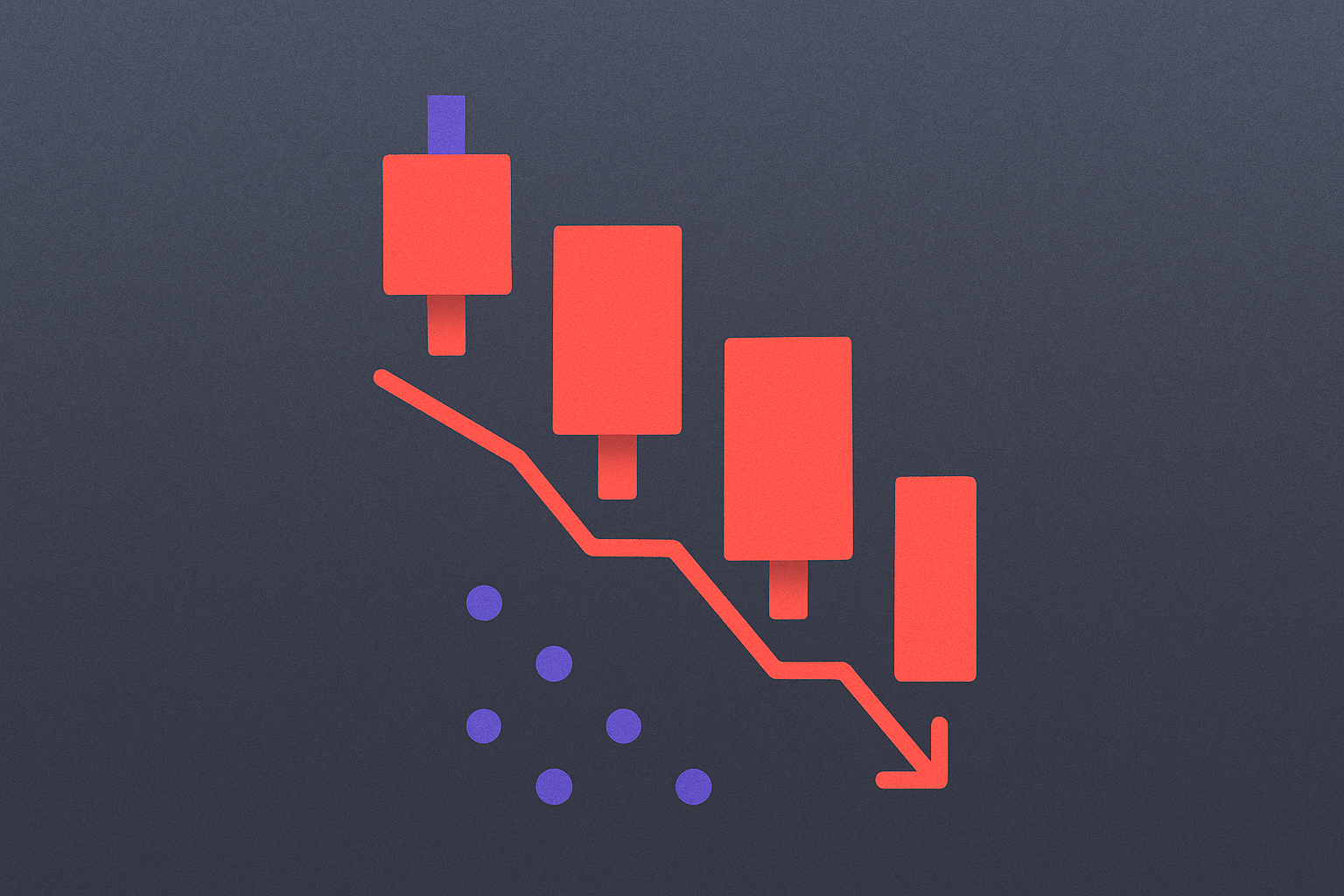
Bearish candlestick patterns

2026-01-06 13:36:37
Crypto Trading
Crypto Tutorial
Investing In Crypto
K-line
Trading Bots
Article Rating : 4
83 ratings
Discover how to spot bearish candlestick patterns in the crypto market. Explore pattern types such as the Shooting Star, Evening Star, and Three Black Crows, along with trading strategies and risk management techniques. This comprehensive guide is designed for traders and analysts on Gate.
Bearish candlestick patterns

Introduction to Bearish Candlestick Patterns

Bearish candlestick patterns are the inverse of bullish patterns and typically emerge after an uptrend. These patterns are essential in technical analysis for financial markets, helping traders and investors pinpoint potential price reversal points. When bearish candlestick patterns appear, they may indicate a shift from an upward to a downward trend, signaling a possible change in market sentiment.

Traders should evaluate bearish candlestick patterns alongside market context, trading volume, and other technical indicators. Note that on both cryptocurrency and traditional candlestick charts, green generally represents a price increase (bullish candles), while red indicates a price decrease (bearish candles).

Main Types of Bearish Candlestick Patterns

Common bearish candlestick patterns include:

  1. Hanging Man Pattern
  2. Shooting Star Pattern
  3. Bearish Engulfing Pattern
  4. Evening Star Pattern
  5. Three Black Crows Pattern

Each pattern has unique characteristics and varying levels of reliability as a trend reversal indicator.

Hanging Man Pattern

The Hanging Man is one of the most recognizable bearish candlestick patterns. It forms when, after a price rally, a candle appears at the top with a long lower shadow and a small body. This candle may be either bearish or bullish, but its structure defines the pattern.

The Hanging Man serves as a strong bearish reversal signal. The candle following the Hanging Man is typically bearish—the longer this bearish candle, the higher the probability of a downtrend starting. Traders often use this pattern to signal entry into short positions.

Shooting Star Pattern

The Shooting Star pattern usually emerges at the peak of an uptrend and is a clear indicator of a possible reversal. It’s characterized by a short body and a much longer upper shadow. This candle can be a small bullish or bearish candle.

The Shooting Star shows that buyers attempted to drive the price higher, but sellers forced it back to or below the opening price. This price action often precedes a reversal from an uptrend to a downtrend.

Bearish Engulfing Pattern

The Bearish Engulfing pattern typically appears at the end of an uptrend and consists of two candles. The first is a small bullish candle, followed by a large bearish candle that completely engulfs the smaller one. This is known as an engulfing pattern and is a strong signal that the trend may reverse.

A Bearish Engulfing pattern suggests heightened price volatility and a shift in the balance between buyers and sellers. The market is likely to turn bearish. The larger the body of the second bearish candle, the stronger and more reliable the potential downtrend signal.

Evening Star Pattern

The Evening Star pattern forms during an uptrend and reliably signals that the market may have reached a top. This three-candle formation is considered one of the most trustworthy reversal indicators.

The Evening Star consists of three candles and is the opposite of the Morning Star pattern. The first candle is bullish, the second can be bearish, bullish, or a doji (a candle where the opening and closing prices are nearly equal). The third candle is bearish, and its low falls below the low of the first candle, confirming the trend reversal.

Three Black Crows Pattern

The Three Black Crows pattern features three consecutive bearish candles with little or no shadows. Each session opens near the previous session’s close, and as selling pressure intensifies, the closing price falls further each day.

This pattern typically signals the start of a downtrend and consistent selling pressure. It shows steady price weakening and is often accompanied by rising trading volume, confirming the strength of the bearish trend.

FAQ

What are bearish candlestick patterns? What are the most common types of bearish candlestick chart patterns?

Bearish candlestick patterns are chart formations that develop during downtrends. The most common types are the bearish flag, descending triangle, head and shoulders (top), and double top. These patterns point to a continuation or strengthening of the price decline.

How do you identify and trade bearish candlestick patterns (such as Shooting Star, Cloud Cover, Engulfing)?

To identify bearish patterns: The Shooting Star forms after a rally and has a long lower wick; Cloud Cover is made up of two red candles; Engulfing occurs when a small green candle is engulfed by a large red one. Trade the downward reversal in combination with support and resistance levels. These signals work best in downtrends.

When using bearish candlestick patterns in trading, how should you manage risk and set stop-loss orders?

Set your stop-loss above the upper boundary of the pattern to manage risk effectively. The size of your stop-loss should reflect your risk tolerance. Trade only during strong downtrends to maximize the probability of success.

How accurate are bearish candlestick patterns? Can you rely on them alone for trading decisions?

Bearish candlestick patterns have an average accuracy of about 60–70%. They are most effective when combined with other technical indicators and volume analysis. You should not rely solely on these patterns for trading decisions.

How do you use bearish candlestick patterns with other technical analysis tools (such as support and resistance levels, moving averages)?

Combine bearish patterns with support and resistance levels to identify sell points. Moving average crossovers reinforce these signals. Oscillators used alongside these tools improve trend prediction accuracy and increase signal reliability.

What are the differences between bearish candlestick patterns across different timeframes (daily, weekly, monthly)?

Bearish patterns on different timeframes reflect different levels of analysis: daily patterns show short-term moves and more detail, weekly patterns reveal medium-term trends, and monthly patterns indicate long-term direction. The same pattern can mean different things depending on the timeframe. Monthly patterns are generally more reliable as signals.

* The information is not intended to be and does not constitute financial advice or any other recommendation of any sort offered or endorsed by Gate.
Related Articles
How to Interpret MACD, RSI, and KDJ Indicators for Crypto Technical Analysis?

How to Interpret MACD, RSI, and KDJ Indicators for Crypto Technical Analysis?

This article explores the interpretation of MACD, RSI, and KDJ indicators in crypto technical analysis, providing essential insights for traders on Gate. It addresses challenges of volatile market conditions and offers a combined approach with price and volume analysis for greater accuracy in predicting market trends. Key problems solved include detecting trend strength, identifying overbought/oversold conditions, and signaling potential reversals. The structure focuses on understanding these indicators, moving average crossovers, and volume-price divergence, enhancing readability for quick scanning and efficient decision-making.

2025-11-19 09:42:23
How to Interpret Crypto Technical Indicators: Mastering MACD, RSI, and Volume Analysis

How to Interpret Crypto Technical Indicators: Mastering MACD, RSI, and Volume Analysis

This article explores how traders can leverage technical indicators like MACD, RSI, and KDJ for crypto trading signals, emphasizing their application in volatile markets such as Chainlink (LINK). It addresses the need for reliable analytical tools to identify market trends and reversals, benefiting both short-term and swing traders. The structured analysis covers interpreting moving average crossovers and analyzing volume-price divergences, offering practical insights for enhanced decision-making. Key topics include the synergy of indicator use, timeframe selection, and volume confirmation, making it essential for readers aiming to refine their trading strategies and risk management approaches.
2025-11-24 08:54:55
How to Interpret MACD, RSI, and Moving Averages for Crypto Trading Success?

How to Interpret MACD, RSI, and Moving Averages for Crypto Trading Success?

The article explores technical indicator analysis for crypto trading, focusing on MACD, RSI, and KDJ, providing traders with tools to identify market trends and entry/exit points. It addresses the need for reliable market analysis among crypto investors seeking consistent returns. The structure covers the function and application of each indicator, moving average crossovers, and volume-price divergences. Keywords include crypto trading, MACD, RSI, moving averages, and volume divergences, enhancing readability and searchability for quick understanding. The insights offered are invaluable for traders aiming to refine their strategy using comprehensive technical analysis.
2025-11-27 11:33:22
An Introduction to Candlestick Charts for Beginners

An Introduction to Candlestick Charts for Beginners

Discover how to read and interpret candlestick charts with our complete guide for beginners. Gain mastery over candlestick patterns, analyze cryptocurrency trends on Gate, and confidently make informed investment decisions.
2025-12-26 20:33:50
Demo Trading

Demo Trading

This article delves into cryptocurrency demo trading, showcasing its rise as an essential tool for risk-free practice. It covers what demo trading is, comparing top platforms like TradeSim Pro, CryptoLab, BlockchainX, FuturesTech, and Gate for their features and educational resources. The piece provides strategies on effectively using demo platforms, emphasizing skill development and disciplined practices. Lastly, it guides the transition from simulation to real trading, underscoring emotional preparedness and smart capital allocation. Designed for beginners and experienced traders alike, the content aids readers in navigating crypto markets with confidence.
2025-07-25 05:30:03
Trading Simulator: The Complete Guide to Paper, Backtests, and Live Drills

Trading Simulator: The Complete Guide to Paper, Backtests, and Live Drills

Before risking real funds, smart traders pressure-test their edge in a simulator. Here’s how to choose one, set it up properly, and use it to turn ideas into a repeatable, data-driven playbook.
2025-08-28 04:52:30
Recommended for You
Amundi launches a tokenized money market on Ethereum

Amundi launches a tokenized money market on Ethereum

Discover the Amundi Tokenized Money Market Fund on Ethereum. This comprehensive guide explains how money market funds work in Web3, highlights the benefits of tokenized financial instruments, explores blockchain investment strategies, and provides outlooks for 2024.
2026-01-09 17:55:38
Crypto Market Recovers $200 Billion in Late November, Still $600 Billion Behind

Crypto Market Recovers $200 Billion in Late November, Still $600 Billion Behind

November crypto market analysis reveals a significant recovery adding $200 billion in valuation, with the market closing at $3.18 trillion. Bitcoin led the rally, gaining 7% to approximately $90,500, supported by substantial Bitcoin ETF inflows signaling renewed institutional interest. Beyond Bitcoin, altcoins delivered impressive performances, including XRP, XLM, and XMR recording double-digit gains, while BOTX surged nearly 2,950%. Despite the strong late-month recovery, the market remains $600 billion below November's opening levels, reflecting the month's volatility and challenges. This comprehensive analysis examines market dynamics, institutional adoption trends, and key performance metrics across major and emerging cryptocurrencies. The article addresses investor concerns about risk evaluation, portfolio diversification, and long-term positioning in volatile markets, making it essential reading for both retail and institutional market participants seeking actionable recovery insights.
2026-01-09 17:53:58
Elon Musk’s net worth has exceeded $500 billion, achieving a historic milestone for the first time ever.

Elon Musk’s net worth has exceeded $500 billion, achieving a historic milestone for the first time ever.

Elon Musk has made history as the first individual to amass a net worth of $500 billion. This analysis explores the dramatic rise in the value of Tesla and SpaceX, the driving forces behind Musk’s swift accumulation of wealth, the implications for the global economy, and projections for future growth. This is must-read information for Web3 investors and anyone following the latest financial developments.
2026-01-09 17:51:27
Bitcoin’s realized net profit and loss has reverted to a neutral position

Bitcoin’s realized net profit and loss has reverted to a neutral position

A comprehensive guide to analyzing Bitcoin's Net Realized Profit and Loss (NRPL). Explore the meaning of positive, negative, and neutral NRPL zones, market trend forecasting, key considerations for investors, and how to make trading decisions on Gate. This essential resource is recommended for everyone from crypto newcomers to seasoned professionals.

2026-01-09 17:50:13
Visa Expands Stablecoin Payment Services Through Partnership with Aquanow

Visa Expands Stablecoin Payment Services Through Partnership with Aquanow

Learn how to make money in an hour using stablecoins and cryptocurrencies. Explore fast trading strategies, Visa-USDC settlement solutions, and blockchain earning opportunities tailored for beginner and intermediate users in web3.
2026-01-09 17:48:41
Cryptocurrency Enthusiast Reflects on Key Predictions and Market Insights

Cryptocurrency Enthusiast Reflects on Key Predictions and Market Insights

This comprehensive guide explores critical cryptocurrency investment trends shaping the market landscape. It examines Bitcoin mining developments following Russia's resumed operations, corporate adoption breakthroughs from Tesla and Mastercard, and blockchain technology fundamentals including Layer solutions and consensus mechanisms. The article addresses essential market risks, token mechanics, and meme coin volatility while providing practical trading strategies for liquidity pools and asset valuation. Key topics include regulatory evolution, emerging technologies like DeFi and NFTs, and protective measures against market exploitation. Designed for both beginners and experienced investors, this resource equips readers with actionable insights on Ethereum's undervaluation, on-chain analysis techniques, and risk mitigation approaches. Whether you're exploring Gate exchange platforms or analyzing long-term cryptocurrency prospects, this guide delivers the knowledge needed to navigate the evolving digital asset

2026-01-09 17:47:17