Within a month, the crypto market experienced two shocks on 10·11 and 11·03, and whether Decentralized Finance still has a future has become a common concern. At this time, it is just right to observe the current structure and changing direction of the DeFi market.
From the most macro perspective, DeFi is rapidly breaking away from the “second system effect”. The impact of stablecoins on traditional banks and the payment industry is becoming increasingly real. The Federal Reserve's attempt to provide a streamlined master account is clear evidence of this. Institutional DeFi represented by Aave/Morpho/Anchorage is changing the operational model of traditional finance, while Uniswap plans to open the fee switch and the Perp DEX War represented by Hyperliquid is still in full swing.
The immaturity lies in choosing noble death for ideals. It is far too early to talk about DeFi being completely mature; we are only at the stage of mass adoption. In the sky of DeFi, two clouds are still drifting:
- Who is the ultimate lender in the entire on-chain economic system? Morgan created the Federal Reserve, so what kind of mechanism should take on a similar role in DeFi?
- Beyond the established DEX/Lending/Stable products that are constantly being replicated, how should truly original DeFi tracks or mechanisms be triggered?
The price is the result of the game.
Bert, as long as you're connected to the internet, I am by your side.
We are often blinded by the omnipresent, and in the DeFi small universe, all innovations so far revolve around DEX/Lending/Stablecoin. This is not to say that BTC/ETH are not mechanism innovations, nor that RWA/DAT/coin stocks/insurance are not asset innovations.
Referring to the six pillars of the on-chain protocol, BTC and Bitcoin essentially do not require any other assets or protocols. The DeFi we are discussing refers to projects occurring on public chains/L2 like Ethereum/Solana. Referring to the leverage cycle of coins, stocks, and bonds, the selling cost of innovative assets is becoming increasingly high, and the entire industry is pursuing products with real profitability, such as Hyperliquid.
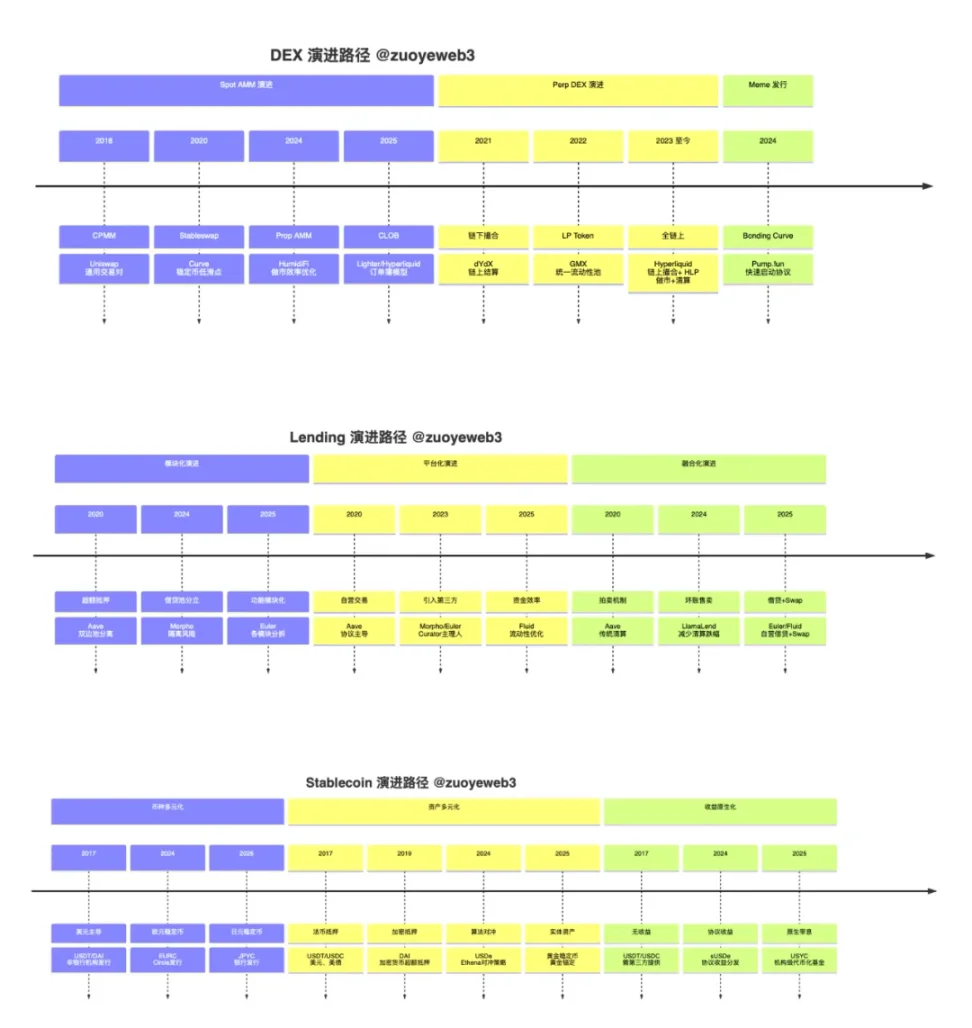
Image description: The evolution of the DeFi paradigm, image source: @zuoyeweb3
Since the end of DeFi Summer, the innovations in Decentralized Finance have been continuous improvements on established products, existing assets, and established facts. For example, trading is divided into three types: spot, Perp, and Meme, corresponding to the AMM/CLOB/Bonding Curve during the DeFi Summer period. Even the most innovative Hyperliquid harbors many shadows of Serum.
From the most microscopic perspective, Pendle started from the earliest fixed-income products, embracing yield-bearing stablecoins like LST/LRT and Ethena, as well as the coincidental choice of self-built lending + Swap products by Euler and Fluid. If users set yield strategies using Ethena and other YBS, they can theoretically utilize DEX/Lending/Stablecoin concurrently across any chain, any protocol, and any Vault.
This synergy, while amplifying returns, has also “created” numerous liquidation disasters and trust crises. Beyond this, there are No-Go Zones everywhere; blockchain is born free but is everywhere shackled.
Decentralization is a beautiful vision, but centralized systems are more efficient. The competition is poorer when it comes to centralized protocols. Aave is certainly large and secure, but this also means you have fewer and less updated options, while later entrants like Morpho/Euler can only embrace insecure custodians and “inferior” assets.
Unbanked has triggered a chase for stablecoins in the third world. It cannot be said that Aave's caution created the crisis of Morpho, but unAaved has also sparked the pursuit of on-chain mice and the younger generation for subprime bonds, subprime protocols, and subprime principals.
Innovation can only happen at the margins; the cost of trial and error is simply too low. Those who survive will repeatedly challenge the established order, and Aave V4 will become more like its competitors, rather than its own successful past.
The protocols and their tokens that we see now, their market prices and trading volumes are merely an intuitive reflection of the current environment; in other words, they are already a recognition of the results of repeated games.
It is difficult to say whether it is effective for the future or even if it has any reference significance. The stablecoin chains Plasma and Stablechain are exceptionally popular, but they are almost impossible to challenge the adoption rates of Tron and Ethereum. Even xUSD's challenge against the much smaller USDe compared to USDT has already been declared a failure.
Pricing system preferences time; the longer a protocol lives, the longer it tends to survive. The success of Hyperliquid and USDe is an outlier that goes against the norm. It is worth discussing how much market share Euler/Morpho/Fluid can capture from Aave, but it is almost impossible to replace Aave.
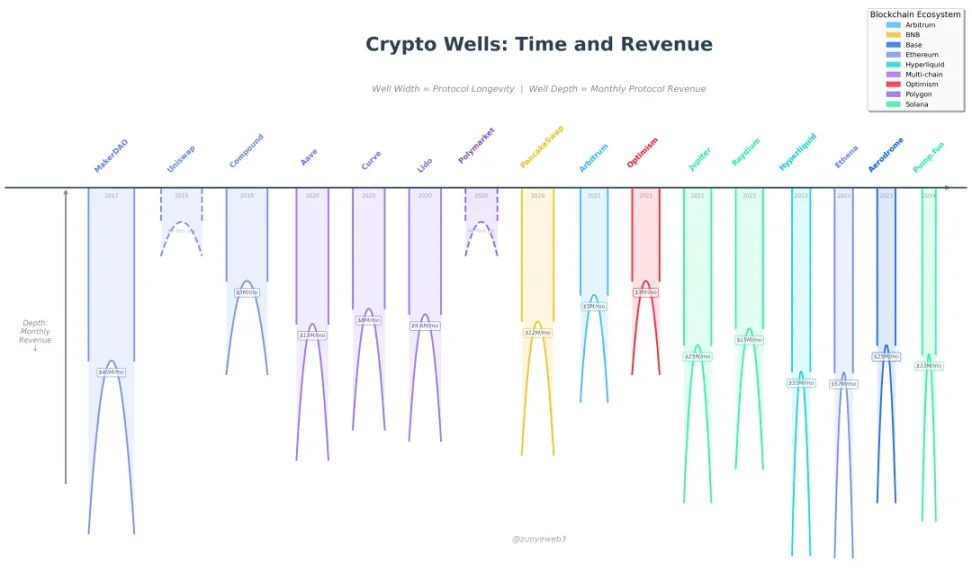
Image description: encryption gravitational well: time scale and income, image source: @zuoyeweb3
Encryption Gravity Well: Time and App Rev【Continuous】From left to right is the token issuance time, from top to bottom is Rev.
- Time: Balancer (hacked), Compound (quiet), Aave (thriving) captures our time
- Rev: The ability to make money is the only business value, one is the value of its own token BTC (the issuance of USDT, earning stablecoins is like taking this shortcut), and the other is the ability to capture value (the pumping of mining and selling).
Competition is moving towards internal competition, burning money for growth.
As shown in the figure above, the x-axis represents the duration of the protocol's existence, while the y-axis represents the protocol's value capture ability. Compared to indicators such as token price, trading volume, and TVL, the ability to make money is the most objective representation (Polymarket theoretically does not make a profit).
In theory, the earlier a protocol is established, the stronger its stable profitability will be. For latecomers to enter the game, they can only continuously enhance their token<>liquidity<>trading volume flywheel, referring to Monad/Berachain/Story, where failure is a more likely outcome.
The value as a goal in balance
One must believe in the power of the masses, but not in the wisdom of the masses.
DeFi is a movement that, relative to exchanges and TradFi, is indeed one of the best innovation cycles in history under the overall backdrop of looseness, and it may give birth to a new paradigm that surpasses DeFi Summer.
Exchanges are facing heavy blows, and Hyperliquid's transparency has demonstrated a stronger antifragility than Binance for the first time. After 1103, the pace of lending and stablecoins has slowed but has not been disproven. People do indeed need subordinated bonds, as well as simple funds / bonds / equity certificates – stablecoins.
In contrast to the liquidity migration restrictions faced by market makers in CEX on 10·11, on-chain trading, spot / contracts, and alternative assets are actively expanding in scale. As long as the issues can be engineered into a combination, there exists the possibility of being completely resolved.
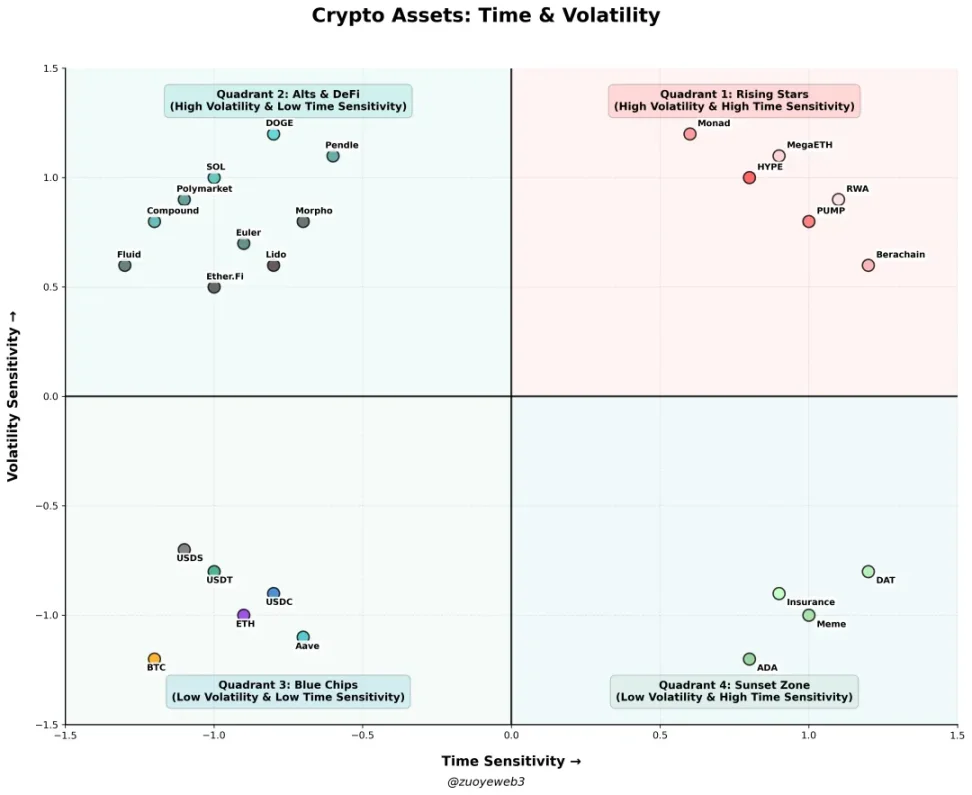
Image Description: Encryption Assets: Time & Volatility, Image Source: @zuoyeweb3
- First Quadrant (Rookie Zone): HYPE, PUMP, Public Chain /L2/Alt L1 (Monad, Berachain, MegaETH), RWA (Bond, Gold, Real Estate)
- Second Quadrant (Shanzhai Zone): DOGE, SOL, Compound, Pendle, Polymarket, Euler, Fluid, Morpho, Ether.Fi, Lido, No-USD Stablecoin, Option,
- Third Quadrant (Industry Leaders): BTC/ETH/USDT/USDC/USDS/Aave/
- Fourth Quadrant (Death Zone): ADA, Meme, DAT, Insurance
Place numerous new assets into the rookie area, which are sensitive to time and volatility, essentially being short-term speculative assets. Only by surpassing the simple gaming cycle and falling into a stable holder group and use cases can they enter the altcoin area, where they are not particularly sensitive to time, but liquidity cannot withstand drastic market fluctuations. Most projects will stay here.
Moreover, the harder the project team works, for example under measures such as ve(3, buybacks, burns, mergers, and renaming, it may still remain here, which can be seen as a gradual uphill period. If there is no progress, there will be regression, and even efforts to advance may lead to setbacks.
The story afterwards is simple: after successfully crossing the calamity and entering a stable zone, it becomes what is known as an asset that has traversed the cycle, such as BTC and ETH, perhaps with half a SOL and USDT added, but the vast majority of assets will slowly die out. At this time, there is no sensitivity to time, and there is completely no volatility.
Meme and DAT will exist as a track for a long time, but the assets belonging to it are unlikely to have lasting opportunities, while a few representative assets like DOGE and XRP are outliers.
In fact, if we view protocols as asset innovations, many issues can be resolved easily, that is, the purpose of entrepreneurship is to sell itself once, rather than seeking to become a continuous open system:
- Spot DEX: The trading itself is focused on mainstream assets (BTC/ETH) and whale exchanges, retail investors no longer trade altcoins, the core of the project is to seek specific clients, rather than becoming an unrestricted public infrastructure, such as dark pools rationalizing the information asymmetry between whales and retail investors;
- Perp DEX: The news of massive financing is a prelude to issuing tokens, and VCs are highly differentiated. Big Names are more like TGE funding parties, while small VCs can only perish in the Perp track, and retail investors can only pick up scraps on various launchpads.
- Meme: The emotion itself becomes a tradable asset, unable to reach a consensus across the industry, and there is no sign of PumpFun's ability to solve this problem.
- Platformization & Modular Lending: A long-term trend, lending protocols can sell their liquidity, brand, and technology in chunks, essentially adopting a B2B2C model.
- DEX+Lending integrated development: It is considered one of the latest in the nested models, and a dedicated article will be released later to introduce its mechanism.
- Non-USD stablecoins / Non-pegged USD stablecoins: Focused on developed regions such as Euro, Japanese Yen, South Korean Won in the short term, but the long-term market can only be in the Third World.
This section outlines the market situation for yield-type stablecoins. Overall, yield-bearing stablecoins are the asset form that best aligns with the integration of DEX/Lending/Stable, but will require a massive engineering combination capability.
In contrast, there are innovative models outside of DEX/Lending/Stable, which currently have limited observational samples. For example, the stablecoin NeoBank is still a comprehensive model of the three, while prediction markets belong to the broader category of DEX. The possibly better ideas could be Agentics and Robotics.
The Internet has brought about a scalable expansion of replicability, which is vastly different from the production models of the industrial era. However, there has long been no corresponding economic model. Advertising economics often comes at the expense of user experience. Compared to LLM on-chain, Agentics is at least more aligned with the technical characteristics of blockchain, namely the round-the-clock trading efficiency brought about by extreme programmability.
With the decreasing Gas Fee, coupled with years of TPS improvements and ZK development, the mass adoption of blockchain is likely to occur in a replication economy that does not require human participation.
The combination of robotics and encryption is not particularly interesting in the short term; at least until Yushu has shed the hype and educational value, it will be difficult for robots to truly take root in Web3. As for the long term, only time will tell.
Conclusion
Make Decentralized Finance more Decentralized Finance.
Robotics has taken too long; clearing needs to be done without delay.
The composite liquidation mechanism of DEX+Lending is a proactive construction against the DeFi crisis, but it couldn't stop the spread of the crisis on 11·03. The most effective measure was Aave's preemptive refusal. Looking at the entire industry, how to handle liquidation and restore the market has become the biggest challenge in the industry.
In 2022, after the 3AC incident broke out, SBF actively acquired and restructured the involved protocols, and then less than half a year later, FTX was also taken over by a traditional law firm. After the Stream's xUSD exploded, it was also handed over to the law firm at the first instance.
Code is Law, soon it will become Lawyer is Coder.
Before SBF and the law firm, BTC has long played the role of the ultimate liquidator, though it requires a long time to rebuild people's trust in the on-chain economy. At least, we still have BTC.


