With the rise of AI Agents, autonomous driving, and smart hardware, machine-to-machine value exchange is emerging as a new requirement within IoT networks.
In the Autonomous Machine Economy, devices require not only connectivity but also trusted identity, real-time payments, and automatic settlement. SEALCOIN builds a decentralized payment and identity network on Hedera's distributed ledger, providing Machine-to-Machine (M2M) transaction infrastructure for IoT devices and AI Agents via the QAIT token and smart contract mechanisms.
Traditional IoT (Internet of Things) platforms primarily connect smart devices for data collection, remote management, and device control.
In conventional architectures, IoT devices typically sync data and interact with services through cloud platforms. These platforms handle device authentication, data storage, and permission management, with the entire system usually controlled by enterprises or centralized service providers.
Traditional IoT platforms are widely deployed in smart homes, industrial equipment, logistics management, and smart cities, with the core goal of improving device connectivity efficiency and data management capabilities.
What Is SEALCOIN?
SEALCOIN is a decentralized payment and device identity protocol designed for the Autonomous Machine Economy, enabling autonomous transactions and resource collaboration among IoT devices, AI Agents, and smart hardware.
Unlike traditional IoT platforms, SEALCOIN goes beyond device connectivity to provide machines with on-chain payment, identity authentication, and automatic settlement capabilities.
QAIT is the native utility and governance token of the SEALCOIN ecosystem, used for machine payments, device access, market settlement, and network governance.
What Are the Core Differences Between Traditional IoT and SEALCOIN?
The fundamental difference between SEALCOIN and traditional IoT platforms lies in whether devices possess autonomous economic agency.
Traditional IoT platforms are built around "connectivity," while SEALCOIN focuses on "transactions." In legacy systems, most payments and resource allocation still depend on manual operations and centralized platforms. SEALCOIN, by contrast, enables devices to autonomously complete payments and service calls.
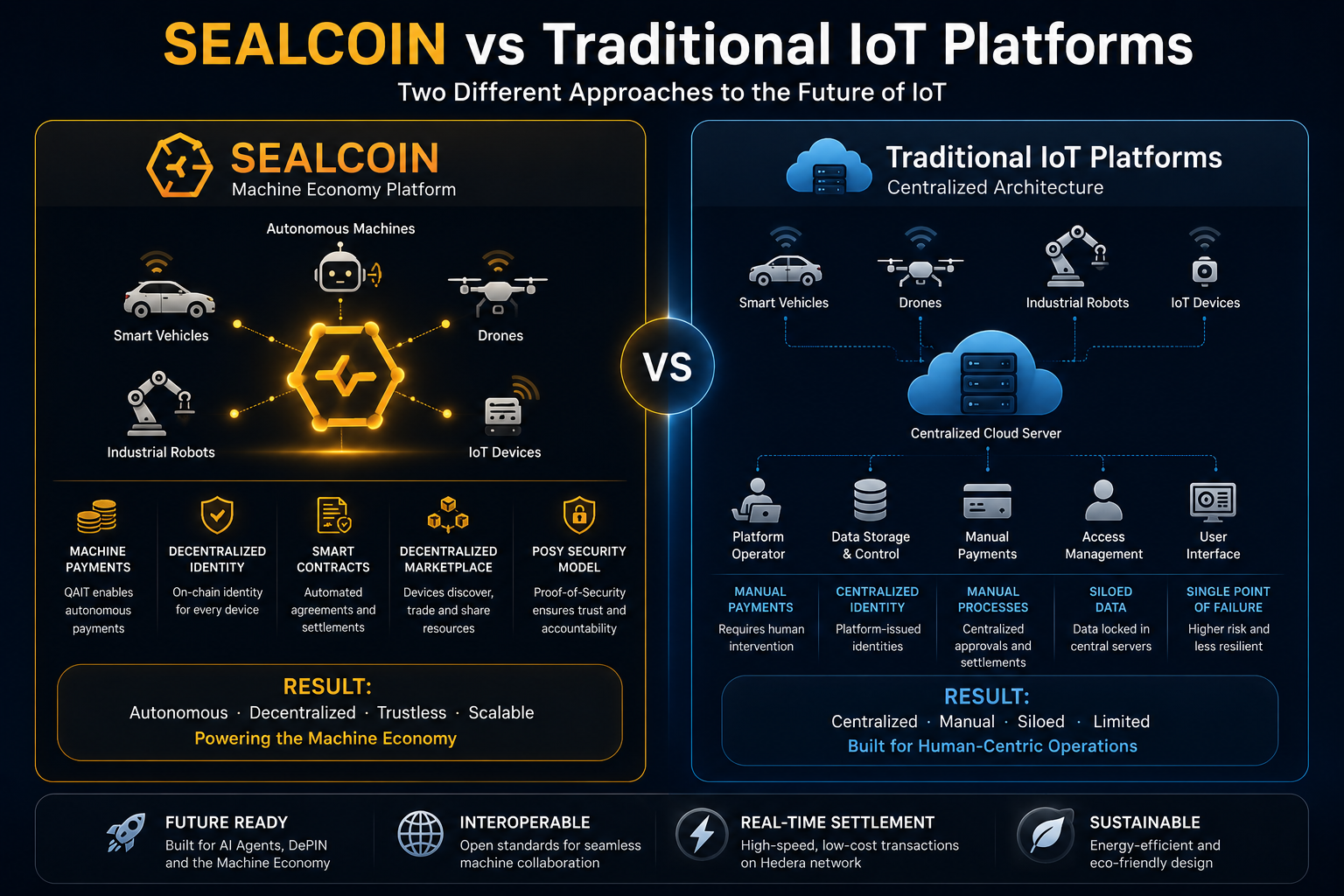
For example, a smart car can not only connect to the internet but also automatically pay for parking fees; an industrial robot can not only exchange data but also autonomously purchase computing resources and maintenance services.
This shift means IoT networks are evolving from "information networks" to "economic networks."
How Do the Device Identity Mechanisms Differ Between Traditional IoT and SEALCOIN?
Traditional IoT platforms typically use centralized account systems to manage device identities, with authentication authority controlled by the platform.
While this model simplifies unified management, it also places significant data and security burdens on the platform. If the centralized server fails, the entire device network may be affected.
SEALCOIN uses a decentralized device identity system, confirming device authenticity through cryptographic keys and on-chain verification. Device identities and transaction records can be verified on-chain, reducing the risk of a single point of failure.
SEALCOIN also introduces the Proof-of-Security (PoSy) mechanism to enhance device trustworthiness and network security.
Why Does the Payment System Become a Key Differentiator?
In traditional IoT networks, payments are typically initiated by users—for example, manually paying parking fees, energy costs, or cloud service fees.
This model is unsuitable for the Autonomous Machine Economy, where machine-to-machine transactions are often high-frequency, micro-amount, and real-time.
SEALCOIN uses QAIT as the machine payment medium, enabling devices to autonomously complete data purchases, API calls, service subscriptions, energy transactions, and automatic settlements.
The entire payment process is executed automatically via smart contracts, with no human intervention required.
What Role Do Smart Contracts Play in SEALCOIN?
In traditional IoT platforms, service logic is usually controlled by centralized servers. SEALCOIN, however, uses smart contracts to automate transaction rules.
Smart contracts can define prices, permissions, usage duration, and settlement logic between devices. For example, a drone can automatically locate a charging station when its battery is low and complete payment and resource allocation through a smart contract.
This mechanism enables a higher degree of autonomous collaboration between devices.
Traditional IoT platforms are better suited for device monitoring, data management, and remote control scenarios such as smart homes, enterprise device management, industrial monitoring, and smart city data platforms.
SEALCOIN is more applicable to scenarios requiring autonomous device transactions and real-time settlement, such as autonomous driving payments, AI Agent service marketplaces, decentralized energy trading, industrial robot collaboration, and DePIN network payments.
These scenarios emphasize economic activity between devices rather than just data connectivity.
| Comparison Dimension |
Traditional IoT Platform |
SEALCOIN |
| Core Goal |
Device connectivity and data management |
Autonomous device transactions and machine economy |
| Identity System |
Centralized account |
Decentralized device identity |
| Payment Model |
Manual payment |
QAIT automatic payment |
| Service Logic |
Centralized platform |
Smart contract |
| Automation Capability |
Limited |
AI Agent autonomous collaboration |
| Trust Mechanism |
Platform guarantee |
Cryptography and PoSy |
| Data Trading |
Platform-controlled |
Decentralized marketplace |
| Applicable Scenarios |
Data management |
Autonomous Commerce |
Summary
The core difference between SEALCOIN and traditional IoT platforms is whether devices are granted autonomous economic agency. Traditional IoT emphasizes device connectivity and data management, while SEALCOIN further provides IoT devices and AI Agents with on-chain payments, smart contracts, and autonomous collaboration capabilities.
As the ecosystem's native token, QAIT not only serves machine payment functions but also supports device trust verification through the PoSy security mechanism. With the growth of the Autonomous Machine Economy, AI Agents, and DePIN networks, the decentralized machine payment system represented by SEALCOIN is driving IoT networks from the "connectivity layer" to the "economic layer."
FAQs
What is the biggest difference between SEALCOIN and traditional IoT platforms?
SEALCOIN emphasizes autonomous device payments and Machine-to-Machine (M2M) transactions, while traditional IoT platforms are built primarily around device connectivity and data management.
What is the Autonomous Machine Economy?
The Autonomous Machine Economy is an economic system in which devices and AI Agents can autonomously complete payments, data exchange, and resource collaboration.
What role does QAIT play in SEALCOIN?
QAIT is used for machine payments, device access, on-chain governance, market settlement, and PoSy security verification.
What is PoSy (Proof-of-Security)?
PoSy is SEALCOIN's device security verification mechanism designed to enhance device trustworthiness and reduce the risk of malicious devices.