As the BTCFi, or Bitcoin DeFi, sector develops rapidly, the market is once again paying close attention to Bitcoin’s financial expansion potential. In the past, Ethereum was the first to build a full DeFi ecosystem through smart contracts, while Bitcoin long lacked native financial applications.
The emergence of Stacks and sBTC has given Bitcoin stronger programmability and asset liquidity, while Zest Protocol has become one of the important application-layer protocols built on this infrastructure. The way these three work together is also becoming an important part of the Bitcoin Layer2 financial ecosystem.
What Is Stacks?
Stacks is a Layer2 network built on Bitcoin. Its goal is to provide Bitcoin with smart contract and decentralized application capabilities without changing the security model of the Bitcoin mainnet.
While the Bitcoin mainnet is mainly responsible for asset transfers and secure settlement, Stacks focuses more on application-layer expansion. Through Stacks, developers can build:
What makes Stacks distinctive is that its state is ultimately anchored to the Bitcoin mainnet, allowing it to inherit Bitcoin’s security.
What Role Does sBTC Play in Bitcoin DeFi?
Although Stacks provides a smart contract environment, native BTC itself cannot directly interact with smart contracts. For this reason, BTCFi needs a form of BTC asset that can circulate within a Layer2 environment.
This is where sBTC comes in.
The core goal of sBTC is to establish an asset structure pegged 1:1 to BTC, allowing Bitcoin to enter the Stacks smart contract ecosystem. Users can convert BTC into sBTC through a specific mechanism, then participate in on-chain lending, trading, and liquidity protocols.
This structure shares some similarities with Wrapped BTC, or WBTC, but its design is more focused on the native Bitcoin ecosystem and decentralized management.
In the BTCFi market, sBTC mainly plays several important roles:
| Function |
Role |
| BTC liquidity entry point |
Brings BTC into the DeFi environment |
| Smart contract interaction |
Supports on-chain lending and financial logic |
| BTCFi asset medium |
Provides protocols with programmable BTC |
| Layer2 asset expansion |
Enhances Bitcoin’s on-chain financial capabilities |
For Zest Protocol, sBTC is one of the important base assets in its lending market.
Why Does Zest Protocol Depend on Stacks and sBTC?
Zest Protocol’s core business is the Bitcoin DeFi lending market. Since the Bitcoin mainnet itself does not support complex smart contracts, the protocol must rely on Layer2 infrastructure and pegged asset structures.
Stacks provides the smart contract execution environment, while sBTC provides the entry point for BTC liquidity. Together, they form the underlying infrastructure for Zest Protocol.
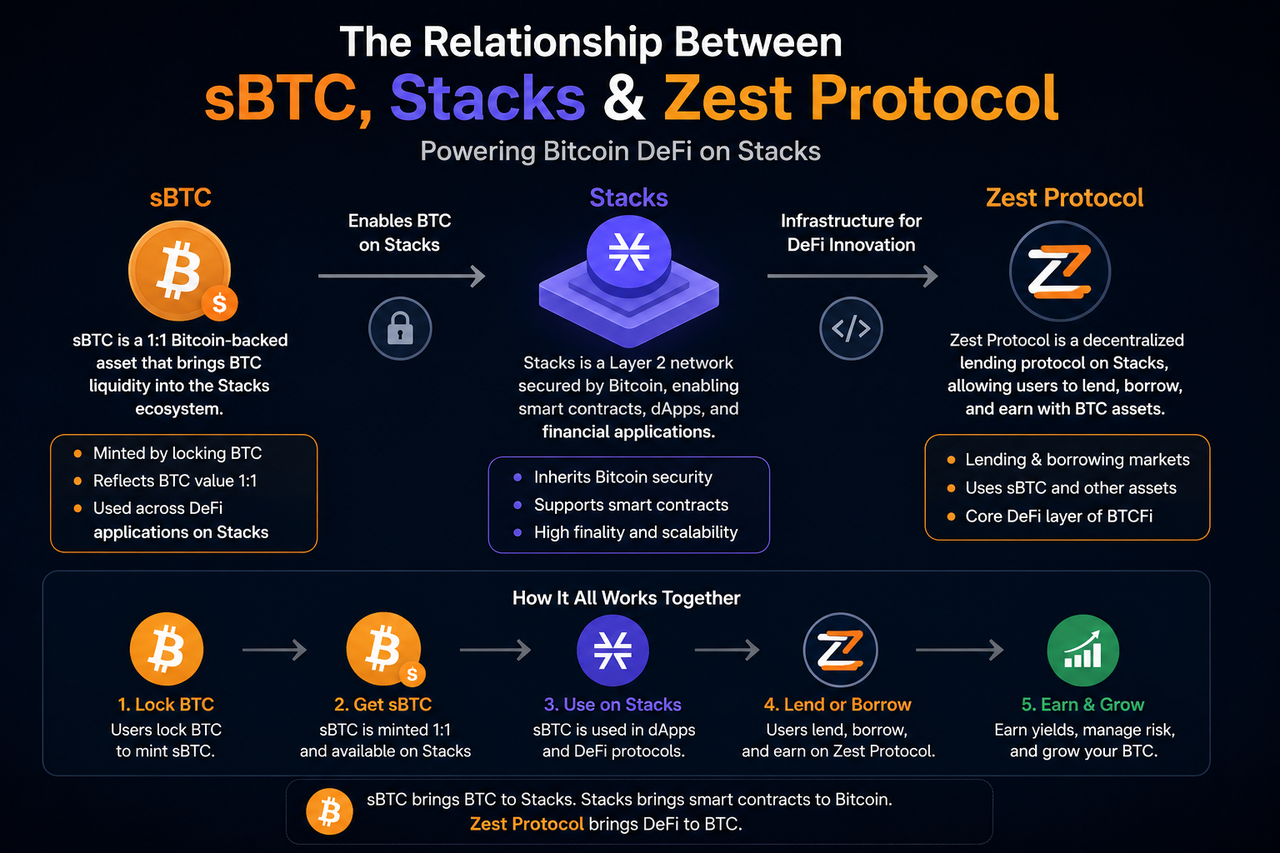
In the actual lending process:
This structure allows BTC to participate in on-chain financial activity in a way similar to ETH.
Compared with the traditional Wrapped BTC model, Zest Protocol places greater emphasis on Bitcoin-native financial infrastructure and a non-custodial direction, which is also one of the major development trends in BTCFi today.
How Does Zest Protocol’s Lending Process Work with sBTC?
In Zest Protocol, sBTC serves as an important bridge between Bitcoin and the DeFi market.
Users typically first convert BTC into sBTC, then deposit sBTC into the protocol as collateral. The protocol then calculates borrowing capacity based on the collateral ratio and allows users to borrow stablecoins or other assets.
The overall process roughly includes:
-
The user holds BTC
-
BTC is converted into sBTC
-
sBTC is deposited into Zest Protocol
-
The protocol creates a lending position
-
The user borrows stablecoin assets
-
Smart contracts continuously monitor the collateral ratio
This structure allows BTC to obtain on-chain liquidity without being sold directly.
Why Is the Stacks Nakamoto Upgrade Important?
The Nakamoto Upgrade is an important upgrade direction within the Stacks ecosystem. Its goal is to further strengthen the performance and security of Bitcoin Layer2.
The significance of this upgrade includes:
-
Faster transaction confirmation
-
Greater network stability
-
Stronger Bitcoin anchoring
-
Better suitability for DeFi applications
For BTCFi protocols such as Zest Protocol, Layer2 network performance directly affects lending, liquidation, and capital flow efficiency. If Bitcoin Layer2 cannot support high-frequency financial activity, BTCFi will struggle to build a mature market. For this reason, upgrades to the Stacks network are seen as a key part of BTCFi infrastructure development.
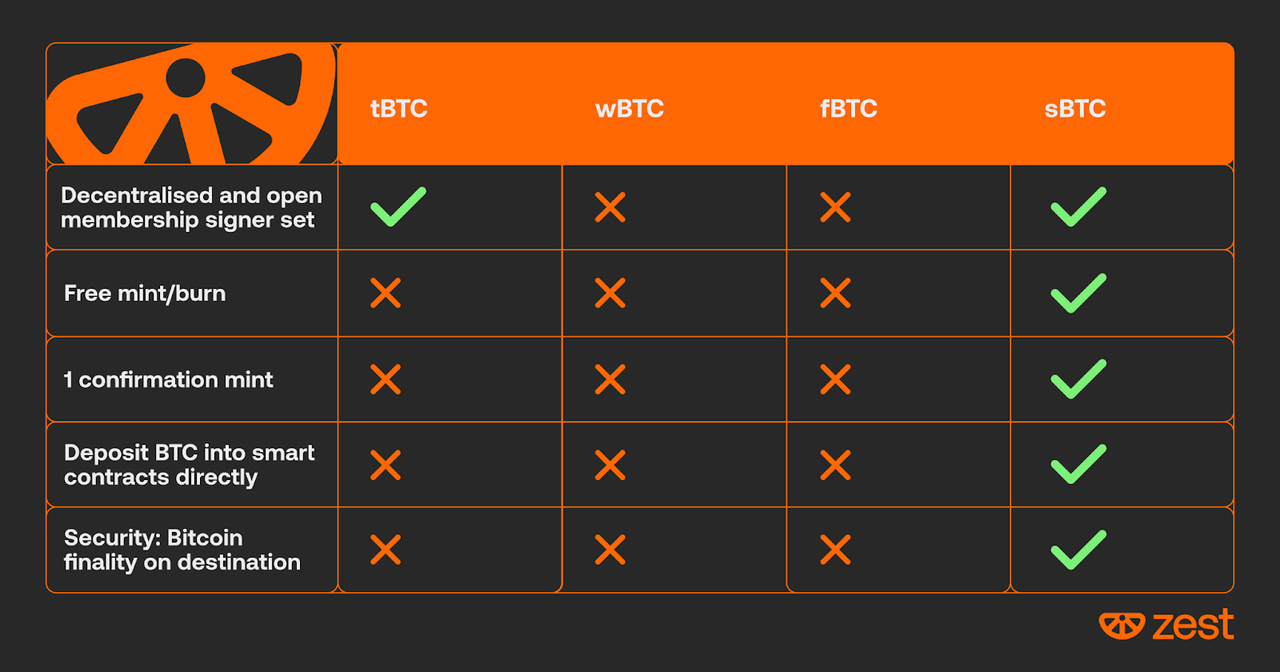
What Is the Difference Between sBTC and Wrapped BTC?
Many users confuse sBTC with Wrapped BTC, or WBTC, but the two differ clearly in their design philosophy and underlying structure.
| Comparison Dimension |
sBTC |
Wrapped BTC, or WBTC |
| Core Ecosystem |
Bitcoin + Stacks |
Ethereum |
| Main Use Case |
BTCFi and Layer2 |
Ethereum DeFi |
| Management Model |
Greater emphasis on decentralization |
Custodian-based model |
| Smart Contract Environment |
Stacks |
Ethereum |
| Target Direction |
Bitcoin-native finance |
Cross-chain BTC liquidity |
WBTC is more of a BTC liquidity tool for Ethereum DeFi, while sBTC places greater emphasis on a programmable asset structure within the native Bitcoin ecosystem.
Why Is Bitcoin Layer2 Gaining Attention?
Bitcoin has long been the largest asset category in the crypto market, but its on-chain financial capabilities have been relatively limited.
With the rise of BTCFi, the market is again focusing on the development potential of Bitcoin Layer2. Compared with directly changing the rules of the Bitcoin mainnet, Layer2 can expand more financial functions while preserving Bitcoin’s security.
At present, the main development directions for Bitcoin Layer2 include:
Stacks and sBTC are core infrastructure within this trend, while Zest Protocol is one of the important application-layer protocols.
Conclusion
sBTC, Stacks, and Zest Protocol together form important infrastructure within the Bitcoin DeFi, or BTCFi, ecosystem.
Stacks provides Bitcoin with smart contract functionality and Layer2 scaling capabilities. sBTC brings BTC into a programmable financial environment, while Zest Protocol builds BTC lending markets and on-chain financial protocols based on these technologies.
The relationship among the three is essentially a coordinated structure of “base network + asset bridge + application protocol.” This model is helping Bitcoin evolve from a pure store-of-value asset into a financial asset that can participate in lending, yield, and on-chain liquidity.
FAQs
What Is sBTC?
sBTC is a BTC-pegged asset structure used to bring Bitcoin into the Stacks smart contract ecosystem and the BTCFi market.
Is Stacks a Bitcoin Layer2?
Stacks is generally regarded as a Layer2 network in the Bitcoin ecosystem. Its goal is to provide Bitcoin with smart contract and application expansion capabilities.
Why Does Zest Protocol Depend on sBTC?
Because native BTC cannot directly interact with smart contracts, Zest Protocol needs sBTC to bring BTC into the on-chain lending market.
What Is the Difference Between sBTC and WBTC?
sBTC places greater emphasis on the native Bitcoin ecosystem and decentralized structure, while WBTC is mainly used in Ethereum DeFi and relies on a custodian-based model.
What Is BTCFi?
BTCFi is short for Bitcoin DeFi. It refers to the lending, stablecoin, yield asset, and on-chain financial ecosystem built around Bitcoin.
Is Zest Protocol a BTCFi Protocol?
Yes. Zest Protocol is one of the lending protocols in the Bitcoin DeFi ecosystem, mainly providing on-chain lending services for BTC-related assets.