Introduction to BNB Attestation Service BNB Attestation Service (BAS) Operational Principles Schema and Composability Features Data Ownership and Access Control Revocation Mechanisms and Application Scenarios Conclusion

Beginner
Quick Reads
Last Updated 2026-03-29 00:19:15
Reading Time: 1m
BNB Attestation Service offers both on-chain and off-chain verification solutions, enabling users to validate data authenticity and claim ownership rights, driving the assetization of data within the Web3 ecosystem.

In the Web3 era, data authenticity and ownership are central concerns. BNB Attestation Service (BAS), a key infrastructure within the BNB ecosystem, provides users with both on-chain and off-chain attestation services. BAS helps users verify information authenticity. It protects data privacy. It also enables data to be treated as assets.

What Is BNB Attestation Service
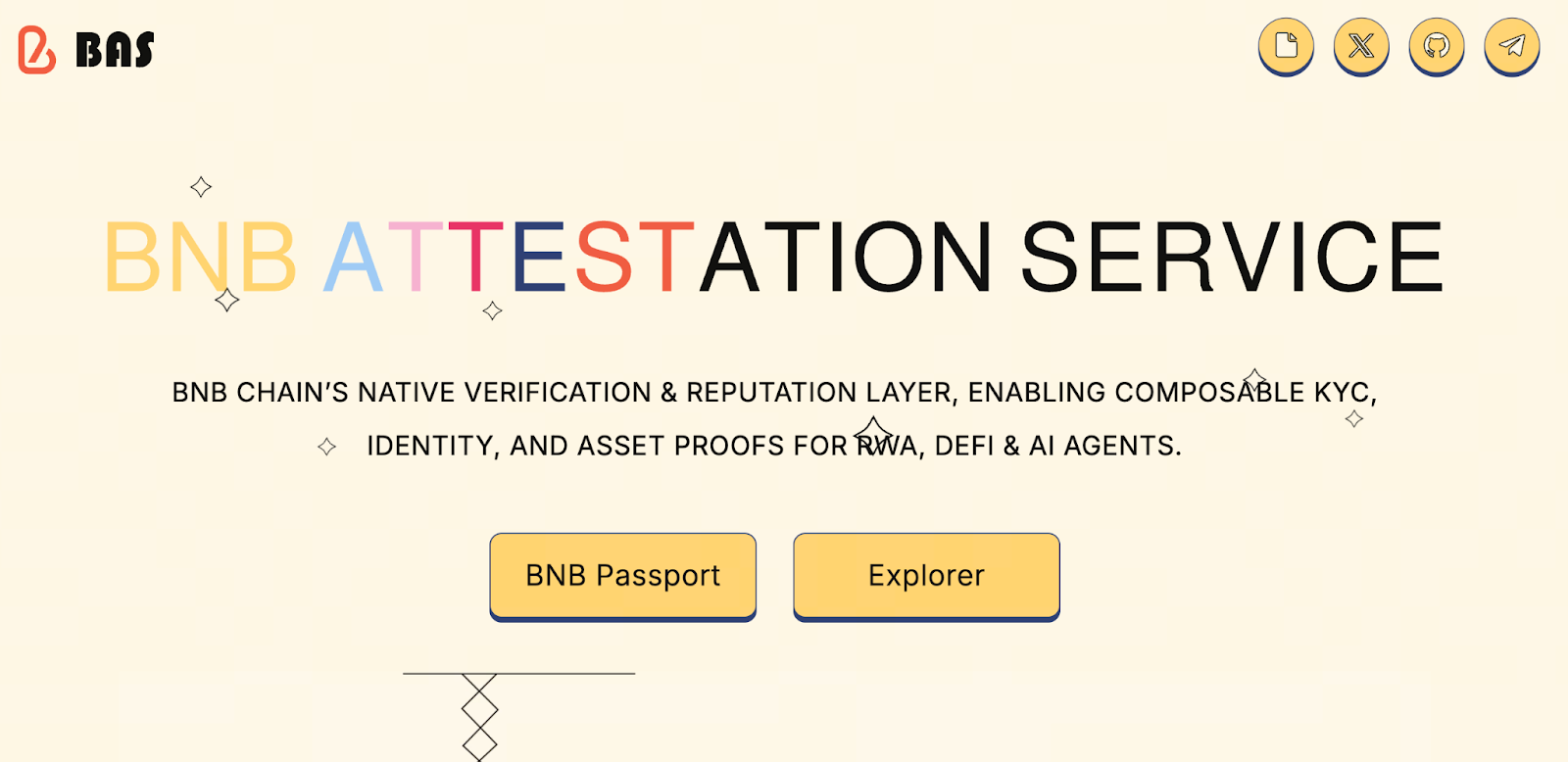

Source: https://www.bnbattest.io/

BAS is a standardized attestation generation and verification service. Users can create any type of attestation on BAS, bringing information into the Web3 ecosystem. Then, they can store it in Greenfield or other solutions to ensure both ownership and access control over their data.

BAS addresses two fundamental issues:

  • How to guarantee data authenticity
  • How to help users establish ownership of their attestations

With BAS, users can verify information and convert data into assets, enabling free exchange and data value to circulate.

How BAS Works

The BAS workflow includes the following steps:

Schema Registration: Users first register a schema in the Schema Registry Contract. They define the data structure, whether it is revocable, and the resolver (optional verification contract).

Create Attestation:

  • On-chain Attestation: Created based on the schema, validated by the resolver, and recorded in the BAS contract
  • Off-chain Attestation: Stored in Greenfield, with access controls set through the BAS contract

Attestation Revocation: The attestor can revoke invalid attestations at any time, supporting dynamic data updates.

BAS also provides SDK support, allowing users to generate zero-knowledge proofs with BNB Passport and apply them to other contracts, such as Pancake v4, RWA, or airdrops.

Schema and Composability

A schema defines the data structure and verification logic. Each schema contains a UID, creator address, field types, and an optional resolver. BAS’s modular design lets users reference other attestations via refUID to build complex data compositions. Examples include:

  • Basic Account Information Schema: Name, age, profile picture
  • KYC attestations referencing a user’s basic account information
  • Social Media attestations: Likes or comments referencing the original content attestation

This composability makes BAS work like Lego bricks, allowing users to flexibly assemble data structures to meet diverse application needs.

Data Ownership and Access Control

Web3’s foundation is complete user ownership of data. BAS supports the storage of off-chain attestations in Greenfield, and you can grant access permissions through NFTs or smart contracts to specific users, enabling data to be treated as assets.

Sample Application: Decentralized LinkedIn

  • User creates off-chain attestations: personal bio, contact details, resume
  • Set access conditions: possession of certain NFTs, passing KYC, or joining a specific DAO
  • Charge for access or resell access rights, allowing data value to circulate

Revocation Mechanism and Use Cases

BAS allows for the revocation of revocable attestations to keep data authenticity up-to-date. For example, a student's "enrolled" attestation can be revoked after graduation.

Revocation Methods:

  • On-chain: invoke the revoke function
  • Off-chain: invoke revokeOffchain(uid)

Summary

BNB Attestation Service delivers a comprehensive solution for Web3 data verification and ownership management. Through on-chain and off-chain attestations, modular schemas, composability, and access control, BAS ensures data within the Web3 world is both reliable and can be treated as assets. Whether for decentralized social networks, professional platforms, or other use cases, BAS offers users convenience and new possibilities.

Gate has launched BAS spot trading. Click here to trade: https://www.gate.com/trade/BAS_USDT

Author: Max
Disclaimer
* The information is not intended to be and does not constitute financial advice or any other recommendation of any sort offered or endorsed by Gate.
* This article may not be reproduced, transmitted or copied without referencing Gate. Contravention is an infringement of Copyright Act and may be subject to legal action.

Related Articles

AI-Native Settlement Layers: How United Stables Is Building the Next Financial Rail
Beginner

AI-Native Settlement Layers: How United Stables Is Building the Next Financial Rail

Stablecoins were originally designed as dollar substitutes within exchanges, primarily used for asset pricing and trade settlement. As on-chain financial ecosystems have matured, their role has expanded beyond simple payments to include collateral assets, cross-chain liquidity mediums, and unified settlement units. In particular, as AI systems and automated agents begin to participate directly in economic activity, demand has risen sharply for programmable value units capable of instant settlement. This shift is pushing stablecoins toward the role of foundational financial infrastructure.
2026-03-25 03:16:17
The ve(3,3) Flywheel Explained: How AERO Tokenomics Powers Aerodrome’s DeFi Economy
Beginner

The ve(3,3) Flywheel Explained: How AERO Tokenomics Powers Aerodrome’s DeFi Economy

In the competition for DeFi liquidity, high-inflation mining alone is no longer enough to build lasting advantages. Aerodrome applies the ve(3,3) economic model to redesign token emissions, voting mechanisms, and revenue distribution, creating a liquidity flywheel centered on governance and cash flow. This article examines AERO tokenomics, the veAERO locking mechanism, and protocol revenue models to explain how Aerodrome builds a sustainable DeFi economic system.
2026-03-25 06:41:58
Aerodrome Tokenomics: How ve(3,3) Powers Base's Most Profitable DEX
Beginner

Aerodrome Tokenomics: How ve(3,3) Powers Base's Most Profitable DEX

AERO is the native token of Aerodrome Finance, a core decentralized exchange and liquidity protocol in the Base ecosystem. It is primarily used for liquidity incentives and ecosystem operations. veAERO is a governance NFT that users receive by locking AERO, representing both voting power and the right to share protocol revenue. Through a dual track structure of AERO as a utility token and veAERO as a governance credential, Aerodrome separates liquidity usage value from long term governance power, allowing participants to act as liquidity providers, governance decision makers, and revenue sharers within the same system.
2026-03-25 06:40:31
DePIN Identity Network and Real World Applications: How Humanity Protocol Brings on-chain Identity Into the Physical World
Beginner

DePIN Identity Network and Real World Applications: How Humanity Protocol Brings on-chain Identity Into the Physical World

Most Web3 identity systems remain confined to on-chain environments and struggle to achieve meaningful adoption in real world settings. Through a DePIN architecture and physical verification hardware, Humanity Protocol aims to bring decentralized identity into access control systems, hospitality, public services, and offline events, allowing on-chain identity to function not just as a digital credential, but as foundational infrastructure for real world access.
2026-03-25 07:40:53
How is the price of PAXG determined? Pegging mechanism, trading depth, and influencing factors
Beginner

How is the price of PAXG determined? Pegging mechanism, trading depth, and influencing factors

PAXG (Pax Gold) is a tokenized asset backed by physical gold reserves, launched by fintech firm Paxos and issued as an ERC-20 token on the Ethereum blockchain. The core concept is to digitally represent real-world gold assets, allowing investors to hold and trade gold via the blockchain network. Because each PAXG token corresponds to a specific quantity of physical gold, its price is theoretically expected to closely track the global gold market.
2026-03-24 19:11:40
How Does PAXG Work? In-Depth Overview of the Physical Gold Tokenization Mechanism
Beginner

How Does PAXG Work? In-Depth Overview of the Physical Gold Tokenization Mechanism

PAXG (Pax Gold) is a tokenized asset backed by physical gold, issued by the fintech company Paxos and traded on the Ethereum blockchain as an ERC-20 token. The core concept is to tokenize physical gold on-chain, with each PAXG token representing ownership of a certain amount of gold. This structure enables investors to hold and trade gold in the form of a digital asset.
2026-03-24 19:12:51





