


Futures
Access hundreds of perpetual contracts
TradFi
Gold
One platform for global traditional assets
Options
Hot
Trade European-style vanilla options
Unified Account
Maximize your capital efficiency
Demo Trading
Introduction to Futures Trading
Learn the basics of futures trading
Futures Events
Join events to earn rewards
Demo Trading
Use virtual funds to practice risk-free trading
Launch
CandyDrop
Collect candies to earn airdrops
Launchpool
Quick staking, earn potential new tokens
HODLer Airdrop
Hold GT and get massive airdrops for free
Launchpad
Be early to the next big token project
Alpha Points
Trade on-chain assets and earn airdrops
Futures Points
Earn futures points and claim airdrop rewards


More


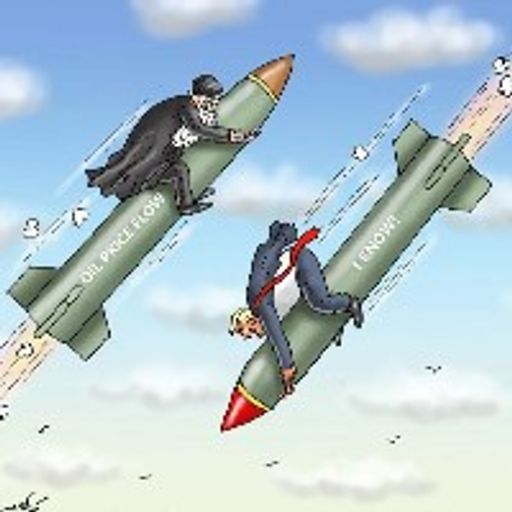



Strait of Hormuz Continues Closure, But Oil Prices Remain Far Below Historical Highs and U.S. Stocks Haven't Panicked—Why Is the Market Holding Steady?
Despite the closure of the Strait of Hormuz and escalating Middle East tensions drawing global attention, oil prices and the U.S. stock market have not experienced the dramatic swings expected.
Currently, crude oil prices fluctuate around $100 per barrel. Historically, after removing inflation, Brent crude reached $179 following the 1979 Iranian Islamic Revolution, hit $155 during the Iran-Iraq War in 1980, soared to $180 during the Arab Spring in 2011, and even spiked to $130 during the 2022 Russia-Ukraine conflict.
The U.S. stock market also appears relatively calm. Even after a decline this Thursday, the S&P 500’s drop from its pre-conflict closing point is less than 3%.
Wall Street’s “Shock Absorber” for Oil Prices
Why haven’t oil prices skyrocketed amid an epic supply disruption? On March 12, James Mackintosh, a columnist for The Wall Street Journal, analyzed three key reasons.
First, the starting price of oil is low, and inventories are ample. Before the Middle East conflict, global oil inventories were at a five-year high, with prices at only $72. Despite nearly a 40% surge in oil during the nine trading days prior to the conflict, the absolute price remained within manageable levels due to the low base.
Second, Wall Street is betting heavily on a quick resolution. Trump’s comments on Monday—“The war is very thorough, almost over”—immediately offset the previous night’s oil price spike to $128. Futures markets show December-delivered crude rising less than half of the spot price, indicating traders expect the supply disruption to last only a few weeks, not months or years.
Finally, macro interventions are offsetting the actual supply gap. The IEA and its member countries are releasing 400 million barrels from reserves. Even though the Strait of Hormuz loses about 15 million barrels of capacity daily, the release of these reserves—though timing and pace are uncertain—serves as an important market expectation and reason for stabilizing oil prices.
A True “Oil Crisis” Might Still Require a $50 Price Increase
Energy analyst John Kemp argues that, although crude futures have risen over one-third since the conflict began—up nearly two-thirds this year—this still isn’t enough to be called an “oil crisis.”
On one hand, historical oil crises involved much higher prices; on the other, major economies have significantly reduced their reliance on oil for heating and power generation. He notes:
Kemp estimates that crude futures need to rise another $40–$50 to trigger an economic recession comparable to past crises. This macroeconomic buffer explains why both sides in the conflict still seem confident in their ability to continue resisting in the short term.
While current price increases haven’t yet shattered the global core economies, regional impacts are highly uneven. Kemp points out that rising prices are causing greater damage to developing economies—especially in Asia—facing the dual risks of soaring oil prices and fuel shortages.
Changing Risk Dynamics in U.S. Stocks: Why Defensive Sectors Are the Biggest Losers
Regarding the market’s relative calm, Mackintosh suggests that as the world’s largest oil producer, the U.S. has insulated itself from the direct energy crisis, sparing the broader stock market from panic.
Additionally, an unusual phenomenon has emerged: typically, geopolitical conflicts cause funds to flow into defensive sectors like consumer staples and healthcare. But now, this traditional pattern is breaking down.
Since the Middle East conflict erupted, energy stocks in the U.S. have risen as expected, while tech and software stocks have dipped less than 1%. Meanwhile, traditional safe havens—healthcare ETFs—have fallen about 5%, and consumer staples ETFs about 6%.
Inside the U.S. stock market, a strange sector rotation is underway.
Why have defensive sectors become the biggest casualties? Another WSJ columnist, David Wainer, analyzes two deeper reasons.
First, this is “rotation within rotation.” Before the conflict, markets worried about AI bubbles and overvalued tech stocks, prompting funds to flow into defensive sectors early. When the actual war broke out, these sectors were already crowded and expensive. Nick Puncer, managing director at Bahl & Gaynor, comments: “Market focus shifted from worries about replacing white-collar jobs and SaaS (Software as a Service) doomsday to the war.” Tech stocks, unexposed to oil or complex global supply chains, have become the cleanest trade at the moment.
Second, defensive sectors are trapped in their own structural issues. Consumer staples like Campbell’s Soup are suffering from the rise of private labels and GLP-1 weight-loss drugs changing snacking habits; healthcare giants like UnitedHealth are caught between government cost controls and rising medical costs. These problems are unrelated to the geopolitical conflict but are amplified in this environment.
Where Is the Money Really Going?
In this disrupted landscape, Wainer observes that Wall Street funds are following two new signals.
First, geographic exposure determines resilience. Data shows that among the top 20 non-cyclical companies in the S&P 500’s healthcare and consumer sectors, an average of 72% of revenue comes from North America. Conversely, the most affected companies rely heavily on international markets, with only 59% of revenue from North America. The logic is straightforward: the more a business is focused on the U.S., the less it is affected by Middle East ripple effects like supply chain disruptions or high European energy costs.
Second, focus on PEG (Price/Earnings to Growth ratio). Citigroup strategist Traver Davis notes that high interest rates combined with geopolitical risks mean investors should avoid chasing absolute low valuations. Instead, they should seek “high-growth, high-value” stocks. In the pharma sector, companies like AbbVie and Lilly, with solid earnings growth, remain favored by investors.
“Now Is Not the Time for Blind Confidence”
However, both Wall Street analysts and energy experts issue stern warnings.
Mackintosh emphasizes that current asset stability relies on the fragile assumption that “all parties want to end the war quickly.” Beyond game theory, revenge sentiments are hard to quantify. If the Strait of Hormuz is sunk, a civilian airliner is shot down, or a key Saudi pipeline is attacked, current optimistic pricing will be shattered.
Kemp also warns that if the conflict persists and the Strait remains closed long-term, oil prices could spike further, testing the willingness of all sides to maintain hostility.
As the article states: “Now is not the time for blind confidence in the outcome.”
Risk Disclaimer
Market risks are inherent; invest cautiously. This article does not constitute personal investment advice and does not consider individual user’s specific investment goals, financial situation, or needs. Users should determine whether any opinions, views, or conclusions herein are suitable for their circumstances. Investment is at your own risk.