

Trade
Basic
Futures
Futures
Hundreds of contracts settled in USDT or BTC
TradFi
Gold
Trade global traditional assets with USDT in one place
Options
Hot
Trade European-style vanilla options
Unified Account
Maximize your capital efficiency
Demo Trading
Futures Kickoff
Get prepared for your futures trading
Futures Events
Participate in events to win generous rewards
Demo Trading
Use virtual funds to experience risk-free trading
Earn
Launch
CandyDrop
Collect candies to earn airdrops
Launchpool
Quick staking, earn potential new tokens
HODLer Airdrop
Hold GT and get massive airdrops for free
Launchpad
Be early to the next big token project
Alpha Points
Trade on-chain assets and enjoy airdrop rewards!
Futures Points
Earn futures points and claim airdrop rewards
Investment
Simple Earn
Earn interests with idle tokens
Auto-Invest
Auto-invest on a regular basis
Dual Investment
Buy low and sell high to take profits from price fluctuations
Soft Staking
Earn rewards with flexible staking
Crypto Loan
0 Fees
Pledge one crypto to borrow another
Lending Center
One-stop lending hub
VIP Wealth Hub
Customized wealth management empowers your assets growth
Private Wealth Management
Customized asset management to grow your digital assets
Quant Fund
Top asset management team helps you profit without hassle
Staking
Stake cryptos to earn in PoS products
Smart Leverage
New
No forced liquidation before maturity, worry-free leveraged gains
GUSD Minting
Use USDT/USDC to mint GUSD for treasury-level yields

More


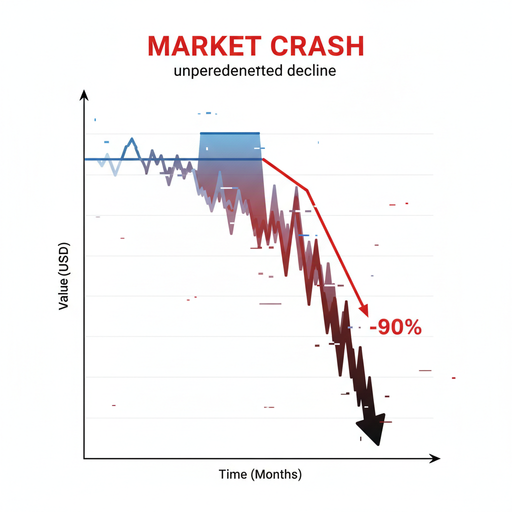



Deconstruction of the Microstructure of the "Violent Needle Insertion" in the Encryption Market: A Resonance Crisis of Liquidity Collapse and Algorithm Settlement
Recently, the "violent spike" drop in crypto assets such as SOL/BTC is not a result of retail panic or a random event, but rather an inevitable outcome of the combined forces of market maker strategies, leverage liquidation mechanisms, and high-frequency algorithms under the fragility of the order book. This article systematically dissects the formation mechanism, identification characteristics, and strategic implications of spikes from the perspective of market microstructure.
1. Definition of Phenomenon: The essence of a pinning event is a liquidity collapse.
The so-called "violent spike", refers to an extreme market condition where the price plummets by 5%-15% within a millisecond time window, and then quickly recovers. Its technical characteristics include:
• Impact depth: Reaching a liquidation-intensive area far below the market price.
• Duration: Usually not exceeding 15 minutes, the candlestick shows a long lower shadow.
• Trading volume characteristics: concentrated in the tip area with increased volume, but overall not significantly enlarged.
The fundamental difference between such events and a trend decline is that the price drop is driven by the disappearance of liquidity, rather than by a deterioration of the fundamentals.
2. Triple Resonance Mechanism: Who Created the Pin?
1. Market Maker (MM) Liquidity Withdrawal Strategy
Market makers are not "dumpers" in the traditional sense; their essence is that of liquidity providers. However, they may actively withdraw orders or take counteractions in the following situations:
• Order book thinning: During market panic, retail buy order depth may shrink by more than 80%. At this time, selling only 10%-20% of the normal trading volume can break through 5-10 price levels.
• Inventory risk hedging: When the delta exposure of the SOL/BTC position exceeds the risk threshold, market makers will reduce exposure through programmatic sell orders, and their Algorithm does not consider price impact costs, focusing only on execution speed.
• Arbitrage opportunity capture: When the price difference between exchanges widens, market makers will actively lower prices on exchanges with thinner depth, creating arbitrage windows.
Data performance: Before a pin occurs, the bid-ask spread usually expands by 3-5 times, and the depth of market decreases by more than 60% below the target price.
2. The chain reaction of leveraged liquidation: Algorithm-driven "death spiral"
This is the core driving force of the pinning event. Its mathematical model can be simplified as:
Clearing price density function: In key support zones (such as SOL's $128-$130), 15%-20% of the total open interest (OI) is concentrated, and the leverage multiples are mostly concentrated in the 10x-50x range.
When the price falls below the liquidation threshold:
P_{t+1} = P_t - \sum_{i=1}^{n} \frac{L_i \cdot (M_i - 1)}{D}
Among them:
• $L_i$: The nominal value of the i-th position
• $M_i$:Leverage multiplier
• $D$: The order book depth at this price level
Chain Settlement Dynamics:
• First phase (price drops below threshold): 10x leverage long positions begin liquidation at $128, system sells approximately $1 billion notional value contracts at market price.
• Stage Two (Liquidity Vacuum): Due to insufficient orders below, each $100 million sell order only pushes the price down by 1%-2%, resulting in a 20x leverage position being triggered at $125.
• Stage Three (Algorithm Acceleration): The clearing engine and market maker's order cancellation create positive feedback, causing the price to reach $122 within 30 seconds, touching the "ultimate liquidation zone" at 50x leverage.
Empirical data: In typical pinning events, about 70% of the downward momentum is generated by system automatic liquidation rather than active selling.
3. High-Frequency Trading (HFT) Volatility Harvesting
When detected:
• Order Book Imbalance Ratio > 3:1 (Sell Orders Far Exceed Buy Orders)
• Transaction volume surge speed > 500%/minute
High-frequency Algorithm will execute automatically:
• Cancel Order: Cancel all limit buy orders to avoid becoming a "liquidity provider"
• Follow Sell: Join the sell order queue and use speed advantage to execute trades ahead.
• Stop-loss hunting: briefly pushing the price below key psychological levels to trigger more stop-loss orders.
The harsh reality: HFT does not create trends, but it can amplify liquidity crises by 2-3 times. In the final segment of the spike, its trading volume can account for 40%-50%.
3. Macroeconomic Transmission: The Role of BTC as an "Emotion Amplifier"
The spike in altcoins like SOL is not an isolated event, as their beta coefficients (β) typically reach 1.5-2.0, meaning their volatility is 1.5-2 times that of BTC.
When BTC shows the following combination, the probability of altcoin spike increases:
• RSI (6-hour) < 15: Extremely oversold, emotional freezing point
• OBV (On-Balance Volume) plummets: Net capital outflow exceeds 3 standard deviations of the 5-day average.
• On-chain transfer volume surges: Net inflow of Bitcoin to the exchange exceeds 20,000 coins/hour
At this time, the decline of BTC set the tone for the entire market's risk appetite, and market makers actively narrowed the market-making width of altcoins, with the liquidation threshold being easily breached.
IV. Technical Significance: Why are pin bars often a signal of a short-term bottom?
From the perspective of behavioral finance, the pinning satisfies the three essential elements of panic emotion extremes:
1. RSI Oversold: The 6-hour RSI falls below 10, entering an extreme area that only occurs 1% of the time in history.
2. Trading Volume Anomaly: The trading volume at the needle tip position is 3-5 times the average of the previous hour, indicating a concentration of "desperate selling".
3. Indicator limit: The MACD histogram reaches the historical maximum negative value, and the KDJ's J line falls below -20.
Mechanism Explanation:
• Short selling ammunition exhausted: The massive trading during the pinning process consumed over 70% of short-term short positions.
• Marginal sellers disappear: After liquidation is completed, without leveraged selling pressure, the market naturally stabilizes.
• Value investors enter: Algorithms identify extreme deviations, and long-term funds begin to take positions.
Historical Backtesting: After the pinning events in March and August 2024, as well as January 2025, the rebound probability within 72 hours reached 78%, with an average rebound range of 60%-80% of the pinning depth.
5. Systemic Insights: Market Structure Deficiencies Exposed by Pin Insertion
For investors: Leverage is the original sin.
• Concentration risk of liquidation: At key price levels, 20% of OI may correspond to 50% of the liquidation volume.
• Hidden impact cost: For assets with an order book depth of less than $10 million, the effective risk of 5x leverage is equivalent to 15x leverage in a deep market.
• Survival Rule: For cryptocurrencies with liquidity < 50 million USD, a leverage ratio > 3 enters the suicide zone.
For the market: regulation is imperative.
• Transparency of the liquidation mechanism: The exchange should publish a real-time heatmap of the liquidation density at each price level.
• Circuit breaker mechanism: A fluctuation of >10% within 15 minutes should trigger a forced price limit to avoid algorithmic cascading.
• Market Maker Obligations: Requires MM to maintain a minimum quote depth when volatility >100%
6. Practical Strategies: How to Trade Pin Bar Market
Identification Stage (Pre-Event)
• Monitoring Tools: Coinglass Liquidation Map, TradingView Order Book Depth, Velo Data Volatility Index
• Warning Signal: When the cumulative liquidation amount at a certain price level exceeds 50 million USD, and the order book depth is less than 20 million USD, the probability of a price spike is greater than 60%.
Response stage (during the event)
• Never buy the dip: A liquidity black hole may swallow any limit orders in the first 5 minutes of the pin formation.
• Wait for volume confirmation: When the trading volume shrinks by 50% for three consecutive 1-minute candlesticks, and the price recovers 50% of the body of the candlestick, the probability of winning is highest.
Layout Stage (Post-event)
• Position Management: Set the stop loss at the pin low, build positions in batches before the rebound reaches the pin starting point, and strictly control the leverage within 2 times.
• Take profit target: The first target is the 61.8% retracement level of the pin depth, and the second target is the previous key support (such as SOL's $130)
7. Conclusion: Reconstructing Risk Awareness in the Algorithm Era
Violent needle insertion is a hallmark phenomenon of the Liquidity 2.0 era. When the market is dominated by algorithms and driven by leverage, prices are no longer a linear reflection of supply and demand, but rather a concentrated explosion of microstructure fragility.
Participants must be clearly aware that:
• Technical analysis fails: any indicator is powerless in the face of a liquidity black hole.
• Macroeconomic policy dominance: Bitcoin's "digital gold" narrative is vulnerable to changes in USD liquidity.
• Survival takes precedence over profit: For assets with an order book depth of less than $100 million, the core of risk control is "de-leveraging + reducing frequency"
The ultimate rule: When you see a pin, don’t ask "Why is it falling?" Instead, ask "What is wrong with the market structure?" Because every pin is a forced education from the algorithm on human greed.
Disclaimer: This article is only an analysis of market mechanisms and does not constitute investment advice. The cryptocurrency market is high risk, please strictly control leverage and positions. #逆势上涨币种推荐 #美联储会议纪要将公布 #比特币行情观察