The core questions regarding the TAC token focus on three primary aspects: its role in supporting the TAC EVM execution layer, its participation in validation and governance, and how its total supply, allocation, and release structure impact the network economy.
These questions can be analyzed from six perspectives: Gas mechanism, validation network, governance design, token allocation, ecosystem incentives, and supply-demand dynamics. Among these, Gas payments and validation staking are the most fundamental functions of the TAC token model.
What Is the TAC Token
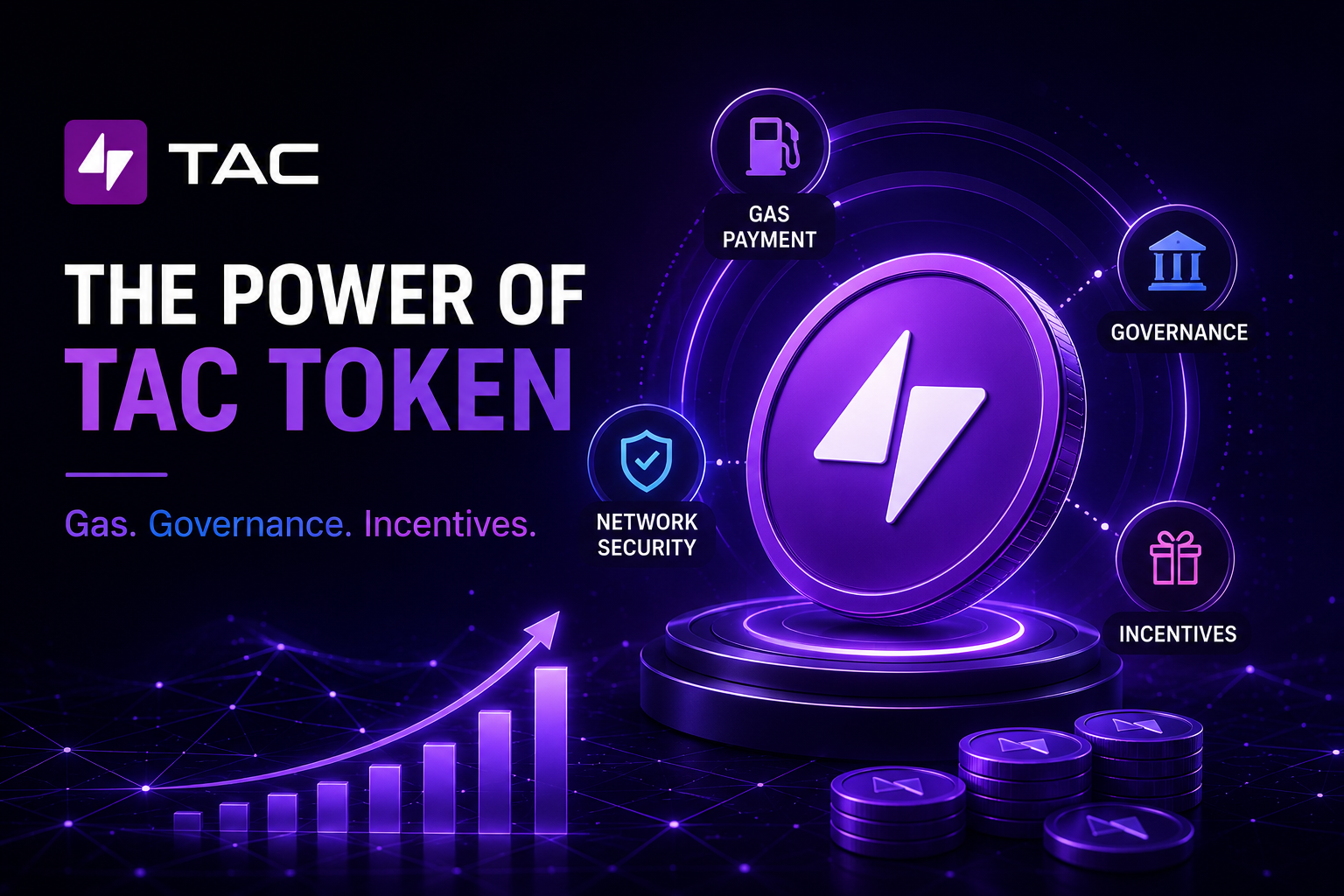
The TAC token is the foundational settlement asset for the TAC EVM execution layer, serving as the economic bridge that connects Telegram users, TON assets, and EVM contract execution. Its core value lies in enabling cross-chain execution, Gas payments, and network security within a unified token system.
From a structural perspective, the TAC network integrates the Telegram frontend, TON Adapter, Sequencer network, and EVM execution layer. Users initiate interactions through the Telegram Mini App or TON Wallet. The system then translates these requests into executable cross-chain messages. The TAC EVM layer processes Solidity contract execution, and all Gas, validation, and network resource consumption are ultimately settled via the TAC token system.
This positioning is significant because TAC is not simply a payment asset for end users—it is a utility token that underpins the core execution environment. While users may interact with TON or Telegram Wallet, TAC continues to fulfill the Gas and economic security roles within the EVM execution network.
How the TAC Gas Mechanism Works
The TAC Gas mechanism provides fee settlement for contract execution on the TAC EVM Layer. In practice, every time a Hybrid dApp executes a Solidity contract on TAC EVM, a corresponding Gas fee is required to cover computing and network resources.
Here’s how it works: users initiate actions such as Swap, Lend, or Stake via the Telegram Mini App or TON Wallet. The application sends the request into TAC’s cross-chain execution process. The TAC EVM Layer then processes the Solidity contract, incurring Gas costs. These costs are settled through the TAC token system, supporting network execution and resource consumption.
This mechanism is critical because TAC token demand is directly tied to network usage. As Hybrid dApp usage increases, EVM contract executions rise, and Gas payment demand grows. The Gas mechanism unifies Telegram app usage, TON cross-chain interactions, and EVM execution activities within a single economic model.
The Role of TAC Tokens in the Validation Network
TAC tokens are essential for staking, delegation, and network security within the validation network. The DPoS mechanism requires validators and delegators to assume economic responsibility and participate in network consensus.
Validators must stake TAC tokens to qualify for network validation. Delegators can delegate their tokens to validators, indirectly contributing to network security. The validation network is responsible for processing cross-chain messages, block production, and status updates. Compliant participants receive rewards, while misbehavior or inactivity may result in penalties.
This structure means TAC tokens are used for both Gas payments and network security. The more validators stake, the stronger the network’s economic security. For cross-chain execution networks, the stability of the validation mechanism is directly linked to message execution, status confirmation, and user asset safety.
TAC Governance Mechanism Design
TAC’s governance mechanism centers on protocol upgrades, ecosystem incentives, treasury resources, and network parameters. TAC token holders participate in governance, helping to shape network rules and resource allocation.
The governance process begins with the community or stakeholders proposing protocol development initiatives. Token holders vote according to governance rules. Governance outcomes may affect ecosystem incentives, treasury management, protocol parameters, or application support. Ultimately, the governance mechanism connects token holding with network decision-making.
This design is important because TAC’s ecosystem growth depends on both technical execution and resource allocation. For the Telegram EVM ecosystem, governance can impact Hybrid dApp incentives, developer support, liquidity programs, and long-term ecosystem development. The quality of governance depends on participation, transparency, and proposal execution efficiency.
TAC Token Supply and Allocation Structure
TAC’s total token supply is set at 10 billion. According to the official Tokenomics article, approximately 18% of tokens will circulate at TGE, with around 80% locked or managed by the foundation and released gradually according to a vesting schedule. The official source also states that the community airdrop will ultimately account for 1.42% of the total supply.
According to data from public tracking platform Dropstab, TAC allocation includes Early Contributors, Seed Initial, Foundation & Reserve, DAO Treasury, Growth, Pre-Mainnet Liquidity, Marketing & Rewards, Advisors, Liquidity Management, Validators, and Infrastructure Partnerships.
| Allocation Category |
Percentage |
| Early Contributors |
22.10% |
| Seed Initial |
16.60% |
| Foundation & Reserve |
14.80% |
| DAO Treasury |
12% |
| Growth |
10% |
| Pre-Mainnet Liquidity |
5.10% |
| Mid-term Market & Rewards |
4.60% |
| Launch Market & Rewards |
4.40% |
| Advisors |
3.40% |
| Liquidity Management |
3% |
| Validators |
3% |
| Infrastructure Partnerships |
1% |
These figures show that TAC’s allocation structure covers team contributions, early-stage financing, foundation reserves, DAO treasury, ecosystem growth, liquidity, and validator incentives. The impact is that supply changes depend not only on total supply but also on the release schedule for each category and whether network demand can absorb additional circulation.
How the TAC Token Model Affects Supply and Demand
The TAC token model affects supply and demand primarily through Gas consumption, staking lock-up, governance incentives, ecosystem growth, and the release cycle. The main question is whether real network usage can offset the supply increase from ongoing unlocks.
In operation, Telegram users create demand by interacting with Hybrid dApps. The TAC EVM executes Solidity contracts, resulting in Gas usage. Validators and delegators participate in network security by staking, locking up a portion of the tokens. Ultimately, Gas demand, staking scale, ecosystem incentives, and unlocking schedules collectively determine effective supply and demand.
The key point is that TAC token demand is driven not only by market trading, but by actual usage on the Telegram EVM execution layer. If DeFi, payments, gaming, or other Hybrid dApps gain traction in the Telegram ecosystem, Gas demand and ecosystem incentive use cases become more robust. If application usage is low, unlocking pressure and supply expansion could challenge the token economy.
Summary
TAC tokens serve multiple functions within the TAC network, including Gas payments, validation staking, governance participation, ecosystem incentives, and balancing supply and demand. The economic logic is built around Telegram user interactions, TON Adapter cross-chain message processing, TAC EVM Solidity contract execution, Gas fee settlement, and validation network security.
Overall, the TAC token model is closely tied to Hybrid dApp usage, EVM contract execution frequency, staking scale, and token release structure. Total supply and allocation define the supply framework, while Gas, governance, and incentive mechanisms determine the token’s practical utility within the network.
FAQ
What is the role of the TAC token
The TAC token is primarily used for Gas payments on the TAC EVM Layer, validation staking, governance participation, ecosystem incentives, and cross-chain execution settlement. It is the core utility asset of the TAC network.
How does the TAC Gas mechanism work
After users initiate interactions in the Telegram or TON environment, the TAC EVM Layer executes Solidity contracts, generating Gas costs that are settled through the TAC token system.
What is the total supply of TAC tokens
The total supply of TAC tokens is set at 10 billion. According to the official Tokenomics article, approximately 18% enters circulation at TGE, with the remaining 80% gradually released according to lock-up and vesting arrangements.
How do TAC tokens participate in the validation network
Validators must stake TAC to participate in network validation, and delegators can delegate their tokens to validators. This mechanism maintains the security of cross-chain messages and EVM execution through economic incentives.
Does the TAC token model affect supply and demand
Yes. TAC’s supply and demand are jointly influenced by Gas usage, staking lock-up, ecosystem incentives, application usage, and the token release cycle, with Hybrid dApp usage being the key variable.