Users searching for the SATO token typically want to know whether it’s just another meme coin or if it offers features like community takeover, governance participation, and ecosystem engagement. SATO’s mechanism focuses not on complex financial models, but on transparent supply, minimal trading friction, and a collaborative community structure.
This inquiry generally revolves around three core aspects: SATO’s supply and allocation structure; how the 0% tax rate and liquidity burn affect token transparency; and how SATO participates in governance, cultural development, and on-chain interaction within the Base ecosystem.
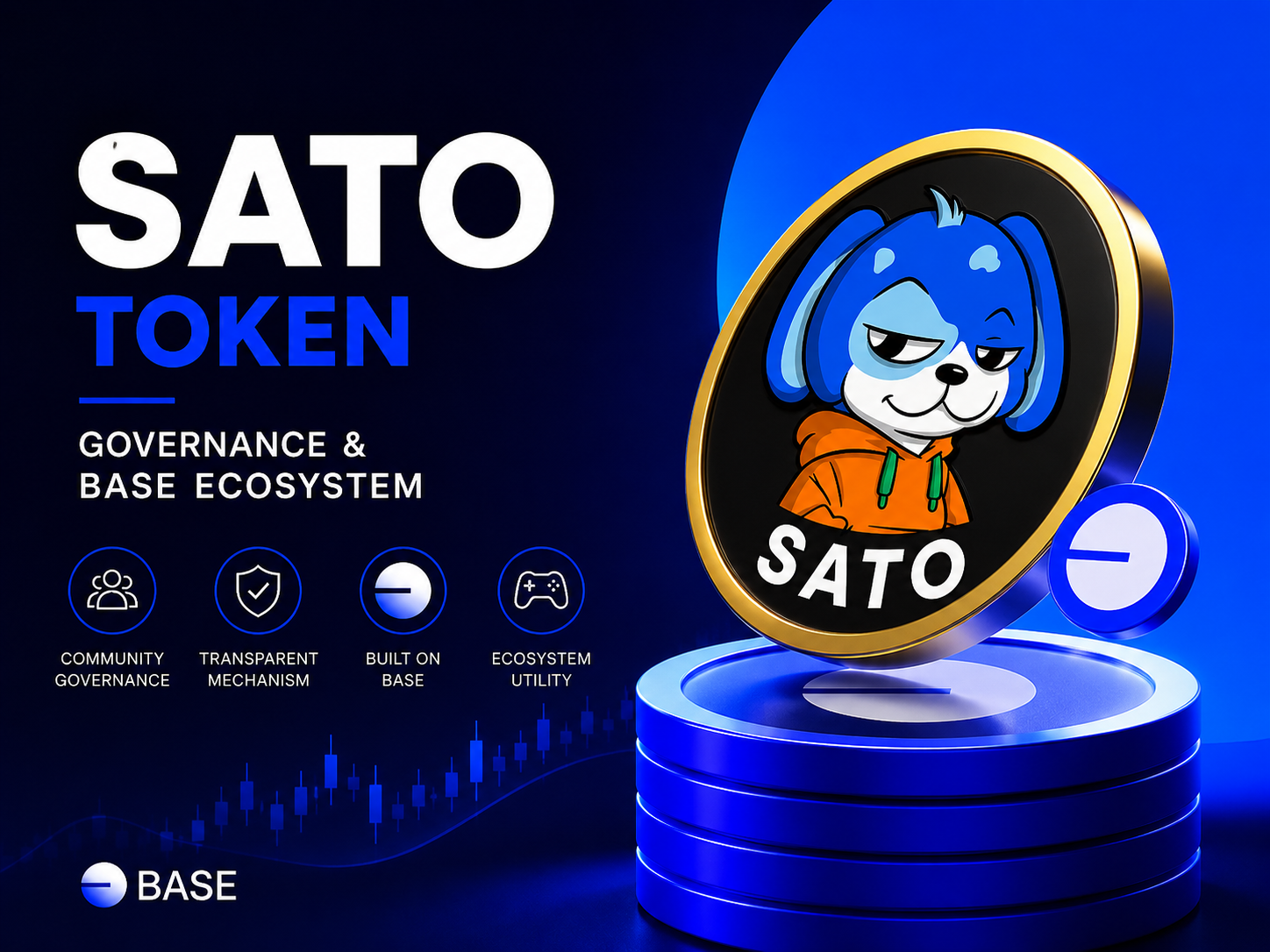
What Is the SATO Token
At its core, the SATO token represents the Base meme ecosystem following the Sato The Dog community takeover. Built on the Base network, SATO is positioned as a community-driven meme coin, rather than a project token under the long-term control of a single team.
SATO’s value proposition is rooted in community consensus, on-chain circulation, and active ecosystem participation. According to official sources, SATO was initially launched as a meme coin. After the original development team ceased operations, community members assumed control, rebuilding the ecosystem around transparent governance, grassroots outreach, and on-chain applications.
SATO serves as the foundational on-chain asset for the Sato The Dog community. By holding and using SATO, users can participate in trading, community events, NFT culture, and future application development within the Base ecosystem. Rather than serving a single function, SATO acts as a gateway for community collaboration and ecosystem engagement.
This design is significant in that it transforms SATO from a simple narrative asset into a tool for community organization. Its essence is not rooted in complex protocol yields, but in sustained engagement enabled by open supply, community governance, and on-chain interaction on Base.
How Is SATO’s Supply Structured
SATO’s supply structure is built on complete circulation with no hidden allocations. The official website states SATO’s total supply is 420.69B, with 100% in circulation on the Base network. The site also highlights a 0% buy tax, 0% sell tax, Ownership Renounced, and Liquidity Burnt.
The white paper further clarifies that SATO has no team wallet, no mint function, and no dev tax. This means there are no traditional minting rights or hidden tax structures reserved for the development team.
| Item |
Data or Mechanism |
| Network |
Base |
| Total Supply |
420.69B SATO |
| Circulating Supply |
100% |
| Buy/Sell Tax Rate |
0% buy tax, 0% sell tax |
| Mint Function |
None |
| Dev Wallets |
None |
This supply structure demonstrates that SATO’s token distribution is community-centric, not based on team reserves or private allocations. With all tokens already in circulation, future ecosystem growth relies on community resource coordination, rather than incentives from additional token issuance.
What Does SATO’s 0% Tax Rate Mean
SATO’s 0% tax rate means users pay no additional contract-imposed trading taxes when buying or selling the token. For meme coins, the trading tax rate directly impacts user entry and exit costs, market liquidity, and overall trading experience.
With a 0% tax rate, on-chain transactions incur no extra friction. When users trade SATO on a DEX or other supported platforms, costs are limited to network fees, slippage, and liquidity depth—not extra taxes from the project contract. The official website clearly states SATO’s taxes as 0% buy and 0% sell.
Here’s how it works: users initiate SATO trades on the Base network; transactions are matched through the relevant liquidity pool; the contract does not deduct extra project taxes for buying or selling. As a result, users’ trade outcomes directly reflect market price, slippage, and liquidity.
This mechanism is important because it eliminates hidden fee structures and positions SATO as a straightforward meme coin. For community-led projects, a 0% tax rate also helps reduce concerns about contract complexity.
What Is the Role of Liquidity Burn and Ownership Renounced
Liquidity burn and Ownership Renounced are mechanisms designed to reduce centralized control by the project team over token trading and contract permissions. SATO’s official website confirms that liquidity has been burnt and ownership renounced—two common strategies to enhance meme coin transparency.
Liquidity burn removes project control over a portion of liquidity, preventing the team from withdrawing it at will. Ownership Renounced means contract ownership has been relinquished, so the project team cannot change core parameters via owner privileges. Together, these mechanisms minimize single-party intervention in token rules.
In practice: the project deploys the token contract and establishes liquidity; liquidity control is burned or removed; contract ownership is renounced. Ultimately, SATO’s trading environment is governed by market forces and community activity, not by subsequent project team intervention.
While this structure does not eliminate risk, it does strengthen transparency. For community-driven meme coins, liquidity burn and renouncing ownership support the “community-owned” narrative.
How Does SATO Participate in Community Governance
SATO and community governance are primarily realized through Woof DAO, community voting, multisig treasury, and proposal mechanisms. The white paper states that SATO’s treasury is managed by a multisig wallet, with key decisions shared publicly and the community voting on strategic direction.
Structurally, SATO is not a traditional corporate project, but a collaborative meme ecosystem. Woof DAO coordinates governance, and while it is not yet fully formalized, the community is already advancing governance through multisig, open communication, and voting.
In practice: community members discuss ecosystem development, events, NFTs, or outreach; multisig members coordinate treasury use based on consensus; the community participates in decision-making through voting or proposals. Ultimately, governance outcomes shape SATO’s resource allocation and community operations.
This governance model is significant because it extends SATO’s narrative beyond trading, linking it to community management and ecosystem collaboration. The relationship between token holders and community members is the foundation for the project’s ongoing success.
What Are SATO’s Use Cases in the Base Ecosystem
Within the Base ecosystem, SATO is primarily used for trading, community identity, NFT culture, and on-chain interaction. Its utility does not rely on complex protocols, but on the Base network’s ability to support community participation and meme proliferation.
The official website shows that SATO can be traded on Uniswap (Base) and accessed via centralized exchanges like GroveX. The site also highlights SATO NFTs and Base Arena—a mini soccer game experience developed in partnership with Krypto Cock Coin.
Ecosystem use cases include token trading, community events, NFT identity, meme content sharing, and gamified engagement. Users acquire SATO on Base, participate in community, NFT, or Base Arena activities, and enhance ecosystem vitality through content and on-chain actions. Ultimately, SATO becomes a gateway to Base meme culture participation.
These scenarios illustrate that SATO functions as a community cultural asset, not just a utility token. Its value comes from community engagement, content distribution, and on-chain interaction within the Base ecosystem.
What Are the Limitations of SATO’s Token Mechanism
SATO’s limitations stem from its meme coin nature, uncertain community governance, and evolving use cases. While the 0% tax, liquidity burn, and absence of a mint function enhance transparency, they also mean the project lacks traditional token-based incentive tools.
SATO has no dev wallets or mint function, so the community cannot quickly create incentive pools via new token issuance. The white paper also notes that early staking programs have ended, and with all tokens in circulation, there are no plans for new staking initiatives.
This structure reduces risks of hidden allocations and excessive minting, but also means ecosystem growth depends on grassroots collaboration, treasury management, and external partnerships. If community engagement wanes, SATO’s expansion and governance efficiency may suffer.
As such, SATO is best understood as a community-led meme coin. Its priorities are transparency, fair circulation, and community autonomy, rather than complex yield models or mature application ecosystems.
Summary
SATO’s primary roles are on-chain circulation on Base, community governance, NFT culture, and ecosystem interaction. It’s not a token built around complex protocols, but a foundational asset shaped by the Sato The Dog community takeover.
In terms of supply, SATO has a total of 420.69B tokens, all in circulation, with 0% buy/sell tax, no mint function, no dev wallets, liquidity burned, and ownership renounced.
Ecosystem-wise, SATO participates in community building through Woof DAO, proposals, multisig treasury, NFTs, and Base Arena. Its strengths are transparency and community autonomy, while its limitations are that functional expansion and long-term sustainability depend heavily on community collaboration.
FAQ
What is the SATO token
SATO is a Base meme coin within the Sato The Dog ecosystem, supporting community circulation, governance, NFT culture, and on-chain interaction. After the community takeover, holders and community members jointly drive the ecosystem.
What is SATO’s total supply
SATO’s official total supply is 420.69B, with 100% in circulation. The white paper confirms there is no mint function or dev wallets.
Does SATO have trading taxes
Both buy and sell taxes for SATO are 0%. Users pay no additional buy/sell taxes to the project contract; trading costs stem from network fees, slippage, and liquidity.
What is the purpose of SATO’s Ownership Renounced
Ownership Renounced means the contract is no longer owned by the project team, preventing further changes to core contract parameters. This reduces the risk of centralized control.
How does SATO participate in community governance
SATO’s governance operates through Woof DAO, multisig treasury, community voting, and collaborative proposals. Community members can discuss ecosystem development, resource allocation, and event direction.
What are SATO’s use cases in the Base ecosystem
SATO is used for on-chain trading, community engagement, NFT culture, and interactive experiences like Base Arena. It functions more as a community cultural asset than a single-purpose protocol token.