Open-source software forms the core of modern internet infrastructure, from cloud services and AI frameworks to blockchain projects, all relying on contributions from the global developer community. However, traditional donation and sponsorship models often fail to accurately measure contribution value, leaving key projects without sustainable incentives.
Tea Protocol and Gitcoin are two representative open-source incentive platforms. They attempt to convert development contributions into economic incentives through different mechanisms, but they differ significantly in how they measure value, distribute rewards, and engage the community.
What Is Tea Protocol?
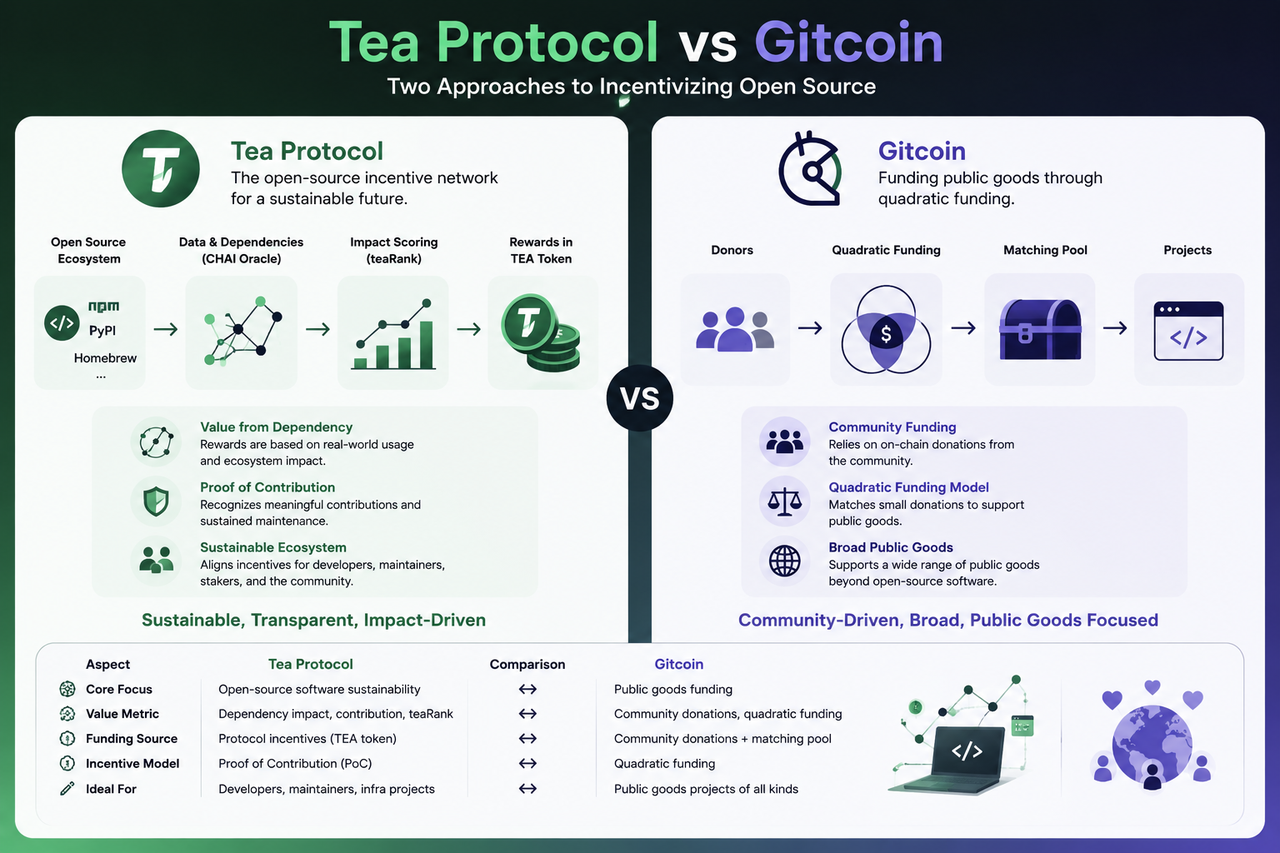
Tea Protocol, as a decentralized incentive protocol for open-source software, establishes a sustainable value distribution system for developers and maintainers through Proof of Contribution, the teaRank reputation system, and on-chain reward mechanisms. It emphasizes the actual ecosystem value of contributions and automatically allocates rewards based on a project's importance in the software supply chain.
Core Features:
- Contribution Quantification: Measures the true influence of developers and projects through PoC and teaRank
- Automated Incentives: Rewards are distributed based on contribution and ecosystem importance
- Software Supply Chain Security: Evaluates dependencies to improve critical infrastructure security
- On-Chain Governance: TEA Token holders participate in protocol decisions
What Is Gitcoin?
Gitcoin, an open-source incentive platform centered on public goods funding, allocates funds through community donations and Quadratic Funding. Its goal is to encourage developers and project teams to contribute to public goods, especially projects with long-term value to society or the technical community.
Core Features:
- Community Funding: Magnifies the impact of small donations through Quadratic Funding
- Public Goods Orientation: Supports open-source projects in software, education, infrastructure, and more
- Contribution Incentives: Project activity and funding volume jointly influence rewards
- Community Participation: Developers and donors jointly determine project funding allocation
Comparison of Incentive Sources: Tea Protocol vs. Gitcoin
| Dimension |
Tea Protocol |
Gitcoin |
| Incentive Mechanism |
Proof of Contribution + teaRank |
Quadratic Funding + Community Donations |
| Reward Trigger |
Open-source contributions and ecosystem influence |
Community donations and voting |
| Automation Level |
High, on-chain automatic reward calculation |
Medium, relies on donations and voting |
| Ecosystem Focus |
Software supply chain value |
Public goods contributions |
| Reward Recipients |
Developers, maintainers, security researchers |
Developers, project teams |
Comparison of Contribution Evaluation Mechanisms: Tea Protocol vs. Gitcoin
Tea Protocol focuses on quantifying the value of each contribution within the entire software ecosystem by analyzing project dependencies and maintenance behavior. Gitcoin primarily relies on community voting and funding allocation to measure project value, depending more on external perception and community consensus.
Comparison of Fund Allocation Methods: Tea Protocol vs. Gitcoin
Tea Protocol rewards are automatically distributed based on contribution records and ecosystem impact, emphasizing the value of long-term contributions. Gitcoin rewards are based on community funding and Quadratic Funding amplification, relying more on fund flow and community choice.
Comparison of Governance Models: Tea Protocol vs. Gitcoin
Tea Protocol uses TEA Token for on-chain governance, with holders participating in protocol upgrades and incentive parameter adjustments. Gitcoin’s governance relies more on platform management and community collaboration and is not yet fully on-chain.
Summary
Both Tea Protocol and Gitcoin aim to solve the incentive and sustainability issues of open-source software, but they differ in their starting points and implementation methods. Tea Protocol emphasizes quantification of contributions and on-chain automated distribution, while Gitcoin focuses on community funding and public goods orientation.
FAQs
What is the main difference between Tea Protocol and Gitcoin?
Tea Protocol focuses on quantifying open-source contributions and ecosystem impact, with rewards automatically distributed; Gitcoin focuses on community funding and public goods contributions, with rewards depending on funding and voting.
Which model is more suitable for long-term project maintenance?
Tea Protocol is more suitable for long-term project maintenance because its rewards are tied to contributions and project ecosystem influence, offering stronger sustainability.
How does Tea Protocol measure contribution value?
Through Proof of Contribution and the teaRank system, it evaluates the value of projects and developers by analyzing software dependency relationships and contribution history.
Where do Gitcoin rewards mainly come from?
Gitcoin rewards come primarily from community donations, with the impact of small donations amplified through Quadratic Funding.
What is the difference in governance mechanisms between the two platforms?
Tea Protocol uses on-chain governance with TEA Token for decision-making; Gitcoin relies on community collaboration and platform management, resulting in a more centralized governance model.
Source (for reference only):
开源软件构成了现代互联网基础设施的核心部分,从云服务、AI 框架到区块链项目,都依赖全球开发者社区的贡献。然而,传统捐赠和赞助模式往往难以准确衡量贡献价值,导致关键项目缺乏可持续激励。
Tea Protocol 和 Gitcoin 是两种代表性开源激励平台。它们试图通过不同机制将开发贡献转化为经济激励,但在价值衡量方式、奖励分配逻辑以及社区参与模式上存在显著区别。
Tea Protocol 是什么
Tea Protocol 作为面向开源软件的去中心化激励协议,通过 Proof of Contribution(贡献证明)、teaRank 声誉评分系统和链上奖励机制,为开发者和维护者建立可持续价值分配体系。它强调贡献的实际生态价值,并自动根据项目在软件供应链中的重要性分配奖励。
核心特点:
Gitcoin 是什么
Gitcoin 作为一个以公共物品资助为核心的开源激励平台,通过社区捐赠和 Quadratic Funding 模式分配资金。其目标是鼓励开发者和项目团队贡献公共物品,尤其是对社会或技术社区具有长期价值的项目。
核心特点:
Tea Protocol 和 Gitcoin 的激励来源对比
| 维度 |
Tea Protocol |
Gitcoin |
| 激励机制 |
Proof of Contribution + teaRank |
Quadratic Funding + 社区捐赠 |
| 奖励触发 |
开源贡献与生态影响力 |
社区资金捐赠与投票 |
| 自动化程度 |
高,链上自动计算奖励 |
中,需依赖捐赠和投票 |
| 生态关注点 |
软件供应链价值 |
公共物品贡献 |
| 奖励对象 |
开发者、维护者、安全研究员 |
开发者、项目团队 |
Tea Protocol 和 Gitcoin 的贡献评估机制对比
Tea Protocol 更侧重对每个贡献在整个软件生态中的价值进行量化,分析项目依赖关系和维护行为。Gitcoin 则主要依靠社区投票和资助分配来衡量项目价值,更依赖外部认知和社区共识。
Tea Protocol 和 Gitcoin 的资金分配方式对比
Tea Protocol 奖励根据贡献记录和生态影响自动分配,强调长期贡献的价值。Gitcoin 奖励基于社区资助和 Quadratic Funding 放大机制,更多依赖资金流向和社区选择。
Tea Protocol 和 Gitcoin 的治理模式对比
Tea Protocol 通过 TEA Token 进行链上治理,持有者参与协议升级和激励参数调整。Gitcoin 的治理更多依赖平台管理和社区协作,尚未全面链上化。
总结
Tea Protocol 和 Gitcoin 都在尝试解决开源软件的激励和可持续性问题,但出发点和实现方式不同。Tea Protocol 更强调贡献的量化和链上自动化分配,而 Gitcoin 注重社区资助和公共物品导向。
FAQs
Tea Protocol 和 Gitcoin 的主要区别是什么?
Tea Protocol 注重量化开源贡献和生态影响,奖励自动分配;Gitcoin 注重社区资助和公共物品贡献,奖励依赖资金和投票。
哪种模式更适合长期项目维护?
长期项目维护更适合 Tea Protocol,因为其奖励与贡献和项目生态影响力挂钩,可持续性更强。
Tea Protocol 如何衡量贡献价值?
通过 Proof of Contribution 和 teaRank 系统,结合软件依赖关系和贡献历史评估项目和开发者的价值。
Gitcoin 奖励主要来源于哪里?
Gitcoin 奖励主要来自社区捐赠,并通过 Quadratic Funding 放大小额捐赠的影响力。
两个平台的治理机制有何不同?
Tea Protocol 使用链上治理和 TEA Token 决策,Gitcoin 依赖社区协作和平台管理,治理模式更加集中化。