Discussions about the role of HPP generally focus on three core aspects: whether the HPP token has genuine utility, how network participants earn returns through their contributions, and whether the tokenomics can sustainably support the protocol.
This question can be analyzed from six dimensions: HPP token functionality, fee model, incentive structure, governance rights, staking mechanism, and allocation data. Among these, the allocation structure is a key foundation for evaluating tokenomics. According to official disclosures, the total HPP token supply is 1,700,000,000, with allocations spanning Instant Swap, Ecosystem, Community, Reserve, Team/Advisors, and Investors.
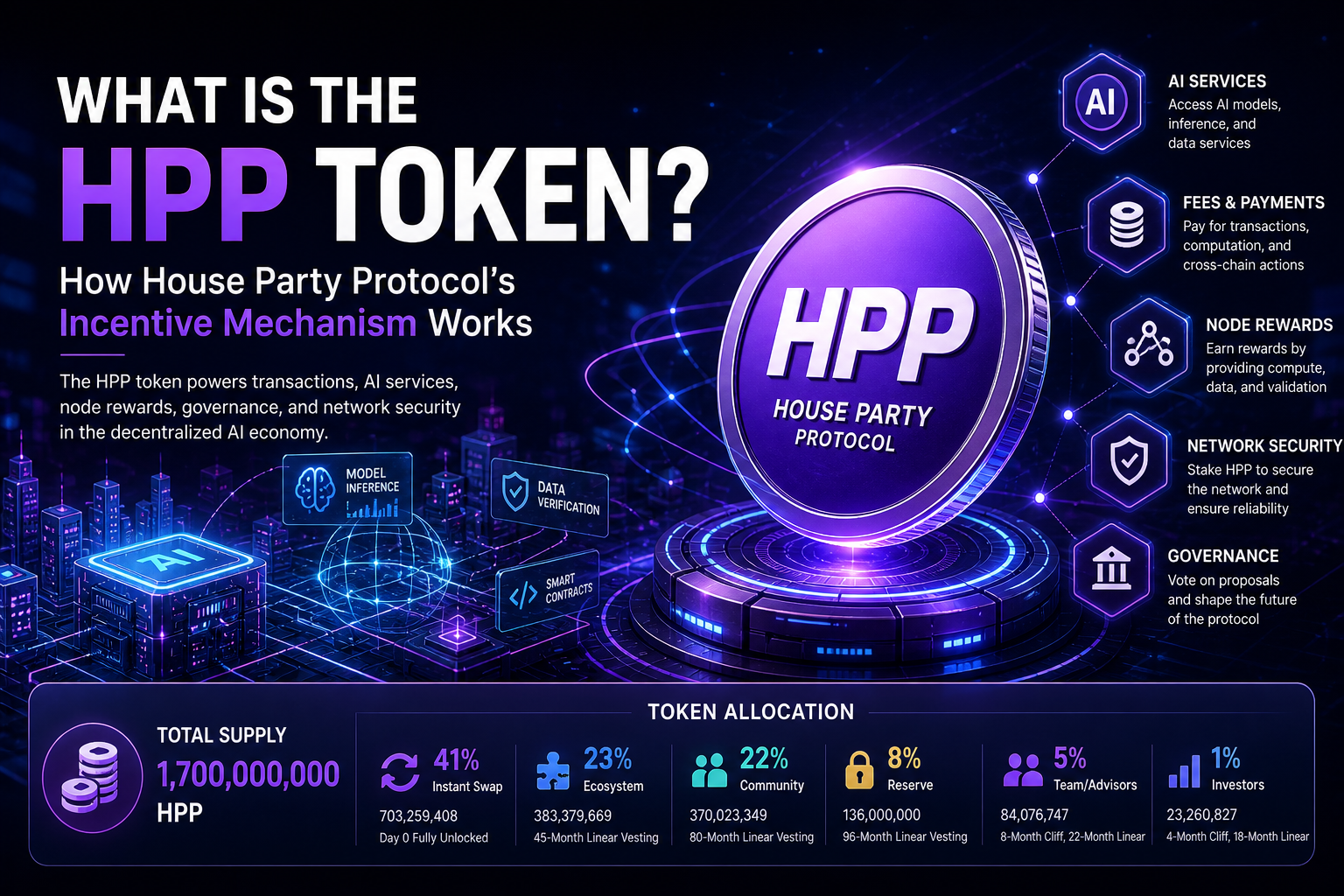
What Is the HPP Token
The HPP token is the native utility token of the House Party Protocol mainnet. Its primary role is to serve as a unified settlement medium for AI model deployment, inference tasks, Smart Contract execution, data verification, and cross-chain operations.
The HPP token is more than just a payment instrument—it is the foundational asset that connects AI services, on-chain actions, and ecosystem participants. Users pay HPP to initiate AI inference, request data verification, or use on-chain services within the HPP network. The system then allocates resources according to the service type, such as hash power, model validation, or cross-chain interactions. Fees are funneled into the network’s incentive system, rewarding validators, compute nodes, and service providers. As a result, the HPP token enables value circulation throughout the protocol.
This architecture directly links HPP token demand to actual network activity, binding AI service consumption and blockchain operations to a single token model. All AI model deployment, inference, Smart Contract execution, data verification, and cross-chain interactions on the HPP mainnet require transaction fees—paid by default in HPP.
Core Functions of the HPP Token
The HPP token’s core functions are network fees, service access, ecosystem settlement, and governance participation. In the AI protocol, HPP serves as Gas, payment asset, access credential, and governance tool.
Developers and users pay HPP for AI inference, model hosting, data verification, and Smart Contract execution. Ecosystem partners and native applications unlock services—such as training datasets, AI asset valuation, and model verification tools—using HPP. Users settle subscriptions, inference, and data services in modules like ArenAI and Noösphere with HPP. This establishes a unified payment and access framework across the ecosystem.
| Function Category |
Specific Use |
Application Scenario |
| Network Fee |
Pay mainnet transaction fees |
Inference, contracts, cross-chain |
| Service Access |
Access AI and data tools |
Datasets, model verification |
| Ecosystem Settlement |
Pay for subscriptions and usage |
ArenAI, Noösphere |
| Governance Participation |
Proposals and voting |
Protocol upgrades, standards selection |
| Security Staking |
Serve as margin |
Validation, service commitment |
This table demonstrates that HPP’s utility spans network operations, AI services, governance, and security. The white paper summarizes its use cases as network access and rights, incentive alignment and revenue sharing, governance and ecosystem participation, and cryptoeconomic security and staking.
HPP Incentive Mechanism and Node Rewards
The HPP incentive mechanism rewards real service contributions, enabling compute nodes, model developers, data validators, and service providers to earn returns based on their contributions.
The process begins when users or developers initiate AI service requests—such as model inference, data verification, or synthetic data generation. The system allocates the necessary compute resources, data services, or validation processes. Fees are distributed among participants—node operators, model developers, and data validators—according to their contributions. Ultimately, contributors are rewarded with HPP, creating ongoing economic incentives for network participation.
According to House Party Protocol’s official documentation, developers pay for AI inference, data verification, and synthetic generation services based on actual usage. When dApps generate revenue through subscriptions or analytics tools, a portion is shared with compute node operators, model developers, and data validators.
This model directly links token incentives to productive output, rather than static allocation. For AI protocols, the alignment of node rewards with effective computation, accurate validation, and data quality is critical for sustainable network services.
HPP Fee Payment and Compute Market
The HPP fee payment model is fundamentally pay-as-you-go for AI services—a decentralized compute market where users pay only for the models, data, or validation they use.
Users select the AI service they need—off-chain inference, risk scoring, model validation, or data access. The system matches the appropriate resources, including Noösphere’s off-chain compute, ArenAI’s strategy affiliate, or data validation services. Users pay in HPP, and the network assigns tasks to the appropriate participants. Results are returned to the user, and fees are distributed based on contribution.
HPP supports usage-based payments for AI inference and model hosting, allowing developers and enterprises to deploy models and run inference tasks on demand, paying only for the compute resources consumed. This model ties AI service fees directly to resource usage, reducing inefficiencies and improving allocation.
As a result, HPP token demand is driven by AI service usage, data validation needs, dApp subscriptions, and cross-chain activity. The more active the network, the more essential HPP becomes for payments and settlement.
HPP Governance Mechanism and Token Utility
HPP’s governance mechanism empowers token holders to participate in protocol decisions—coordinating network parameters, AI standards, protocol upgrades, and ecosystem direction.
Beyond payments, the HPP token is also a governance instrument for the AI alliance ecosystem. Token holders can submit proposals on protocol upgrades, AI standards, or strategic issues. The community votes, and the protocol implements changes based on governance results—such as adjusting token mechanisms, selecting interoperability frameworks, or filtering ArenAI strategy providers. Governance outcomes shape protocol rules and resource allocation.
The House Party Protocol white paper specifies that HPP, as the ecosystem’s governance token, enables holders to take part in adopting new AI standards or protocol upgrades, adjusting token mechanisms, submitting and voting on strategic proposals, and selecting ArenAI strategy providers.
This model links token holding to protocol participation, giving ecosystem members a direct voice in network governance. The effectiveness of governance, however, depends on participation rates, transparency, and proposal execution.
HPP Incentive Mechanism and Network Security
HPP network security relies on staking, validation, and penalty enforcement. Key participants are required to stake HPP, binding service quality to economic accountability.
Model trainers, data providers, or validators must stake HPP as a performance bond. They then perform inference validation, data certification, or service delivery tasks. The protocol evaluates their performance—rewarding accuracy, timeliness, and neutrality. Failure to meet service standards can result in penalties or slashing of staked tokens.
HPP is used for staking in critical protocol operations, particularly in Proof-of-Inference systems. Validators stake tokens to verify data and AI model reliability, earning rewards for upholding trust, accuracy, and accountability in the AI infrastructure. Those who fail to meet service agreements may be penalized.
Token allocation also shapes network security and incentive cycles. The total HPP supply is 1,700,000,000, with 703,259,408 (41%) for Instant Swap; 383,379,669 (23%) for Ecosystem; 370,023,349 (22%) for Community; 136,000,000 (8%) for Reserve; 84,076,747 (5%) for Team/Advisors; and 23,260,827 (1%) for Investors. Ecosystem and Community together account for 45%—representing 76% of new token issuance—demonstrating a long-term commitment to ecosystem development and community participation.
| Allocation Category |
Amount |
Percentage |
Unlock Schedule |
| Instant Swap |
703,259,408 |
41% |
Fully unlocked on Day 0 for legacy token holders |
| Investors |
23,260,827 |
1% |
4-month lock-up, 18-month linear release |
| Reserve |
136,000,000 |
8% |
96-month linear release |
| Team/Advisors |
84,076,747 |
5% |
8-month lock-up, 22-month linear release |
| Ecosystem |
383,379,669 |
23% |
45-month linear release |
| Community |
370,023,349 |
22% |
80-month linear release |
This allocation structure features a high initial release and long-term unlocking for ecosystem, community, and reserve allocations. In the short term, circulating supply is mainly from Instant Swap, while long-term incentives are driven by ongoing releases to the ecosystem, community, and reserve.
Summary
The HPP token in House Party Protocol is used for fee payments, service access, node incentives, governance participation, and network security. Its operational logic centers on AI service requests, system resource allocation, HPP fee payments, service contribution distribution, and staking-based security.
HPP’s total supply is 1,700,000,000, with 45% allocated to ecosystem and community, 41% to Instant Swap, and the remainder to reserve, team/advisors, and investors with various unlock schedules. Overall, HPP’s utility is closely tied to AI computation, data validation, model services, governance, and the Proof-of-Inference security framework.
FAQ
What is the HPP token?
The HPP token is the native utility token of the House Party Protocol network, used for paying mainnet fees, accessing AI services, governance participation, staking, and supporting network activities such as AI inference, data validation, and cross-chain operations.
What is the total supply of HPP tokens?
According to official data, the total supply of HPP tokens is 1.7 billion.
How are HPP tokens allocated?
HPP tokens are allocated as follows: 41% to Instant Swap, 23% to Ecosystem, 22% to Community, 8% to Reserve, 5% to Team/Advisors, and 1% to Investors. Ecosystem and Community together account for 45%.
How are HPP tokens used for node rewards?
HPP incentivizes compute nodes, model developers, data validators, and validators through usage fees, revenue sharing, and staking rewards. Participants earn returns based on their compute, validation, or data services.
What is the relationship between HPP tokens and network security?
HPP maintains network security through a staking mechanism. Validators and service participants must stake tokens to participate in critical network operations, earning rewards for accurate performance and facing penalties for failing to meet service standards.







