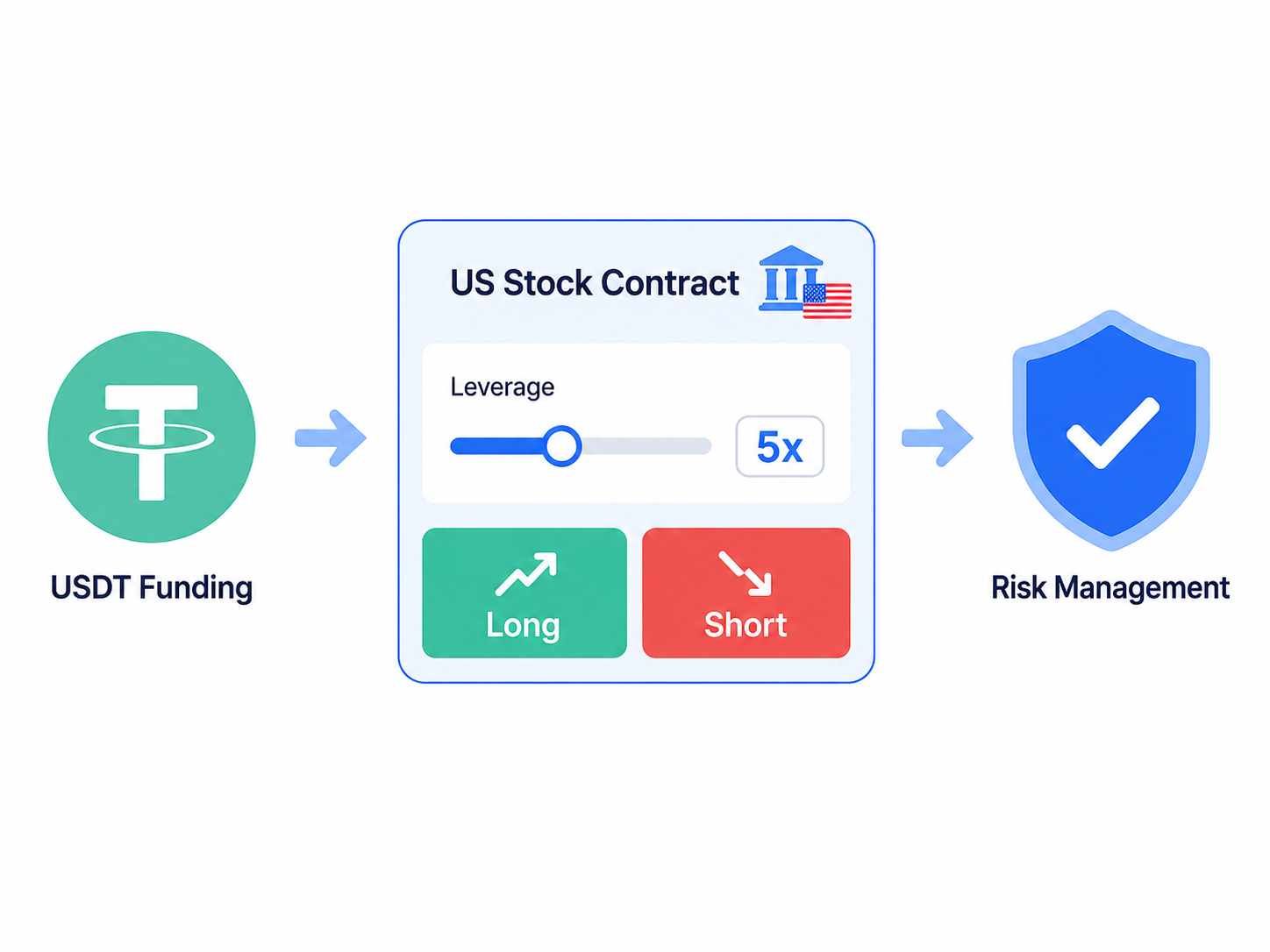
Gate US stock contract leverage is a trading mechanism used for gaining amplified exposure to stock-linked contract products through USDT-settled positions.
Gate’s US stock-related products matter because crypto users increasingly look for ways to access traditional market exposure through digital-asset infrastructure. Gate Stocks focuses on USDT-based access to stocks and ETFs, while Gate xStock-style contract products connect stock price exposure with tokenized and contract-based trading rails.
The digital asset value comes from using USDT as a settlement asset, bringing stock-linked exposure into a crypto account environment, and showing how real-world assets can move closer to Web3 market infrastructure. This structure also creates a need for careful product separation, because spot stock access, tokenized stocks, CFDs, and leveraged contracts do not carry the same rights, costs, or risks.
What Are Gate US Stock Products?
Gate US stock products refer to different ways eligible users may access stock or ETF exposure through Gate’s crypto account environment. The most important distinction is between Gate Stocks spot trading and leveraged stock-linked contract products.
On the spot side, Gate Stocks is described as a USDT-based service for accessing supported stocks and ETFs. The product page states that users can trade global stock assets with USDT, start from 0.01 shares, and use a stock account without opening a separate overseas brokerage account. It also states that market access is powered by Alpaca’s regulated brokerage infrastructure.
On the contract side, Gate xStock is described as a tokenized stock contract area where stock price exposure is mapped into crypto trading infrastructure. Gate Learn describes these products as USDT-settled contracts that can support long and short positions with 1x to 10x leverage. That makes them very different from simple stock or ETF spot purchases.
This distinction is the foundation of safe product understanding. A user looking at USDT buying US stocks may be thinking about stock spot access, while a user searching for stock contract leverage is dealing with margin, direction, liquidation risk, and contract rules.
Gate Stocks vs Gate xStock: What Is the Difference?
Gate Stocks spot trading and Gate xStock-style contracts may both relate to stock prices, but they are not the same product structure. Spot trading focuses on buying and selling supported stocks or ETFs with USDT, while stock contracts focus on trading price exposure through a leveraged contract.
| Feature |
Gate Stocks Spot |
Gate xStock / Stock Contract Exposure |
| Product structure |
Stock and ETF spot access |
Tokenized stock contract exposure |
| Settlement asset |
USDT |
USDT |
| Leverage |
Not the core product feature |
Gate Learn describes 1x to 10x leverage |
| Direction |
Buy and sell spot holdings |
Long or short positions |
| Ownership wording |
Product page states users own the stocks or ETFs purchased |
Tracks stock price exposure through contract products |
| Main user focus |
Accessing supported stocks and ETFs with USDT |
Trading amplified stock-linked exposure |
| Main risk area |
Market risk, product rules, settlement, regional eligibility |
Leverage risk, liquidation risk, liquidity, product structure |
The table shows why users should not treat all USDT-based stock products as interchangeable. A spot stock position and a leveraged contract position may reference a similar underlying stock price, but the account process, rights, risk exposure, and loss mechanics can differ significantly.
How Does Gate US Stock Contract Leverage Work?
Gate US stock contract leverage works by allowing a user to control a larger stock-linked contract exposure than the margin amount used to open the position. For example, 5x leverage means the position exposure is five times the margin committed, although actual platform rules, margin requirements, and liquidation conditions depend on the specific product.
Leverage changes the risk profile. A small price move in the underlying stock-linked contract can have a larger effect on the user’s margin. This can amplify profitable and unprofitable outcomes, but the educationally important point is risk: leverage reduces the distance between price movement and forced position closure.
Long and short directions add another layer. A long position is generally aligned with upward price movement in the referenced asset, while a short position is generally aligned with downward price movement. Neither direction removes risk. If the market moves against the position, margin can decline quickly.
Gate xStock products are also connected to the broader idea of US stock spot vs futures, because spot exposure and contract exposure serve different purposes. Spot positions usually emphasize direct asset exposure, while futures and contract products add margin, leverage, and directional trading mechanics.
How to Use Gate US Stock Contract Leverage Step by Step
Using Gate US stock contract leverage begins with identifying the exact product type. A user should confirm whether the screen shows Gate Stocks spot trading, Gate xStock, stock futures, or another contract-based product before placing any order.
First, check eligibility and account requirements. Product availability may vary by region, account status, KYC level, and current platform rules. A user should review official product pages, terms, fee information, and risk disclosures before using any stock-linked product.
Second, fund the relevant account with USDT. Gate Stocks uses USDT as the settlement asset for stock and ETF spot access, and Gate xStock-style contracts are also described as USDT-settled. The user still needs to confirm which account balance is required for the chosen product, such as a stock account, spot account, unified account, futures account, or contract account.
Third, choose the product carefully. If the goal is to buy supported stocks or ETFs without leverage, Gate Stocks spot is structurally different from a leveraged contract. If the product page includes leverage, margin, long or short direction, liquidation price, or contract terms, it should be treated as a leveraged product.
Fourth, select direction, margin, leverage, and order details. A user should understand how order type, entry price, position size, margin mode, leverage setting, and fees interact. If the product only supports limited order types, execution risk may be higher during volatile periods.
Fifth, monitor the position after opening. Leveraged positions require ongoing attention to margin ratio, liquidation level, unrealized profit or loss, funding or holding costs where applicable, and market liquidity. A stock-linked contract can move quickly around earnings, macro data, company news, or changes in broader market sentiment.
| Step |
User Action |
Key Check |
| 1 |
Confirm eligibility |
Region, KYC, account access, product terms |
| 2 |
Fund with USDT |
Correct account balance and transfer path |
| 3 |
Identify product type |
Spot stock, tokenized stock, CFD, futures, or contract |
| 4 |
Choose direction and leverage |
Long or short exposure, margin, liquidation level |
| 5 |
Place order |
Order type, quantity, fees, execution conditions |
| 6 |
Monitor position |
Margin ratio, price movement, liquidity, exit rules |
This process is not a trading recommendation. It is a risk-aware operating framework for understanding how product selection, account setup, and margin monitoring fit together.
Key Risks Before Using Gate US Stock Contract Leverage
Gate US stock contract leverage carries higher risk than basic spot access because leverage magnifies market movement. A user can experience rapid margin loss if the referenced stock-linked contract moves against the position.
Market risk is the first concern. US stocks and ETFs can move because of earnings, interest-rate expectations, inflation data, sector news, company-specific events, or broader liquidity conditions. Leverage does not reduce market risk. It concentrates it.
Liquidation risk is the second concern. If margin falls below required levels, a leveraged position may be reduced or closed according to product rules. This can happen during fast market moves, gaps, low liquidity, or sudden volatility.
Product-structure risk is equally important. Gate Stocks economic rights and shareholder rights are a separate topic from tokenized stock contracts. A product that tracks a stock price does not automatically provide the same rights, protections, or corporate-action treatment as direct stock ownership.
USDT and digital-asset risks also remain. Using USDT can simplify settlement inside a crypto platform, but stablecoins and crypto account infrastructure can involve liquidity, operational, counterparty, technical, and regulatory risks. Users should also review the applicable risk disclosure and product terms.
Execution risk can appear when the displayed price and final execution price differ. This may matter more during high volatility, low liquidity, or market events. For leveraged contracts, execution differences can affect margin and liquidation distance.
Platform comparison should begin with product structure, not headline fees or asset count. A user comparing platforms for buying US stocks with USDT should first ask whether the product is real-stock spot access, a tokenized stock, a CFD, a futures contract, or another derivative.
The next factor is rights and settlement. Some products may give economic exposure to price movement, while others may describe stock or ETF ownership through a brokerage infrastructure. Gate Stocks vs brokers vs stock CFDs is a useful comparison context because brokers, spot access models, CFDs, and tokenized contracts may look similar on the surface but differ legally and operationally.
Fees should be reviewed beyond the visible trading fee. A platform comparison may include spreads, custody-related costs, funding charges, withdrawal fees, conversion costs, overnight costs, and liquidation-related rules. For leveraged contracts, the cost of keeping a position open can matter as much as the entry fee.
Liquidity and trading hours also matter. A product that trades around the clock may still have periods of thinner liquidity. A product tied to US equities may also be affected by US market hours, corporate announcements, and market closures, even if the crypto interface remains accessible.
| Comparison Factor |
Why It Matters |
What Users Should Verify |
| Product structure |
Defines ownership, rights, and risk type |
Stock spot, tokenized stock, CFD, futures, or contract |
| Settlement asset |
Determines funding path |
USDT, USDC, USD, or other assets |
| Leverage |
Changes loss speed and liquidation risk |
Maximum leverage, margin mode, liquidation rules |
| Fees and spreads |
Affects total trading cost |
Trading fee, spread, funding, withdrawal, holding cost |
| Order tools |
Affects execution and risk control |
Market order, limit order, trigger order, stop tools |
| Liquidity |
Affects entry and exit quality |
Depth, slippage, volatile periods |
| Regulation and custody |
Affects legal framework and recourse |
Broker, custodian, jurisdiction, terms |
| Rights and corporate actions |
Affects dividends, splits, voting, and claims |
Product rules and official disclosures |
The safest comparison is factual and product-specific. No platform should be evaluated only by whether it offers USDT settlement or leverage, because the deeper structure determines what the user is actually trading.
Advantages, Limitations, and Common Misconceptions
The main advantage of Gate US stock contract leverage is operational access to stock-linked exposure through USDT-based crypto infrastructure. For users already familiar with contract interfaces, this can reduce the need to move funds through separate fiat and brokerage channels.
Another advantage is directional flexibility. Long and short contract positions can express different market views, while leverage allows exposure sizing beyond the starting margin. This flexibility is exactly why risk controls matter.
The limitations are significant. Leveraged stock contracts are not the same as holding real shares. Product rules may differ for trading hours, fees, margin, liquidation, corporate actions, and account eligibility. Some users may also misunderstand tokenized stock exposure as direct shareholder ownership, which can lead to incorrect assumptions.
A common misconception is that USDT settlement removes all currency and platform risk. It does not. USDT can simplify settlement within the product environment, but it also adds digital-asset infrastructure considerations that do not exist in a conventional cash brokerage account.
Another misconception is that higher leverage is simply a more efficient version of lower leverage. Higher leverage reduces the amount of adverse price movement that can be tolerated before margin becomes stressed. It should be treated as a risk multiplier, not a shortcut.
Summary
Gate US stock contract leverage refers to USDT-settled, stock-linked contract exposure that may support margin, long and short positions, and amplified exposure. It should be clearly separated from Gate Stocks spot trading, where the product page describes USDT-based access to supported stocks and ETFs.
The key user task is product identification. Before trading, users should confirm whether they are using spot stocks, tokenized stocks, CFDs, futures, or leveraged contracts. Each structure has different rights, risks, fees, account requirements, and risk controls.
Leverage can increase both gains and losses, and a position may face liquidation if margin becomes insufficient. Gate US stock contract leverage is therefore mainly a product-education topic, not a recommendation to trade.
This content is for educational purposes only and does not constitute investment advice. Digital assets involve market, liquidity, smart contract, and regulatory risks.
FAQ
What is Gate US stock contract leverage?
Gate US stock contract leverage is a USDT-settled trading mechanism that allows eligible users to gain amplified exposure to stock-linked contract products. It may support long and short positions depending on the specific contract. It is different from buying supported stocks or ETFs through Gate Stocks spot trading.
Is Gate US stock contract leverage the same as Gate Stocks?
Gate US stock contract leverage is not the same as Gate Stocks spot trading. Gate Stocks focuses on USDT-based access to supported stocks and ETFs, while leveraged stock contracts involve margin, direction, and liquidation risk. Users should check the product screen and official rules before placing any order.
Does using USDT mean the user owns real US shares?
Using USDT alone does not determine whether the user owns real US shares. Gate Stocks spot trading and stock-linked contract products can have different structures. Users should verify whether the product describes actual stock or ETF ownership, tokenized exposure, CFD exposure, or contract-based price tracking.
What leverage does Gate xStock support?
Gate Learn describes Gate xStock contracts as USDT-settled products that support 1x to 10x leverage and long or short positions. Leverage limits, available assets, account rules, and risk settings may change, so users should check the current product page before trading.
What are the main risks of Gate US stock contract leverage?
The main risks of Gate US stock contract leverage include market volatility, margin loss, liquidation, liquidity changes, execution differences, USDT-related risks, product-structure risk, and regional availability limits. Leverage can make losses develop faster than in spot trading.
Who should avoid Gate US stock contract leverage?
Gate US stock contract leverage may be unsuitable for users who do not understand margin, liquidation, short selling, order execution, or product terms. It may also be unsuitable for users who cannot actively monitor positions or tolerate rapid losses. Product education should come before any leveraged exposure.







