Against the backdrop of digital assets increasingly converging with traditional finance, crypto platforms are now offering trading access linked to global indices, allowing users to tap into a broader range of market assets through a unified account system. This model is pushing crypto finance beyond single-asset digital trading toward a comprehensive global market infrastructure.
What Are NAS100, SPX500, and US30?
As three of the most representative indices in the U.S. stock market, NAS100, SPX500, and US30 respectively track tech growth stocks, large-cap core assets, and traditional industrial blue-chip companies. They not only reflect the overall health of the U.S. capital market but are also widely regarded as key barometers for global risk assets.
NAS100 typically follows the largest non-financial tech companies on the Nasdaq, covering sectors like artificial intelligence, cloud computing, semiconductors, and internet platforms. For a deeper understanding of how tech indices operate, check out "What Is NAS100? A Comprehensive Guide to Its Composition, Calculation, and Role in the Financial Ecosystem."
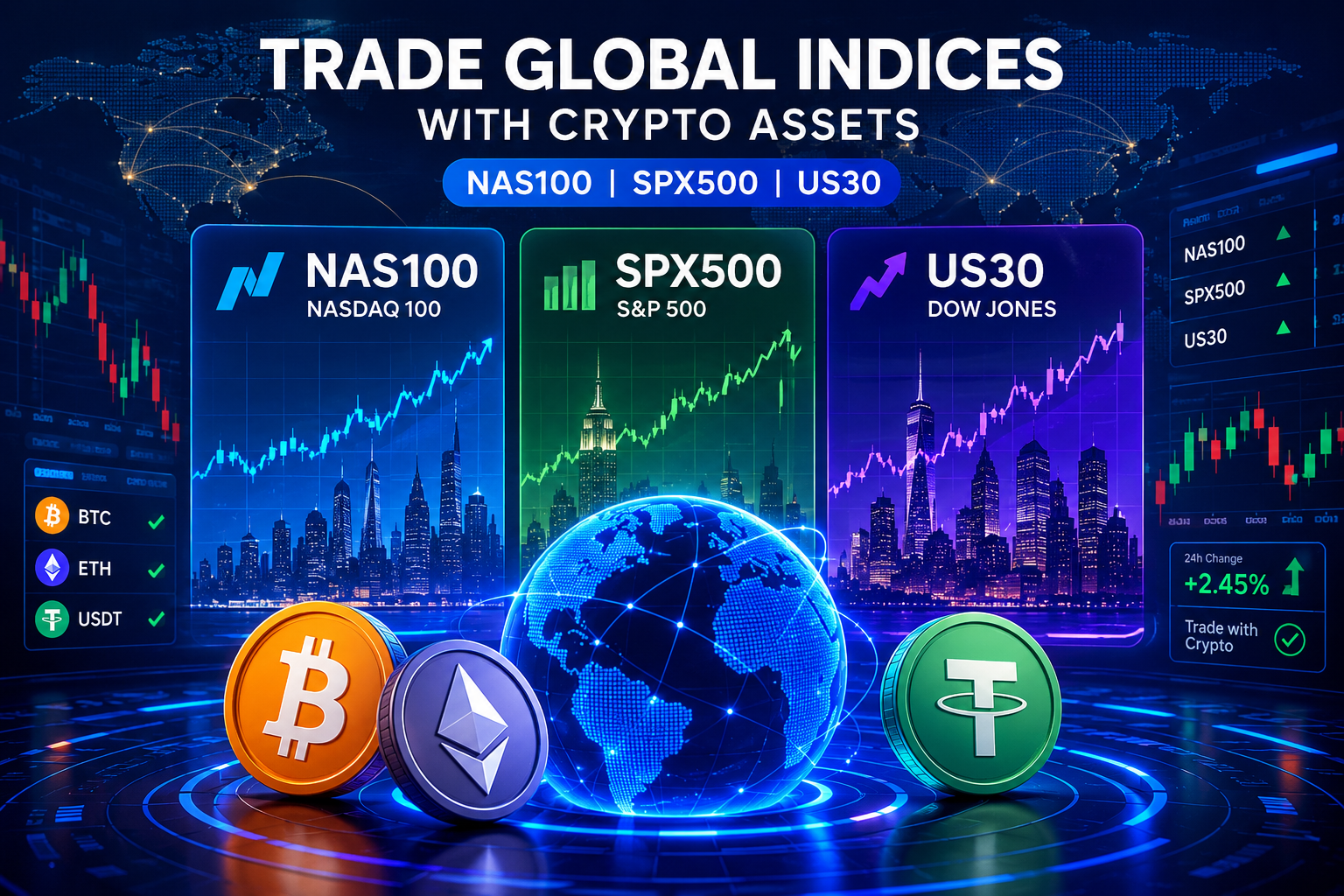
SPX500, meanwhile, captures the overall performance of major U.S. publicly listed companies across a wider range of industries and is commonly used to measure the health of the U.S. economy and equity market. In contrast, US30 is more concentrated on traditional industrial and consumer leaders, giving it a distinct volatility pattern compared to tech-heavy indices.
Together, these three indices form a core framework for global investors to assess the U.S. market and serve as essential underlying assets for index CFDs, ETFs, and digital financial derivatives.
What Are the Core Differences Between NAS100, SPX500, and US30?
NAS100, SPX500, and US30 all measure U.S. stock market performance, but they differ significantly in constituent composition, sector weight, and volatility profile.
| Index |
Core Characteristics |
Key Sectors |
Volatility Profile |
| NAS100 |
Predominantly tech growth stocks |
AI, internet, semiconductors |
Higher volatility |
| SPX500 |
Covers large U.S. companies |
Broad sector diversification |
Strong market representativeness |
| US30 |
Primarily industrial blue chips |
Manufacturing, finance, consumer |
Relatively stable volatility |
NAS100 is more sensitive to tech earnings expectations and interest rate shifts, which typically results in higher elasticity. SPX500's more balanced sector composition makes it a go-to benchmark for the overall U.S. stock market among institutions. US30, with fewer components and a bias toward established companies, tends to have more stable price movements.
How to Participate in Global Index Trading via Crypto Assets?
Methods for engaging in global index trading using crypto assets include index CFDs, synthetic assets, and on-chain derivative protocols.
Index CFDs (Contracts for Difference) are financial derivatives settled based on price movements, allowing traders to take long or short positions on index price changes without directly owning the constituent stocks.
Some digital asset platforms also let users post stablecoins as margin to trade indices like NAS100, SPX500, and US30 within a unified account. This setup reduces the friction of switching between traditional cross-market accounts.
Additionally, certain on-chain protocols issue synthetic assets pegged to indices, sourcing index prices through oracles and handling settlement and liquidation within smart contracts. This approach makes index assets composable on-chain and enables integration with DeFi, lending, and yield protocols.
What Drives Global Index Prices?
Global index prices are influenced by a combination of corporate earnings, macroeconomic conditions, monetary policy, and market sentiment.
NAS100 is especially responsive to tech sector earnings growth and interest rate expectations. When markets anticipate rate cuts, high-growth tech valuations often rise, making NAS100 more volatile.
SPX500 offers a broader picture of the economy, reflecting employment, consumer spending, manufacturing, and corporate profits. US30, with its heavier weighting in industrial and traditional consumer companies, is more directly tied to real economic cycles.
U.S. dollar liquidity and global risk appetite also play a role. When risk appetite increases, capital tends to flow into growth assets; during risk-off periods, index markets may see heightened volatility.
Because crypto markets are closely linked to global liquidity conditions, a growing correlation is emerging between global indices and digital assets.
What Is the Risk Structure in Global Index Trading?
Despite high liquidity and a mature market foundation, global index trading carries significant risks.
First, market volatility: index prices can swing rapidly due to economic data, earnings reports, and policy changes, especially during macro events.
Second, leverage risk: many index CFD products allow margin trading, so small price moves can amplify account gains or losses.
Third, liquidity and trading session risks: while some digital asset platforms offer near 24/7 trading, the underlying indices are still constrained by traditional stock market hours and liquidity conditions.
For on-chain synthetic assets, additional risks include smart contract vulnerabilities, oracle failures, and systemic liquidation cascades—risk profiles that differ markedly from traditional securities.
Products involving global indices and digital asset trading carry market risk, and related asset prices may fluctuate significantly due to macroeconomic shifts, liquidity changes, and market sentiment.
How Are Crypto Finance and Traditional Index Markets Converging?
The convergence of crypto finance and traditional index markets is reshaping financial infrastructure from a single-asset model into a cross-market ecosystem.
Traditional financial markets have long depended on brokers, exchanges, and clearinghouses, whereas the digital asset ecosystem emphasizes on-chain settlement, round-the-clock markets, and open protocols. As stablecoins and on-chain financial infrastructure mature, more traditional financial assets are entering the crypto space in digital form.
Index assets, with their high standardization and established pricing frameworks, are among the easiest traditional products to digitize. Indices like NAS100, SPX500, and US30 are now entering on-chain financial systems via CFDs, synthetic assets, and real-world asset (RWA) mapping mechanisms.
This trend signals that the crypto asset market is evolving from an "independent asset class" into an integral part of global financial infrastructure.
Summary
As the world's most critical stock indices, NAS100, SPX500, and US30 respectively represent tech growth stocks, core large-cap assets, and industrial blue chips. With the ongoing advancement of digital asset infrastructure, the crypto market now offers a variety of ways to trade global indices, including index CFDs, on-chain synthetic assets, and digital financial derivatives.
FAQ
What are the differences between NAS100, SPX500, and US30?
NAS100 consists mainly of tech growth companies, SPX500 covers the broad market of large U.S. publicly listed firms, and US30 is more focused on traditional industrial blue chips. They differ in sector composition, volatility, and market representation.
What is an index CFD?
An index CFD is a contract for difference settled based on index price changes. It allows traders to take leveraged long or short positions without holding the underlying stocks.
Why is NAS100 more volatile?
NAS100 has a high concentration of tech growth stocks, making it more sensitive to interest rate shifts, tech earnings expectations, and market risk appetite. Its price volatility is generally higher than that of traditional industrial indices.
Is there a correlation between crypto assets and global indices?
Global liquidity, U.S. interest rates, and market risk appetite often influence both crypto assets and stock indices, so the two markets may exhibit correlated movements during certain periods.
What are the main risks of global index trading?
Key risks include market volatility, leverage, liquidity, and macro policy changes. For on-chain synthetic assets, smart contract and oracle risks also apply.







