As AI models continue to scale, global demand for hashrate resources is skyrocketing. From large language models and AI agents to real-time image and video generation, an ever-growing number of applications are consuming vast amounts of hashrate. While traditional cloud services remain the market standard, high infrastructure costs, resource centralization, and regional deployment limitations are driving the industry to explore new supply models. Edge computing and DePIN (Decentralized Physical Infrastructure Network) have thus emerged as key areas of focus.
From a digital infrastructure standpoint, Bless Network aims to do more than create a new hashrate market. It seeks to establish a technical pathway for networking, assetizing, and making programmable idle hardware resources worldwide. Through distributed resource scheduling, node incentives, and trusted verification mechanisms, Bless empowers any user to participate in hashrate supply and collectively build a new open computing network for the AI era.
Bless Network Core Technical Architecture Analysis
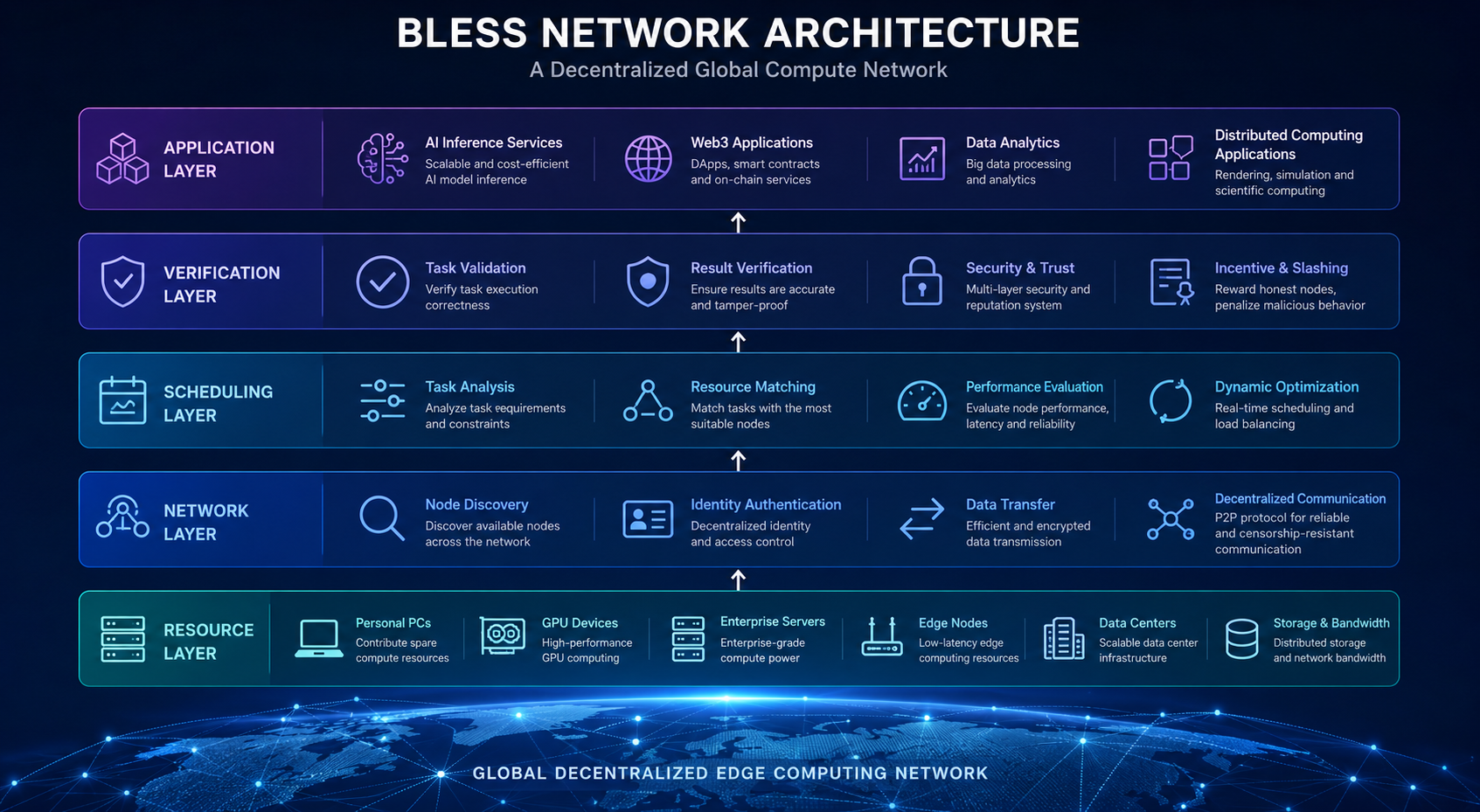
Architecturally, Bless Network is a multi-layered computing system consisting of the Resource Layer, Network Layer, Scheduling Layer, Verification Layer, and Application Layer. Each layer performs a distinct function, and together they complete the full workflow from resource onboarding to task execution.
The Resource Layer is the foundation, comprising personal computers, GPU devices, enterprise servers, edge nodes, and data center resources worldwide. These devices connect to the network via the Bless client, contributing hashrate, storage, and bandwidth.
The Network Layer handles node discovery, identity verification, and data transmission. Using decentralized protocols, nodes connect and communicate without centralized management, forming a global resource network.
The Scheduling Layer is the core. It analyzes task requirements, evaluates node performance, and matches resources. When a user submits a request, the system dynamically assigns tasks based on node status, hashrate, and network environment to maximize efficiency.
The Verification Layer ensures trusted computing. Since tasks are executed by diverse nodes, the system must verify that tasks are completed correctly and results are reliable. Multiple verification mechanisms guarantee network security and result integrity.
The Application Layer sits at the top. Developers can build AI inference services, Web3 applications, data analysis platforms, and other products requiring distributed computing on Bless Network.
Edge Computing and DePIN Networks
Understanding Bless Network requires familiarity with edge computing and DePIN.
Edge computing is an architecture that deploys computing power close to users. Unlike traditional cloud computing, which sends all data to large data centers, edge computing processes tasks at nearby locations, reducing latency and improving response times.
For example, when a user makes an AI request, the traditional model routes data to a remote server. In edge computing, nearby nodes handle the task and return results, significantly cutting network transmission time.
DePIN is a major Web3 trend. It uses blockchain incentives to organize global physical resources into open infrastructure networks.
Under DePIN, participants contribute hardware devices and earn incentives. Over the past years, projects have emerged in decentralized storage, wireless communication, and GPU networks. Bless Network is a key explorer in decentralized computing.
How Bless Aggregates Global Idle Hashrate Resources
Globally, vast hashrate resources sit underutilized. Home PCs, enterprise servers, and GPU devices rarely run at full capacity, leaving enormous potential hashrate idle.
Bless Network aims to aggregate these fragmented resources. When users install the Bless client and join the network, the system automatically profiles devices for CPU power, GPU performance, memory, storage, and bandwidth.
After detection, the system creates a Resource Profile for each node and adds it to a unified resource pool. Based on performance and task suitability, nodes are categorized as AI inference, general computing, data processing, or storage nodes.
This classification improves scheduling efficiency, allowing the network to quickly match tasks with the best devices. As more nodes join, Bless Network's total hashrate grows, generating scale effects.
From a business perspective, Bless creates an open two-sided market: developers and enterprises needing hashrate on one side, and node operators providing idle resources on the other, exchanging value through the network.
Node Verification and Task Distribution Mechanisms
For any decentralized computing network, ensuring result trustworthiness is critical. Since task executors are independent nodes worldwide, verification is essential.
When a user submits a task, Bless's scheduling system analyzes requirements and considers node performance, online status, historical reputation, geographic location, and network latency to select the optimal node(s).
During execution, multi-layer verification ensures reliability. Common methods include:
- Redundant verification: The same task runs on multiple nodes; results are compared. High consistency increases trust, at the cost of extra resources.
- Random spot checks: The network verifies some tasks to detect cheating; anomalous results may lower a node's reputation.
- Reputation system: Nodes accumulate long-term performance scores. High-reputation nodes get more tasks and higher rewards; low-reputation nodes may be restricted.
These mechanisms collectively maintain network quality.
How Bless Supports AI Inference
AI is a major driver of computing demand, and inference is becoming one of the largest consumption areas.
Previously, the market focused on training clusters. But with growing AI users, inference demand is surging. Every chat, image generation, or agent call consumes real-time computing resources.
For developers, renting high-performance servers long-term is expensive. Bless Network offers flexible resource access: developers call distributed resources on demand without heavy upfront infrastructure.
Edge computing also reduces latency. When requests are processed by nearby nodes, response times improve—critical for real-time AI assistants, customer service, and interactive apps.
Additionally, Bless's global node network enables flexible regional deployment. As AI goes global, cross-region resource scheduling becomes a key infrastructure advantage.
Bless Network vs. Traditional Cloud Services
Both provide hashrate, but they differ fundamentally in organization and operations.
Traditional cloud is built and operated by large vendors with centrally managed data centers, offering rental services with mature ecosystems and enterprise support.
Bless Network uses a distributed supply model. Resources come from global node contributors, with ownership spread across participants. Protocol-level coordination and incentives integrate these resources into a unified network.
| Comparison Item |
Bless Network |
Traditional Cloud Services |
| Resource Source |
Global node contributions |
Centralized data centers |
| Ownership Structure |
Distributed |
Centralized control |
| Network Architecture |
Decentralized |
Centralized |
| Scaling Method |
Nodes joining network |
Building new servers |
| Incentive Mechanism |
Token incentives |
Commercial rental |
| Fault Tolerance |
Multi-node collaboration |
Data center redundancy |
These models are likely to complement each other. Traditional cloud handles critical enterprise needs, while decentralized networks offer new possibilities in resource utilization, open participation, and global collaboration.
Challenges for Decentralized Computing Networks
Despite great potential, large-scale adoption faces several challenges:
- Node stability: Personal devices and edge nodes often go offline or fluctuate, complicating scheduling.
- Latency and data sync: Global node distribution adds overhead for coordination and result synchronization, especially for real-time applications.
- Data security: Some tasks involve sensitive data. Ensuring privacy in an open network is crucial for enterprise adoption.
- Verification costs: Balancing verification overhead with efficiency and trust is a key design challenge.
- Developer ecosystem: Mature tools, APIs, and applications are needed to attract developers.
Future Development Directions for Bless Network Technology
As AI and DePIN evolve, Bless Network's roadmap becomes clearer.
- AI-native computing: Optimizations for LLM inference, AI agent workflows, and GPU scheduling.
- Zero-knowledge proofs: ZK verification can validate results while preserving user privacy.
- Cross-chain compatibility: Enabling resource scheduling, payments, and incentives across multiple blockchains for broader ecosystem synergy.
- Automated resource markets: Smart contracts for pricing, bidding, and revenue distribution to reduce costs and improve efficiency.
If node scale continues to grow and scheduling efficiency improves, Bless Network can become a global edge computing infrastructure, providing open resources for AI and Web3 applications.
Summary
Bless Network is a decentralized computing network combining DePIN, edge computing, and distributed resource scheduling. Its core goal is to aggregate idle hashrate worldwide, providing open, scalable infrastructure for AI inference, data processing, and Web3 applications.
Architecturally, it creates a complete computing loop through resource, network, scheduling, verification, and application layers—from resource onboarding to task execution, result verification, and revenue distribution. The essence is turning fragmented hardware into a coordinated computing network, improving global resource utilization.
As AI inference demand grows and the DePIN ecosystem matures, decentralized computing networks are becoming a key digital infrastructure trend. Despite challenges in node stability, data security, and developer ecosystem, Bless Network's open computing model offers a new technical pathway and practical direction for future global computing collaboration.







