

Trade
Basic
Futures
Futures
Hundreds of contracts settled in USDT or BTC
Options
HOT
Trade European-style vanilla options
Unified Account
Maximize your capital efficiency
Demo Trading
Futures Kickoff
Get prepared for your futures trading
Futures Events
Participate in events to win generous rewards
Demo Trading
Use virtual funds to experience risk-free trading
Earn
Launch
CandyDrop
Collect candies to earn airdrops
Launchpool
Quick staking, earn potential new tokens
HODLer Airdrop
Hold GT and get massive airdrops for free
Launchpad
Be early to the next big token project
Alpha Points
NEW
Trade on-chain assets and enjoy airdrop rewards!
Futures Points
NEW
Earn futures points and claim airdrop rewards
Investment
Simple Earn
Earn interests with idle tokens
Auto-Invest
Auto-invest on a regular basis
Dual Investment
Buy low and sell high to take profits from price fluctuations
Soft Staking
Earn rewards with flexible staking
Crypto Loan
0 Fees
Pledge one crypto to borrow another
Lending Center
One-stop lending hub
VIP Wealth Hub
Customized wealth management empowers your assets growth
Private Wealth Management
Customized asset management to grow your digital assets
Quant Fund
Top asset management team helps you profit without hassle
Staking
Stake cryptos to earn in PoS products
Smart Leverage
NEW
No forced liquidation before maturity, worry-free leveraged gains
GUSD Minting
Use USDT/USDC to mint GUSD for treasury-level yields

More

Stop gambling within the "Fortune" framework: Don't ask AI whether to buy or not, first talk to it about your thinking and current situation.
8h ago
A review of 9 Perp DEX projects expected to airdrop in 2026
11h ago
Trending Topics
View More5.52K Popularity
575.77K Popularity
78.89K Popularity
6.28K Popularity
7.43K Popularity
Hot Gate Fun
View More- MC:$3.74KHolders:20.09%
- MC:$3.68KHolders:20.23%
- MC:$3.64KHolders:10.00%
- MC:$3.63KHolders:10.00%
- MC:$3.61KHolders:10.00%





Pin
Traveling through the dark times, Bybit performs a liquidity miracle in 2025
Author: Frank, PANews
In the cyclical ups and downs of cryptocurrencies, the standard for measuring an exchange’s scale is often not its expansion speed during smooth sailing, but how steady it remains in the face of headwinds. Bybit’s performance in 2025 not only exemplifies this resilience but also unexpectedly staged a “countertrend comeback.”
On December 22, Bybit’s 24-hour spot trading volume exceeded $9 billion, surpassing Binance to top the market share in crypto spot trading volume. Observing its recent trading volume curve, we can see a explosive upward trend: starting from $2.2 billion on December 16, within just a week, it surged past $9 billion on December 22, with a weekly increase of over 4 times.
This performance is not a coincidence but a demonstration of the resilience benefits unleashed after Bybit experienced extreme stress testing. For Bybit, 2025 was an extremely volatile year, completing a “survival test” under the shadow of a $1.4 billion hack at the beginning of the year, and ending with a deep V-shaped reversal to become the “King of Spot” trading.
How exactly did Bybit turn the tide during a market-wide “winter”? Reviewing this year’s journey not only allows us to re-understand this highly “resilient” giant but also provides insight into the underlying logic behind the reshuffling of the crypto industry landscape.
From resilience to expansion, challenger transforming into “Defender of the Arena”
When mentioning Bybit, many early users still associate it with the 2018 founding by former forex veteran Ben Zhou, entering the market with “extreme trading experience” and “perpetual contracts” as its niche. However, after seven years, Bybit is no longer a challenger of that era; it has grown into a comprehensive platform covering spot, derivatives, Web3, and institutional services.
The transformation of Bybit is vividly reflected in the scale leap of its user base. Over the past year, Bybit’s global registered users surged from 50 million to over 79 million, an increase of nearly 60% within just one year.
This scale jump not only signifies a broader user base for Bybit but also directly translates into its increasing pricing power in the market.
According to a report released by coinlaw.io in November, Bybit’s average daily trading volume is about $6 billion, ranking second only to Binance in the market.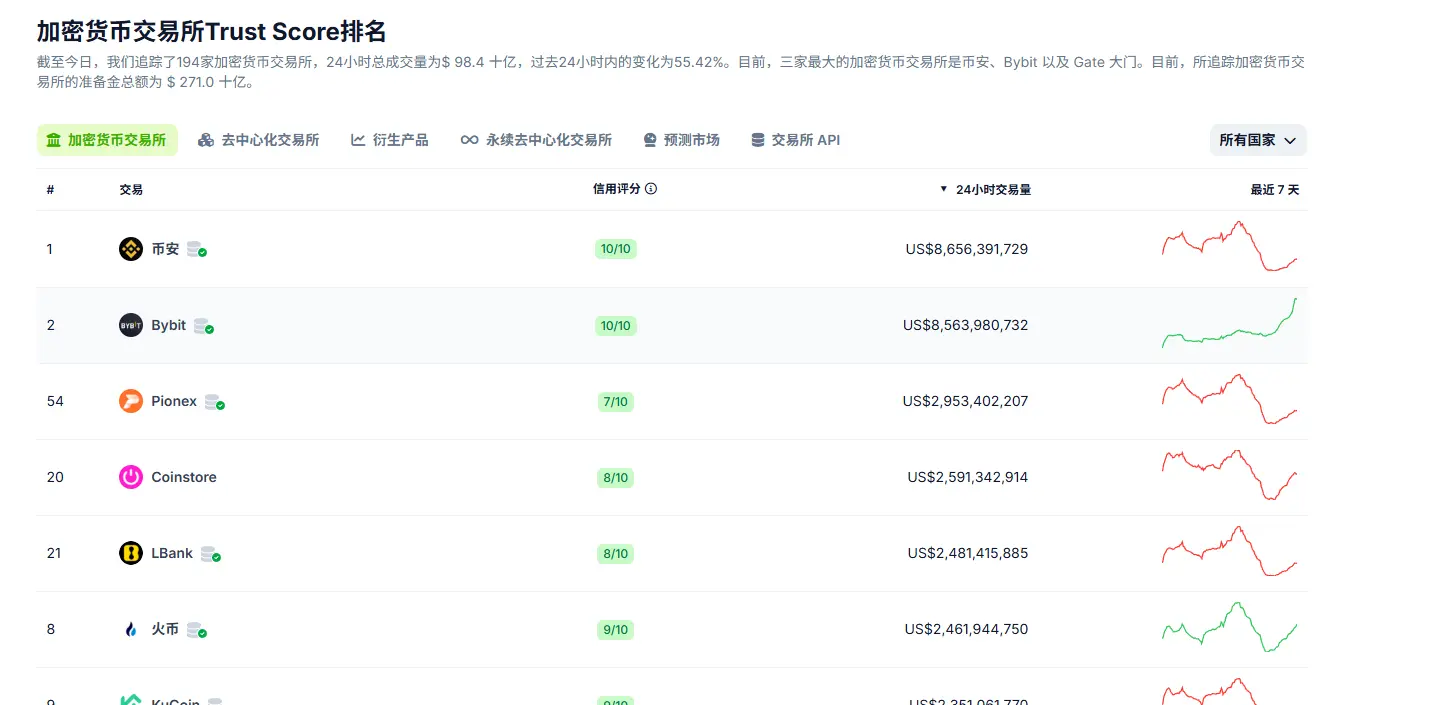
Since December, this growth trend has become even more apparent. On December 7, Bybit’s spot daily trading volume was about $1.4 billion, and by December 22, this figure had grown to a peak of $9.1 billion, with a maximum monthly increase of 5.5 times, topping all exchanges in trading volume. More importantly, this surge occurred amid a generally sluggish market, further demonstrating Bybit’s resilience and competitiveness.
In addition to retail market enthusiasm, institutional funds are also shifting toward Bybit. At a recent institutional event in Dubai, Ben Zhou disclosed some notable data: the platform’s institutional asset management scale grew from $40 million in Q3 to $200 million in Q4. As of December 22, Bybit’s exchange assets ranked fourth among all exchanges with $19.5 billion.
With the rise of on-chain trading, large amounts of capital are beginning to shift, and many crypto exchanges are also starting to deploy on-chain trading. Bybit has not stuck solely to centralized business; by launching Bybit Alpha and incubating Byreal on the Solana chain, it has seized the benefits of on-chain capital inflows.
Take Byreal as an example: since its launch in October, it achieved over $1 billion in trading volume within just 10 weeks. In early December, according to DefiLlama’s Solana DEX rankings, Byreal ranked fifth in 30-day fee and revenue charts.
Moreover, Bybit’s business lines have recently seen many developments. Through strategic cooperation with Mantle Network, MNT has been expanded into a multi-functional asset supporting fee discounts, RWA tokenization, institutional leverage, and high-yield staking. On the compliance front, Bybit obtained the EU MiCA license and a full UAE license, and recently announced its return to the UK market. In derivatives, Bybit Card launched real-time conversion payments and high cashback activities, integrating crypto into daily consumption scenarios. These initiatives further reinforce Bybit’s positioning as a comprehensive, compliant platform, bridging DeFi innovation with TradFi capital inflows.
From continuous user base expansion, to topping spot market trading volume, to strong breakthroughs in on-chain markets and derivatives, these data depict Bybit no longer as just a “feature-rich exchange,” but as a “behemoth” sitting at the top of the industry.
$1.4 billion Black Swan strikes, Bybit performs liquidity miracle
However, for Bybit, this year was also a critical year of life, death, and rebirth.
In February, Bybit’s start was “hellish,” as it unexpectedly experienced the largest single hack in crypto history, with $1.46 billion stolen. Such a massive black swan event did not crush Bybit; instead, it demonstrated a textbook-level crisis response, showing a unique kind of “resilience.”
According to a report by research firm Kaiko, Bybit’s recovery speed after the hack exceeded industry expectations. The report states that Bybit’s Bitcoin liquidity recovered to about $13 million per day within 30 days of the security incident, fully closing the liquidity gap caused by the attack.
In terms of exchange assets, after the hack, a large amount of funds were quickly withdrawn due to panic, causing Bybit’s assets to drop by $3 billion, from $16.9 billion to around $13 billion. However, within just one month, Bybit’s funds had returned to pre-attack levels. By March 25, its assets rebounded to over $15.3 billion. By May, it surpassed pre-attack levels, reaching a record high of $29.3 billion in October.
When the crisis struck, such a huge loss raised concerns about Bybit’s future. However, when it announced sufficient funds for settlement, expectations may have been slightly raised. More importantly, for everyone, the outlook for Bybit’s development this year was not overly optimistic, let alone whether it could return to the industry forefront or even top the market.
Yet, the ability to recover quickly under extreme pressure is rare in the crypto industry and has become a key validation of Bybit’s reliability. Behind these series of data is the premium of user trust in Bybit, which has also built a solid brand moat. For traders, a platform capable of withstanding massive losses and insisting on rigid settlement has, paradoxically, established a higher level of trust.
Continuous “Warm Offensive,” real money for growth
Exploring the deep reasons behind Bybit’s growth, besides strengthening its security foundation, high-intensity incentive activities are the main driver of its recent countertrend activity amid a sluggish crypto market.
Coinciding with its seventh anniversary, Bybit launched the “7UpBybit” campaign, with a total prize pool of up to $2.5 million. Users earn points and upgrade avatars through completing tasks, ultimately sharing these rewards. On December 22, official data showed that the reward distribution within 24 hours reached $230,000. This monetary incentive has made Bybit one of the most active exchanges recently.
Deep cooperation with new projects (such as Airdrop + exclusive trading rewards) also brought significant incremental growth. For example, NIGHT, launched on December 9, featured a double-token splash event with a total prize pool of 200 million NIGHT (worth several million USD). New user deposits could share 80 million tokens, with the top 32,000 users earning an average of 2,500 tokens (about $250). The remaining 120 million tokens could be earned through trading volumes over $500, with the highest share reaching 200,000 NIGHT tokens (about $20,000). Such reward levels are highly stimulating for retail traders; as of December 22, over 64,000 users participated in this activity.
Meanwhile, these activities significantly boosted Bybit’s trading volume. On December 22, NIGHT’s total trading volume across the network exceeded $9.2 billion, with Bybit’s single-day volume reaching $7.1 billion, accounting for over 77% of the total, making it the main liquidity platform for NIGHT trading.
Of course, Bybit’s recent ecosystem stimulation is not limited to this. Upcoming Christmas activities include rewards for using Bybit Card or Bybit Pay, high-yield Bybit Earn rewards, and more. From trading and wealth management to payments, these intensive “money-spreading” activities provide retail traders with timely “subsidies” in a quiet market. Strategically, during the market’s most dormant period, most platforms choose to shrink and defend, but Bybit’s genuine “subsidy” campaigns have become the most efficient customer acquisition method.
Looking back at Bybit’s seventh year, from the darkest moments at the start of the year to a spectacular comeback at year’s end, this is undoubtedly one of the most dramatic “Comeback Stories” in the crypto industry and a watershed moment in Bybit’s development history.
The rollercoaster of this year proved to the world that true industry giants are not built on expansion during good times but on the courage to withstand pressure and the decision to expand against the trend in adversity. Standing at a new starting point of 80 million users, Bybit is demonstrating a new image of “resilience” and “innovation” to the market. This tumultuous data ledger may well be the most effective way for Bybit to showcase itself.