In the current DeFi landscape, liquidity fragmentation has become a key constraint on growth. Capital is dispersed across different protocols without unified coordination, reducing overall efficiency and forcing projects to rely on high emission incentives to attract users. This model often proves difficult to sustain, especially during periods of market volatility.
Katana (KAT) is designed to address this structural issue. As a network centered on DeFi liquidity integration, it introduces a chain level architecture that unifies liquidity sources and improves coordination across protocols. By combining the KAT token with the vKAT model, Katana creates a closed loop system for yield distribution and incentives. Within the broader trend of Layer 2 and DeFi convergence, Katana is emerging as a direction worth close attention.
What Is Katana (KAT)?
As a blockchain network focused on DeFi use cases, Katana (KAT) is designed to address the problem of liquidity fragmentation. Unlike traditional DeFi protocols that operate as standalone applications, Katana is built as an integrated infrastructure layer that combines trading, lending, and derivatives into a unified system.

Within Katana, liquidity is no longer dispersed across multiple protocols but is managed at the chain level. This “chain level liquidity” design allows capital to move efficiently between different DeFi scenarios, improving overall capital efficiency.
By consolidating liquidity in this way, Katana not only enhances user experience but also introduces a more sustainable model for DeFi development, where capital utilization and incentive alignment are structurally optimized.
Katana’s Core Architecture
Katana is designed as a unified DeFi infrastructure where multiple financial functions operate within a single coordinated system. Its core architecture integrates trading, lending, and derivatives into one network, allowing these modules to interact rather than function independently.
Within this structure, the trading module enables asset exchange and generates transaction fees, forming a primary source of protocol activity. The lending module enhances capital efficiency by allowing users to deploy idle assets for yield, while the derivatives module expands functionality by supporting more advanced trading strategies.
What differentiates Katana is that all these modules share a common liquidity layer. Instead of spreading capital across separate protocols, liquidity is managed at the chain level. This allows funds to move freely between trading, lending, and derivatives, reducing fragmentation and improving overall efficiency. As a result, liquidity becomes a shared resource that continuously supports multiple use cases.
How Katana Works (Flywheel Model)
Katana’s core operating logic is based on a “liquidity flywheel.” This mechanism creates a continuous cycle that enables the network to achieve self sustaining growth and ongoing value accumulation.
Within this system, users first provide liquidity or deposit assets. These funds are then utilized across trading, lending, and other use cases, generating fees and interest. Rather than leaving the system, these earnings are redistributed to KAT and vKAT holders.
As returns increase, more users are attracted to the Katana network, further strengthening liquidity depth. This positive cycle allows Katana to reduce reliance on external incentives and move toward a more sustainable DeFi model.
Katana’s Core Innovation: The vKAT Mechanism
vKAT is one of the core mechanisms within the Katana ecosystem, designed to optimize both incentive distribution and governance structure. Users can obtain vKAT by locking KAT tokens, allowing them to participate in key decisions within the network.
In Katana, vKAT represents not only voting power but also determines how incentives are directed. Holders of vKAT can influence the allocation of liquidity rewards, guiding capital toward more efficient markets. This mechanism enables more precise resource allocation across the ecosystem.
In addition, vKAT grants users access to a share of the protocol’s generated revenue. Through this design, Katana closely aligns user behavior with protocol development, creating a system where participation, incentives, and long term growth are interconnected.
KAT Tokenomics and KAT Token Use Cases
KAT functions as the foundational asset within the Katana network, with a total supply of 10 billion tokens. Its role extends across incentive distribution, value capture, and governance, forming the backbone of the entire liquidity system.
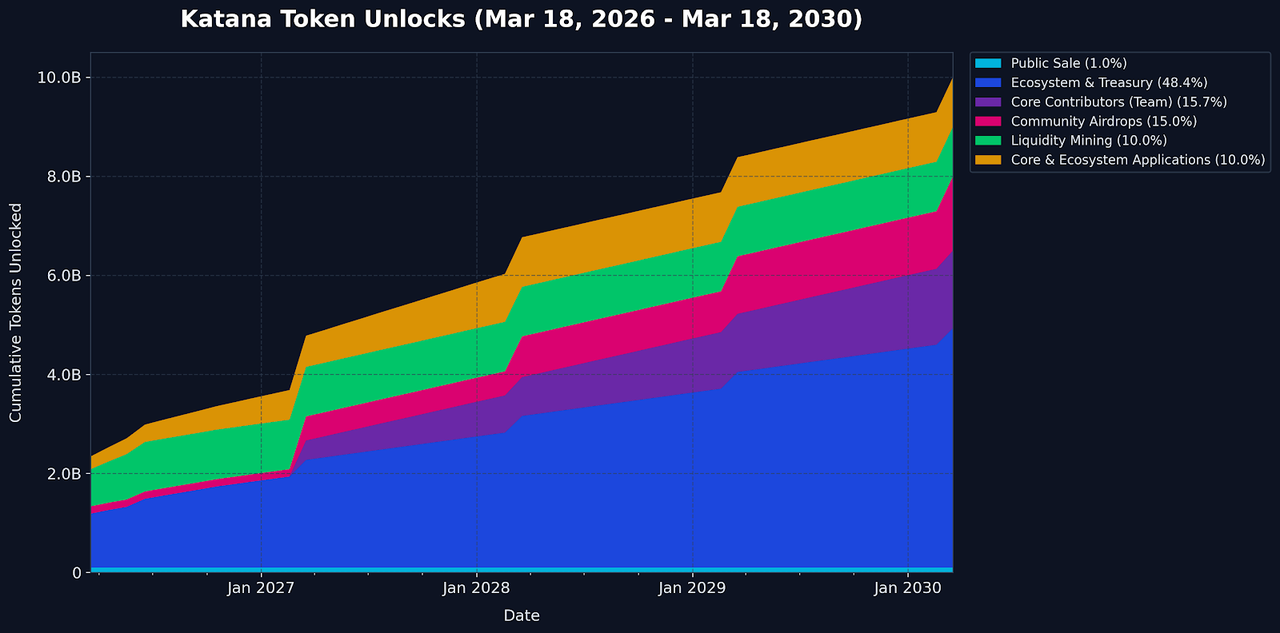
At its core, KAT is used to incentivize liquidity providers and active participants, encouraging capital to flow into the Katana network and sustain its activity. Through the vKAT mechanism, KAT holders can also access protocol level revenue, allowing them to capture value generated across the ecosystem. In addition, KAT plays a key role in governance, enabling participants to influence how the network evolves over time.
Taken together, Katana’s tokenomics is designed with a long term perspective rather than short term incentives. By linking rewards directly to token participation and network performance, Katana builds a more sustainable economic model where value creation and user alignment develop in parallel.
How To Participate In The Katana Ecosystem?
There are multiple ways to participate in the Katana ecosystem, and users can choose the approach that best fits their needs. The first step is to bridge assets into the Katana network. Once assets are available on-chain, users can engage in activities such as providing liquidity, lending, or trading.
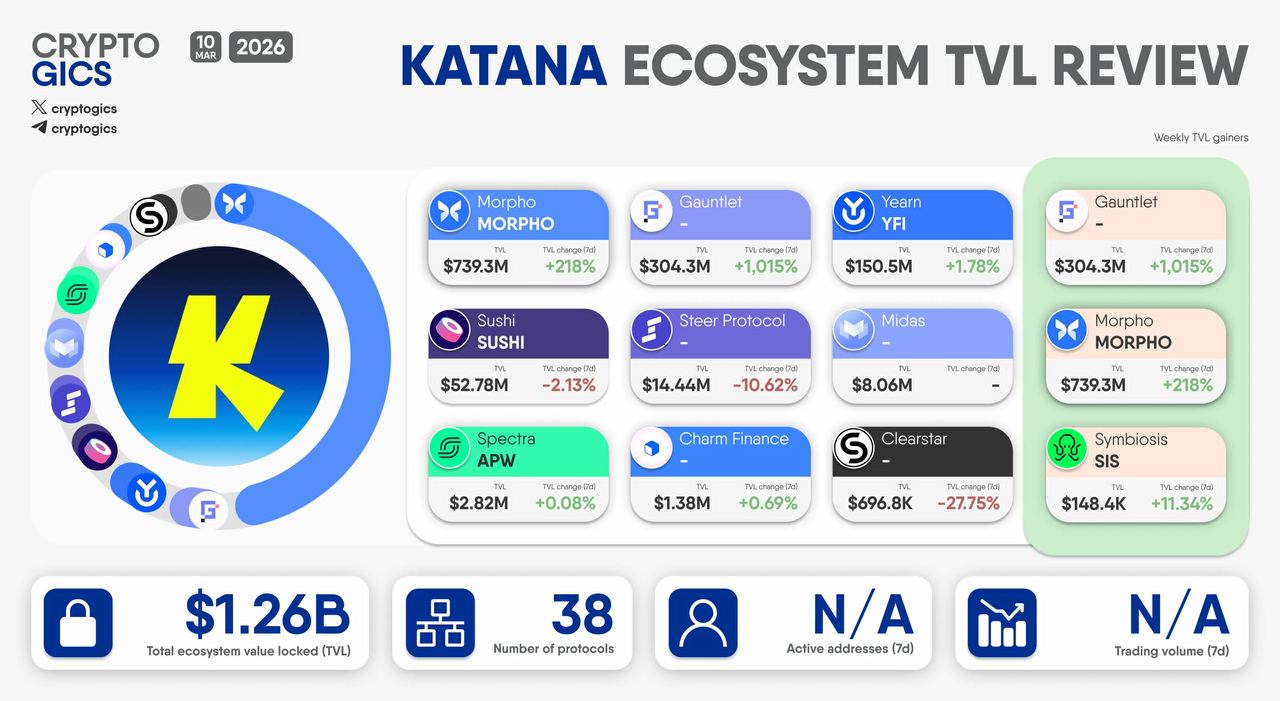 Image source: Cryptogics
In addition, users can lock KAT tokens to obtain vKAT, allowing them to participate in governance while also earning a share of protocol rewards. Different participation methods correspond to different return structures. For example, liquidity providers mainly earn transaction fees, while vKAT holders rely more on revenue distribution.
It is important to note that participation in Katana also involves certain risks. Users should evaluate their own risk tolerance before engaging with the network.
Katana’s Advantages And Risks
Katana’s main advantage lies in its chain level liquidity design, which enables more efficient liquidity management within DeFi. At the same time, the flywheel model and the vKAT mechanism help create a more stable and sustainable reward structure over the long term.
However, Katana is still in an early stage of development and carries inherent risks. The complexity of its mechanisms may increase the difficulty of understanding the system, while smart contract risks and market volatility can affect returns. In addition, although liquidity concentration improves efficiency, it may also introduce systemic risk under certain conditions.
For these reasons, users should fully understand both the mechanism and potential risks before participating in the Katana ecosystem.
Katana vs Curve: Key Differences
Katana (KAT) and Curve differ significantly in their design philosophy. Curve primarily focuses on optimizing stablecoin trading, while Katana is built to integrate multiple DeFi functions into a single system, enabling chain level liquidity management.
In terms of incentive structure, Curve adopts the veCRV model, whereas Katana uses the vKAT model. While both emphasize token locking and governance, Katana places greater focus on unified incentive distribution across different modules within the ecosystem.
In addition, Katana features more diversified sources of yield, including trading, lending, and derivatives. Curve, by contrast, mainly relies on trading fees. This structural difference gives Katana a potential advantage in improving overall capital efficiency within DeFi.
Conclusion
Katana (KAT) introduces a new approach to DeFi by combining chain level liquidity with the vKAT incentive mechanism. Its core idea is to unify liquidity sources, improve capital efficiency, and create a sustainable growth model through integrated reward distribution.
Although the network is still in an early stage, its innovations in liquidity optimization suggest meaningful potential. As the ecosystem evolves, Katana may become an important component within the broader DeFi infrastructure landscape.
FAQs
What is Katana (KAT)?
Katana is a blockchain network focused on optimizing liquidity within DeFi.
What is the role of the KAT token?
KAT is used for incentive distribution, governance participation, and value capture within the ecosystem.
What is vKAT?
vKAT is obtained by locking KAT tokens and represents both governance rights and access to protocol rewards.
What is the difference between Katana and Curve?
Katana emphasizes chain level liquidity and integrated DeFi functions, while Curve focuses on optimizing stablecoin trading.
Is Katana worth participating in?
Participation depends on individual risk tolerance, as Katana is still in an early stage of development.







