With the rise of mobile internet, cloud computing, IoT, and AI, global data traffic continues to surge, making communications infrastructure more critical than ever. Rather than directly operating telecom services, American Tower acts as an "infrastructure provider," building and managing communication sites to deliver long-term, stable network coverage for operators.
In the modern digital economy, communication towers have become essential infrastructure alongside highways, power grids, and data centers. With a site network spanning multiple countries and regions, American Tower has established itself as one of the most important infrastructure companies in the global communications industry.
What Is AMT (American Tower)?
Founded in 1995 and headquartered in Boston, Massachusetts, American Tower Corporation is one of the world's largest independent communication tower operators. Its stock ticker is AMT, and it operates as a Real Estate Investment Trust (REIT).
Unlike traditional real estate firms, American Tower's primary assets are not residential or commercial properties but communication towers, wireless base stations, rooftop sites, and related digital infrastructure. These assets form a critical component of modern wireless networks, providing mobile operators with space for network deployment.
American Tower's core business model relies not on service fees but on infrastructure leasing. Operators lease tower space to deploy equipment for network coverage and signal transmission, while American Tower generates revenue from long-term lease contracts.
This approach gives American Tower the stability of infrastructure assets while allowing it to benefit from the ongoing growth in global mobile communications demand.
American Tower's History and Market Position
American Tower initially focused on the U.S. domestic wireless market. As the global mobile communications industry grew rapidly, the company built a multi-country infrastructure network through acquisitions and international expansion.
In the 4G era, smartphone adoption drove a massive increase in data traffic, forcing operators to build more base stations to boost network capacity. American Tower capitalized on this trend, rapidly expanding its asset base and becoming a major player in the global tower industry.
More recently, the company has expanded into Latin America, Europe, Africa, and Asia. This international diversification has provided new growth opportunities while reducing exposure to single-market volatility.
Today, American Tower serves as a key platform connecting telecom operators, internet services, and digital infrastructure. Its market positioning is more akin to a global communications infrastructure operator than a traditional REIT.
How American Tower's Tower Leasing Business Works
American Tower's core business is leasing communication towers. After building or acquiring towers, it rents space to mobile operators for installing wireless equipment.
The tower industry's defining feature is the sharing model. A single tower can typically host multiple operators, allowing one asset to generate multiple rental income streams. Adding a second or third operator to an existing site involves minimal incremental cost but significantly boosts revenue.
This is known as the Multi-Tenant Model. It gives tower operators high operating leverage and is a key driver of American Tower's profitability.
Rather than building new network facilities from scratch, operators generally prefer leasing existing tower space. This reduces capital expenditure, speeds up network deployment, and helps tower operators achieve economies of scale.
American Tower's Role in Global Communications Infrastructure
Modern mobile networks are built by operators, equipment vendors, and infrastructure providers. American Tower occupies the foundational infrastructure layer of this ecosystem.
Wireless operators rely on towers to deploy antennas and equipment for mobile coverage. Whether users are browsing the web, streaming video, or making online payments, communication sites are essential for signal transmission.
By providing site resources, American Tower helps operators cut construction costs and improve coverage efficiency. Tower construction requires land, permits, and long-term operational expertise, creating high entry barriers.
This infrastructure role makes American Tower a vital backbone of the global digital economy—similar to Equinix in data centers or pipeline operators in energy.
Why 5G Is Driving Tower Demand
5G offers faster speeds and lower latency than 4G, but it also requires a much denser network of sites.
Because 5G uses higher frequency bands, operators need more wireless sites to achieve broad coverage. This means tower demand is likely to increase, not decrease, as networks evolve.
Beyond mobile communications, autonomous driving, industrial IoT, smart cities, and connected devices all depend on 5G infrastructure. Higher data demand translates to greater need for network capacity and coverage density.
For American Tower, 5G is not a one-time event but a long-term catalyst for infrastructure upgrades. This is why the market continues to focus on the tower industry.
American Tower's Data Center and Digital Infrastructure Strategy
As the digital economy grows, communications infrastructure has expanded from towers to include data centers, edge computing, and cloud connectivity.
American Tower has recently invested in data centers and digital infrastructure to diversify revenue. While towers handle signal transmission, data centers provide storage and computing—together forming the backbone of the modern internet.
Edge computing also presents new opportunities. As applications demand lower latency, computing resources must be located closer to users.
By combining communication sites with digital infrastructure, American Tower is evolving from a pure tower operator into a comprehensive digital infrastructure platform.
How American Tower Differs From Crown Castle and SBA Communications
American Tower, Crown Castle, and SBA Communications are the three most prominent U.S. tower companies.
| Company |
Core Characteristics |
Primary Market |
| AMT |
Most global footprint |
Multiple countries |
| Crown Castle |
Highly concentrated in the U.S. |
United States |
| SBA Communications |
Smaller tower portfolio |
Primarily the Americas |
American Tower's key differentiator is its international reach. By owning assets across many countries, it can capture growth from global mobile markets.
Crown Castle is more U.S.-focused and has a strong position in fiber and small cells. SBA Communications is smaller but similarly focused on tower operations.
All three use a leasing model, but their geographic scope and growth strategies differ significantly.
Key Applications of American Tower's Infrastructure
American Tower's infrastructure supports mobile communications, internet access, enterprise networks, and IoT.
The most common application is mobile voice and data. When users make calls, send texts, or use data, signals pass through towers and base stations.
Enterprise private networks, industrial automation, and smart city projects also rely on this infrastructure. As connected devices multiply, the importance of communication sites grows.
Moreover, 5G, edge computing, and AI are creating new digital services, making communications infrastructure a critical asset in the digital economy.
How to Buy AMT (American Tower) Stock
AMT is American Tower's ticker on the New York Stock Exchange (NYSE). Traditionally, investors could buy AMT stock through a brokerage account supporting U.S. equities, gaining exposure to the global communications infrastructure sector.
As a leading REIT, American Tower's performance is closely tied to mobile data growth, network upgrades, and digital infrastructure investment—attracting infrastructure-focused investors.
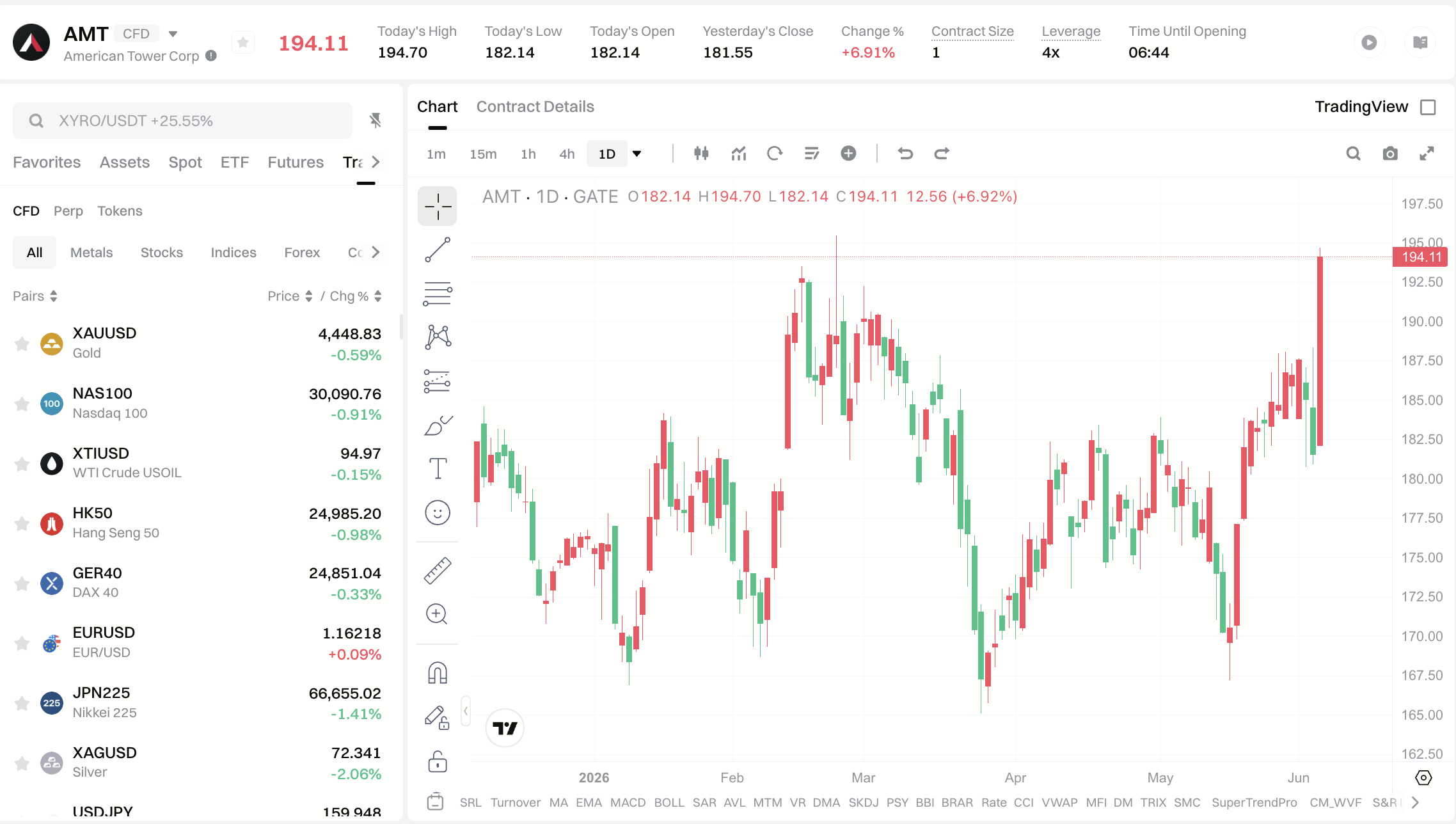
As digital and traditional financial markets converge, more trading instruments linked to U.S. stocks and infrastructure assets have emerged. Some platforms offer CFDs tied to stock price movements, allowing users to participate without owning the underlying shares.
Gate TradFi is expanding its traditional asset coverage, enabling users to monitor digital assets, U.S. stocks, ETFs, indices, and commodities in one account. Certain markets also offer Gate CFD products for cross-market asset management and price tracking.
Regardless of the method, investors should fully understand the product structure, trading rules, and local regulatory requirements.
American Tower's Strengths and Limitations
American Tower's biggest strength is its infrastructure nature. Towers have high construction costs, long approval cycles, and regional scarcity, creating a stable competitive landscape.
The multi-tenant model boosts per-asset profitability, while long-term leases provide predictable revenue. With global data traffic growing, long-term demand for communications infrastructure remains strong.
However, American Tower faces challenges. Changes in operator capex can affect short-term demand, and interest rate shifts can impact REIT valuations. Additionally, regulatory differences and currency fluctuations add complexity to international operations.
Thus, American Tower combines the stability of infrastructure with the complexity of a global business.
Summary
American Tower is one of the world's largest communications infrastructure operators, built on tower leasing, multi-tenant operations, and digital infrastructure. As 5G rolls out, mobile data grows, and the digital economy expands, communications infrastructure becomes ever more critical. With a global asset base and long-term leasing model, American Tower stands as a key infrastructure provider in the wireless ecosystem.
FAQ
What is American Tower?
American Tower is a communications infrastructure REIT that owns and operates towers, leasing space to wireless operators for network coverage.
How does AMT make money?
AMT earns revenue primarily through tower leases. Having multiple operators share a single tower increases profitability.
Is American Tower a real estate company?
American Tower operates as a REIT, but its core assets are towers and digital infrastructure, not traditional properties.
Why is 5G positive for AMT?
5G requires a denser network of sites, which drives demand for tower leasing.
What's the difference between AMT and Crown Castle?
American Tower has a more global footprint, while Crown Castle is U.S.-focused with an emphasis on fiber and small cells.
Who are American Tower's main customers?
American Tower's customers include mobile operators, wireless service providers, and some enterprise network organizations.