Pi Network Project Introduction
Pi Network is a decentralized cryptocurrency project launched by a team of Stanford University graduates in 2019. It aims to simplify the mining process, allowing more people to participate in the cryptocurrency ecosystem. The project’s vision is to create a platform that allows users to easily mine coins and communicate with each other, establish a user-driven decentralized ecosystem, accelerate the popularization and application of cryptocurrencies in the real world, and democratize the acquisition of digital currency.
Unlike traditional Proof of Work (PoW) systems, Pi Network uses a consensus mechanism similar to the Stellar Consensus Protocol (SCP), allowing users to mine through mobile devices without the need for high-performance hardware. In terms of token model, Pi Network adopts a token issuance mechanism with negative exponential decay, and the mining rate will gradually decrease with the passage of time and the growth of the network scale.
At the application layer, Pi Network has various potential possibilities, such as serving as a medium for the exchange of goods and services. Although its future development still holds uncertainties, in the broader cryptocurrency market, its growth potential is very promising.

Pi Network project identifier (Image source:https://x.com/PiCoreTeam)
Related Links:
Official website entrance:https://minepi.com/
X (Twitter):https://x.com/PiCoreTeam
Medium:https://pinetwork-official.medium.com/
Telegram:https://t.me/PiAnnouncements
App download:
- https://apps.apple.com/us/app/pi-network/id1445472541(iOS)
- https://apps.apple.com/us/app/pi-network/id1445472541 (Google Play)
Blockexplorer: https://blockexplorer.minepi.com/mainnet/
Trading Entrance:https://www.Gate.com/en/trade/PI_USDT
PI Network main advantages
Wide user base
Pi Network has attracted over 60 million active users, forming a massive global community. As a decentralized cryptocurrency project, it is dedicated to building a Web3 ecosystem that combines accessibility and high practicality. Compared to traditional blockchain projects, Pi Network lowers the technical barriers, enabling ordinary users to easily participate, accelerating the global adoption and circulation of digital assets.
Free mining on mobile end
Pi Network adopts a unique mobile mining mechanism, allowing users to mine Pi tokens for free using their phones. This innovative model not only reduces hardware costs and technical barriers, but also decreases energy consumption, making it easier for more ordinary users to participate in the cryptocurrency ecosystem. Its goal is to promote the decentralization of finance (DeFi) globally, making the acquisition of digital currency more fair and sustainable.
Globalization Core Team
The core team of Pi Network is composed of professionals from Silicon Valley, the United States, Europe, and Asia, with deep backgrounds in blockchain technology development and experience in the Internet industry. The team continues to drive the development of the Pi ecosystem, including technical infrastructure construction, application scenario expansion, and user growth strategies, enabling Pi Network to better adapt to the needs of different markets and expand its influence in the Web3 field.
Prioritize privacy protection
At the technical level, the Pi Network project combines decentralized identity verification (KYC) solutions, utilizing crowd-scaled KYC technology to enhance the security and efficiency of user identity authentication. This solution not only ensures user privacy but also improves network compliance, providing a more secure and trustworthy identity verification service for the Web3 ecosystem, laying a solid foundation for the future implementation of blockchain applications.

Key features of Pi Network (https://minepi.com/)
$PI 2030 Price Prediction
According to the CoinDataFlow market forecast, the price range of $PI in 2030 is estimated to be between $0.746 and $2.33, with an average price of about $1.54. Compared to the expected price ceiling of $5.06 in 2029, the price forecast for 2030 shows a certain pullback trend, reflecting multiple value considerations of the market expansion pace of $PI ecosystem, the overall crypto market environment, and macroeconomic factors.
Overall, if Pi Network continues to expand its ecosystem applications in 2030 and gradually solidifies its market position in the real world, the price of $PI may fluctuate upwards. However, there is still considerable uncertainty in the market, and it is recommended that investors pay attention to technological advancements to assess the long-term investment value of $PI.
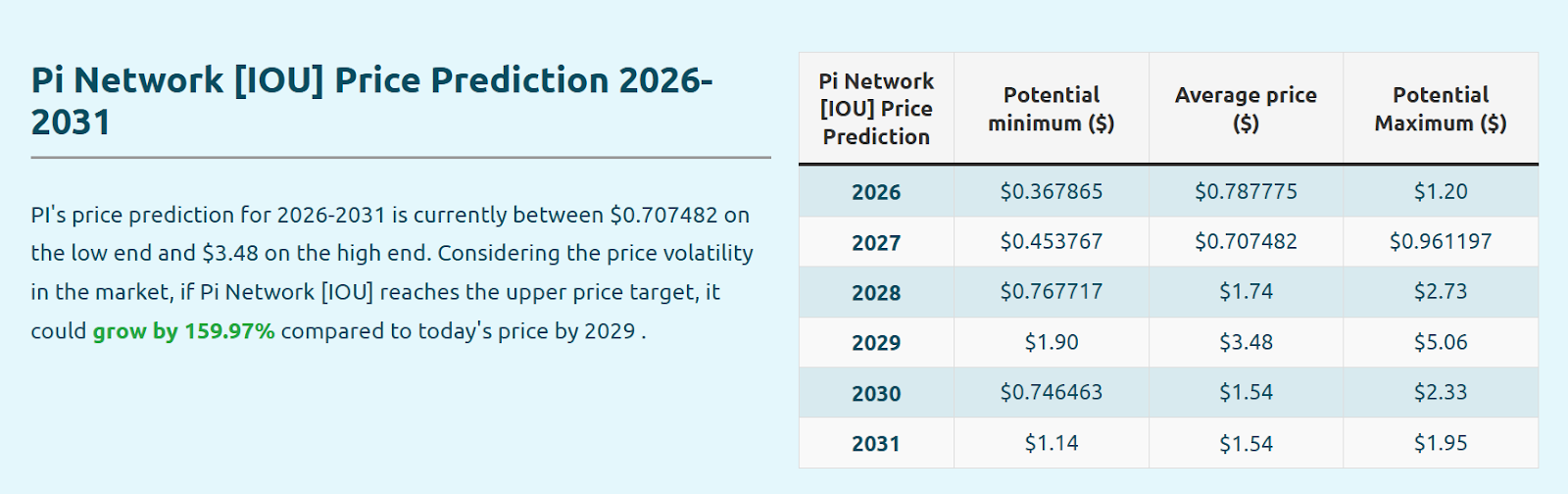
$PI 2030 Price Prediction (Image Source:https://coindataflow.com/en/forecast/pi-network)
Factors affecting the future price of $PI
Technological progress: such as the innovation of underlying protocols or the optimization of smart contract functionality, affecting the availability and security of the Pi Network.
User adoption rate: $PI The degree of application in daily transactions and its integration with commercial scenarios will determine the growth rate of market demand.
Regulatory Environment: Regulatory policy changes on cryptocurrencies in various countries can affect Pi Network’s investors’ sentiment and market liquidity.
Macroeconomic environment: Factors such as the global economic situation, inflation levels, and financial market fluctuations will affect the overall risk appetite of the cryptocurrency market.
Ecological construction: the expansion of enterprise partnerships, the prosperous development of decentralized applications (DApps) ecosystem, and the continuous optimization and upgrade of the blockchain network will be the key factors for Pi Network to build core competitiveness in the Web3 track.
Conclusion
Pi Network, as an innovative decentralized cryptocurrency project, demonstrates unique growth potential in the Web3 ecosystem with its low-threshold mining mechanism and strong technical support. According to current predictions, the price of $PI in 2030 may range from $0.746 to $2.33. Investors are advised to closely monitor the technological development, ecological application expansion, and market trends of Pi Network to more accurately assess its long-term investment value.







