As AI automation, smart hardware, and DePIN networks evolve, more devices are becoming capable of executing tasks autonomously and collaborating in real time. Yet traditional payment systems can't keep up with the high-frequency, automated transaction needs of machines.
In the Machine-to-Machine (M2M) economy, devices need more than just internet connectivity—they require trusted identities, automatic payments, and real-time settlement. SEALCOIN provides the infrastructure for autonomous machine-to-machine transactions through device authentication, smart contracts, and the QAIT payment system.
What Is Machine-to-Machine (M2M) Payment?
Machine-to-Machine (M2M) payment is a mechanism where devices handle transactions and payments without human intervention. In the traditional internet landscape, most payments are user-initiated; M2M payments, by contrast, emphasize automatic collaboration between devices.
For instance, autonomous cars can pay parking fees on their own, smart grids settle energy trades in real time, and industrial robots purchase sensor data automatically. These use cases all demand autonomous payment capabilities and trusted settlement.
SEALCOIN's machine payment network is purpose-built for these automated transaction scenarios.
What Makes Up SEALCOIN's Machine Payment System?
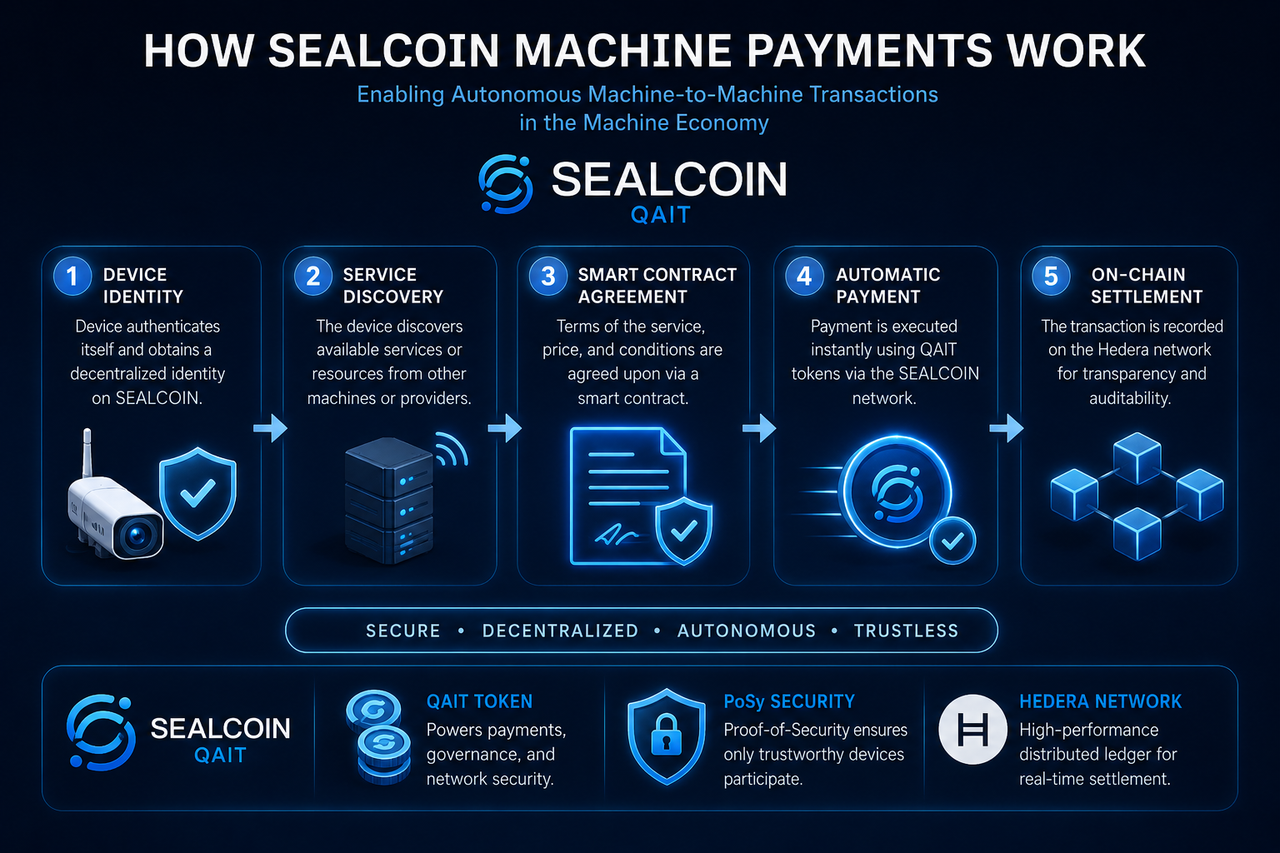
SEALCOIN's machine payment process consists of four layers: the device identity layer, payment layer, smart contract layer, and security verification layer.
Device Identity Layer
Every device on the SEALCOIN network must have a trusted digital identity, typically established via hardware authentication, encryption keys, and on-chain verification.
The core goal of identity authentication is to confirm device authenticity and minimize the risk of counterfeit devices or malicious nodes. Only verified devices can participate in the machine marketplace and automated transaction network.
Payment and Settlement Layer
QAIT serves as the primary payment medium in the SEALCOIN ecosystem, handling real-time transactions and fee settlements between devices.
Machine payments are typically high-frequency, low-value, and automated, requiring a low-cost, high-throughput payment network. SEALCOIN is built on Hedera's distributed ledger technology to meet the real-time transaction demands of the machine economy.
Smart Contract Layer
Smart contracts define transaction rules between devices. For example, after a device uses a data service, it can automatically pay fees and settle resources.
The entire process runs on-chain without any centralized payment platform.
PoSy Security Verification Layer
SEALCOIN introduces the Proof-of-Security (PoSy) mechanism to verify device trustworthiness and network security.
Devices must stake QAIT tokens to participate in security verification. If a device behaves maliciously, its staked assets can be penalized.
How Does SEALCOIN's Machine Payment Process Work?
Think of it as "devices automatically discovering services and completing payments in real time."
Step 1: Device Network Access
IoT devices or an AI Agent must first join the SEALCOIN network, complete identity authentication, and register their keys.
After registration, the device receives an on-chain identity and transaction permissions.
Step 2: Device Service Discovery
Devices find available resources or services over the network. For example, a drone might automatically locate nearby charging stations, while an AI Agent searches for callable data interfaces.
It works like internet service matching, but the counterparty shifts from "humans" to "machines."
Step 3: Smart Contract Transaction Negotiation
Devices negotiate transaction terms via smart contracts, including:
- Service price
- Usage duration
- Data permissions
- Settlement rules
All conditions are encoded into the on-chain protocol.
Step 4: QAIT Automatic Payment
Once the service is invoked, the system automatically uses QAIT for payment and settlement.
No human confirmation is needed—payments complete in seconds.
Step 5: On-Chain Recording and Verification
Transaction data is recorded on the Hedera network for subsequent verification and auditing.
On-chain records boost transparency and help establish long-term trust between devices.
What Role Does Hedera Play in Machine Payments?
Hedera is SEALCOIN's underlying distributed ledger network. It handles transaction ordering, data recording, and payment settlement.
Machine payments require:
- High throughput
- Low fees
- Real-time confirmation
- Scalability
Hedera's Hashgraph consensus mechanism supports high-frequency transactions, making it ideal for IoT and AI Agent payment networks.
Compared to traditional blockchains, Hedera prioritizes real-time performance and enterprise-grade capabilities.
How Does an Automatic Drone Payment Work?
The drone charging scenario clearly illustrates SEALCOIN's machine payment flow.
When a drone detects low battery, the system automatically searches for nearby charging stations and retrieves price and service details. The drone then confirms service conditions via a smart contract and pays with QAIT on-chain.
After charging, the transaction is recorded on the Hedera network for later verification. The entire process runs autonomously—no human involvement required.
This model also applies to autonomous driving, industrial IoT, and AI Agent service procurement.
How Does SEALCOIN's Machine Payment Differ From Traditional Systems?
The key difference lies in the transaction subject and settlement logic.
| Comparison Dimension |
Traditional Payment System |
SEALCOIN |
| Payment subject |
Human users |
IoT devices & AI Agent |
| Authorization method |
Manual confirmation |
Automated execution |
| Payment frequency |
Low to medium |
High-frequency micropayments |
| Settlement model |
Banks & platforms |
On-chain real-time settlement |
| Identity system |
Platform accounts |
Decentralized device identity |
| Transaction logic |
Manual operation |
Smart contract automation |
Traditional systems are built for humans and financial institutions; SEALCOIN focuses on autonomous machine collaboration and real-time economic activity.
What Challenges Does SEALCOIN's Machine Payment Face?
The machine payment network is still early-stage, facing several technical and industry hurdles.
The IoT industry lacks unified standards, causing compatibility issues between device protocols. Large-scale device transactions also raise privacy and regulatory concerns.
AI Agent autonomous transactions bring liability and security risks, making device identity verification and on-chain security mechanisms long-term priorities.
Additionally, widespread adoption depends on hardware uptake, developer ecosystem growth, and real-world application scale.
Conclusion
SEALCOIN's machine payment system—combining device identity authentication, smart contracts, the QAIT payment system, and the PoSy security mechanism—enables IoT devices and AI Agent to autonomously handle payments and resource collaboration.
In the Autonomous Machine Economy, devices are no longer just "terminals" on the internet; they are becoming economic participants capable of independent transactions and collaboration. SEALCOIN's Machine-to-Machine (M2M) payment network is driving deeper integration between AI, IoT, and blockchain infrastructure.
FAQs
What is SEALCOIN's machine payment?
SEALCOIN's machine payment system is an on-chain mechanism that allows IoT devices and AI Agent to complete payments and transactions autonomously.
What role does QAIT play in machine payments?
QAIT is the payment and governance token in the SEALCOIN ecosystem, used for machine transactions, service settlement, device access, and security verification.
What is Machine-to-Machine (M2M) payment?
Machine-to-Machine (M2M) payment is a mechanism where devices automatically handle payments and value exchange without human intervention.
Why is Hedera suitable for machine payments?
Hedera offers high throughput, low fees, and real-time confirmation, making it ideal for high-frequency, small-value IoT payment scenarios.
What is the role of PoSy (Proof-of-Security) in machine payments?
PoSy is SEALCOIN's device security verification mechanism that enhances device trustworthiness and reduces the risk of malicious nodes.