Unlike earlier meme coins that relied heavily on market sentiment, Bonk (BONK) introduces a more structured tokenomics design that connects supply mechanisms, distribution logic, and real usage into a clearer value framework.
From an industry perspective, BONK is not only a representative asset within the meme coin category but also reflects broader trends in the recovery and innovation of the Solana ecosystem. Its large scale community distribution lowers the barrier to entry, while the expansion of use cases across DeFi, NFTs, and payments helps shift the token from a narrative driven asset toward a demand driven model.
Bonk (BONK) Role Within the Ecosystem
Bonk (BONK) emerged during a period of low activity in the Solana ecosystem, initially positioned as a community-driven meme token aimed at revitalizing ecosystem participation through a fair distribution mechanism. Unlike traditional meme tokens, BONK does not rely solely on market sentiment but has gradually integrated into multiple application scenarios including DeFi, NFTs, and payments.
Within the Solana ecosystem, BONK is regarded as both a liquidity catalyst and a user growth tool. Its broad distribution strategy allowed it to quickly spread across various protocols and wallets, increasing overall on-chain activity. The development of BONK also reflects a shift in meme tokens from purely speculative assets toward lightweight application-oriented assets.
BONK Supply Model and Deflationary Emission Mechanism
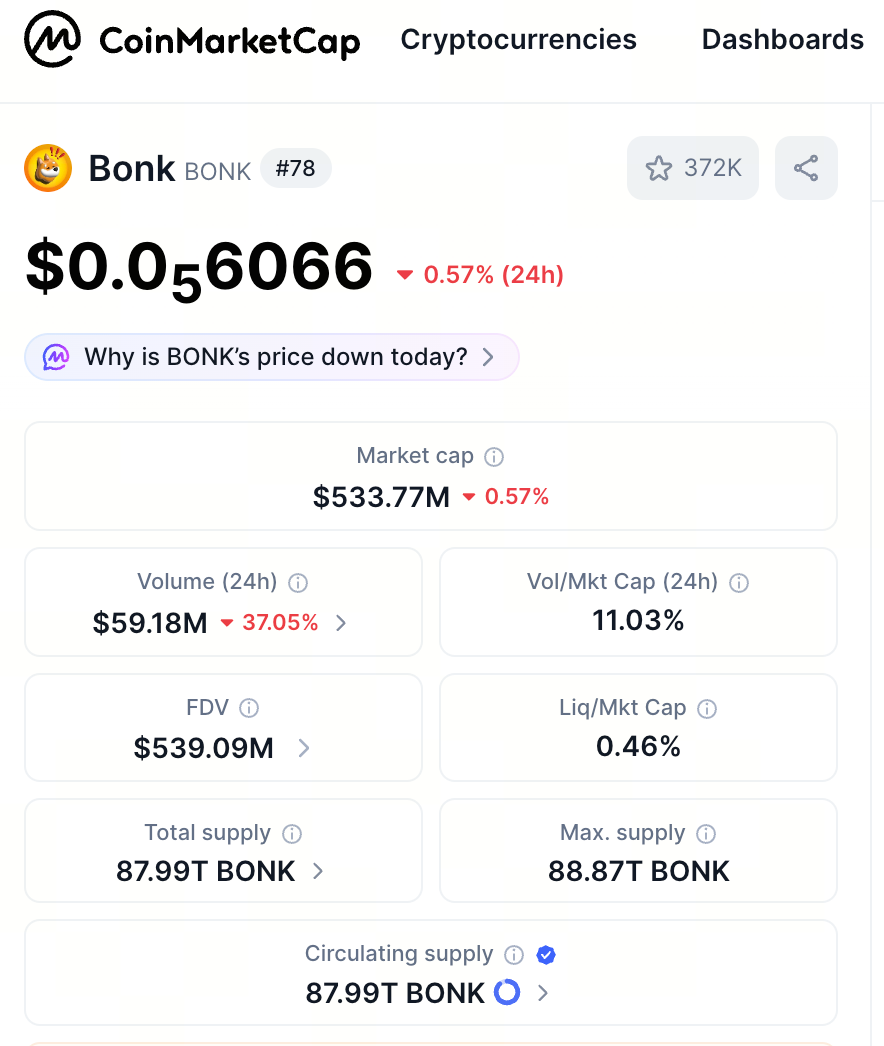
BONK has an initial total supply of approximately 100 trillion tokens, representing a high-supply meme token design. This structure helps lower the unit price and attract retail participation.
In terms of emission, BONK does not follow a continuous inflation model. Instead, it relies primarily on one-time distribution, with subsequent circulation driven mainly by market trading. This design implies:
-
No ongoing high inflation pressure
-
Relatively lower token dilution risk
-
Greater reliance on ecosystem demand to support price
At the same time, BONK incorporates a burn mechanism. Through continuous token burning from activities such as BonkBot trading and ecosystem protocol fees, a potential deflationary effect is formed. The current circulating supply is distributed among airdrop recipients, liquidity pools, centralized exchanges, and ecosystem incentive accounts. Mainstream data sources indicate that circulation has exceeded 80 trillion tokens, contributing to relatively high liquidity both on-chain and across exchanges.
 Source: CoinMarketCap
BONK Distribution Mechanism
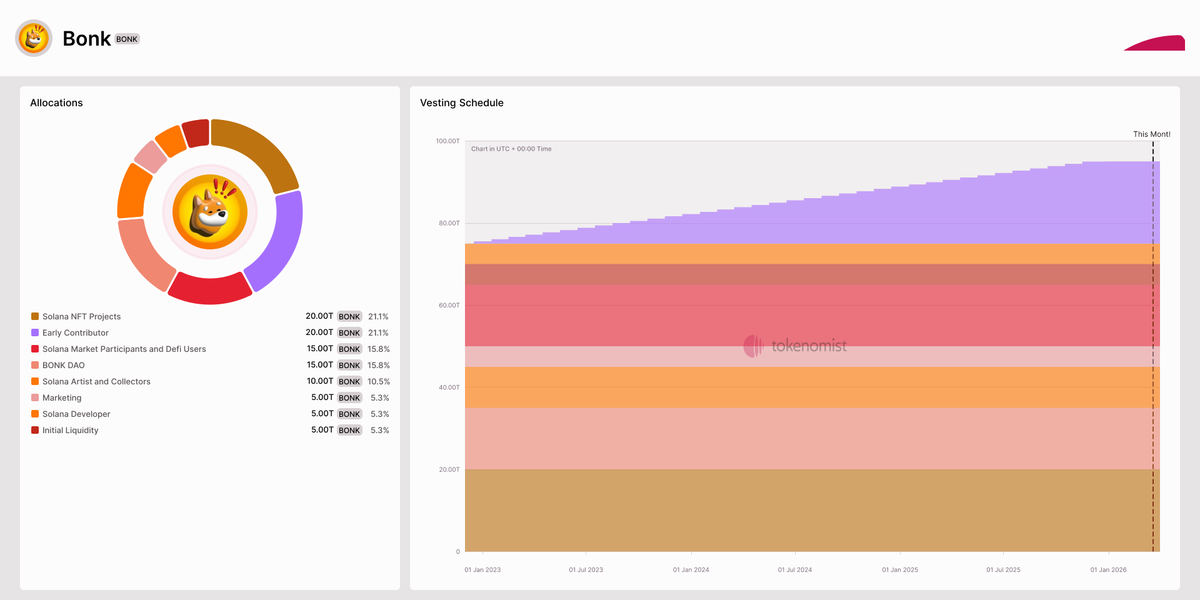
BONK’s token distribution is one of its most distinctive design features, emphasizing a community-first approach. According to official information, the allocation is roughly structured as follows:
-
Around 50% of the total supply was distributed via airdrops to the Solana community, including blue-chip NFT holders, developers, artists, and active traders, aiming to avoid excessive concentration among the team and investors.
-
The remaining tokens are typically allocated to ecosystem development funds, team and advisors, market and liquidity operations, and partner incentives, with different vesting schedules applied to reduce short-term selling pressure.
 Source: tokenomist
The key characteristics of this distribution model include:
-
Large-scale airdrops → rapid user base expansion
-
Reduced centralization risk
-
Strengthened community governance attributes
However, it may also introduce short-term selling pressure.
BONK Deflation Mechanism and Value Support
Within BONK’s tokenomics, deflation is not the primary driving force, but it still plays an important role in value formation. BONK’s deflation mainly comes from transaction-based burning and usage-driven consumption.
-
Transaction burn mechanism
In certain transactions or integrated applications, BONK tokens are burned, reducing the total circulating supply.
-
Usage-driven consumption
As BONK is used in payments, NFT transactions, or gaming, actual usage leads to natural token consumption.
-
Liquidity locking
Some BONK tokens are locked in liquidity pools, reducing selling pressure in the market.
The value of BONK is mainly supported by community size and activity, growth of the Solana ecosystem, and expansion of real use cases. Compared with traditional meme tokens, its value logic reflects a combination of weak deflation and strong usage-driven demand.
BONK Use Cases Within the Ecosystem
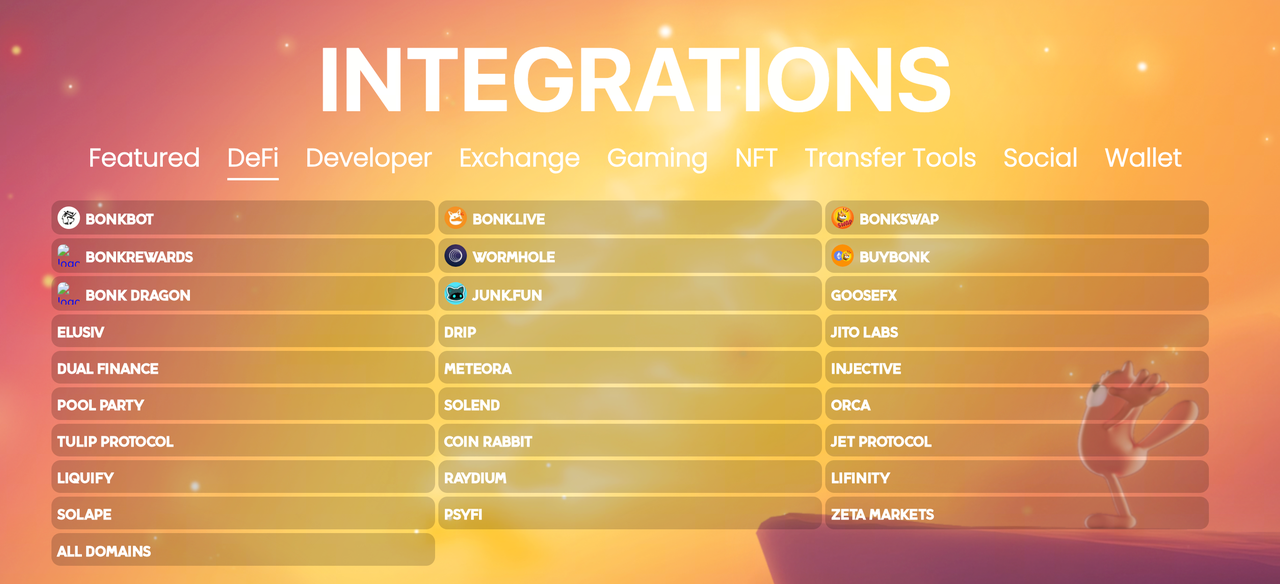
At the application level, BONK has gradually expanded from a purely meme asset into a multi-scenario utility token. In the DeFi sector, BONK is used in liquidity mining and trading pairs, providing yield opportunities while enhancing market liquidity. In the NFT ecosystem, it can serve as a transaction medium and is often used for community incentives and airdrop distributions.
In addition, BONK shows potential in payment and consumption scenarios, such as on-chain tipping, microtransactions, and in-game currencies. These lightweight use cases help increase token circulation frequency and strengthen real demand.
Through these continuously expanding use cases, BONK is attempting to move beyond reliance on market sentiment and evolve into a more functional meme token.
Advantages and Potential Risks of BONK Tokenomics
From an overall design perspective, BONK’s advantages are first reflected in its strong community foundation. Large-scale airdrops enabled it to gain broad user support in a short period while also improving decentralization. In addition, its non-inflationary supply model reduces long-term dilution risk, and diversified use cases provide initial value support.
However, this model also has limitations. Since BONK still carries clear meme characteristics, its price can be highly volatile and sensitive to market sentiment. Selling pressure from early distribution can become more pronounced during weak market conditions.
Furthermore, compared with tokens that have gas or staking functions, BONK has relatively limited value capture capability. More importantly, its development is highly dependent on the overall performance of the Solana ecosystem. If ecosystem growth slows, demand for BONK may also be affected.
Conclusion
Bonk (BONK) follows a tokenomics design built on community-first distribution, one-time issuance, and a mild deflation mechanism, creating a differentiated approach within the meme token sector. Its core strength lies in rapidly establishing a user base and enhancing demand through multi-scenario applications.
However, the long-term value of BONK depends on its ability to expand its ecosystem and transition from a meme-driven narrative toward a more sustainable value capture model.
FAQs
What is the total supply of BONK?
BONK has an initial total supply of approximately 100 trillion tokens. Due to the burn mechanism, the actual circulating supply has slightly decreased over time.
Is BONK a deflationary token?
BONK has certain deflationary characteristics, but overall it follows a weak deflation model, with value more dependent on usage demand.
What are the main use cases of BONK?
BONK is used across DeFi, NFTs, payments, and community incentives, making it a multi-functional meme token.
Is BONK worth long-term attention?
The long-term performance of BONK depends on ecosystem expansion and market recognition of its practical use cases, while also requiring attention to the inherent volatility of meme tokens.